Formation Pressure from Kick Analysis

Once you shut in the well in and obtain shut in drill pipe pressure, you can estimate formation pressure by applying the hydrostatic pressure concept.

This following equation demonstrates you how to figure out formation pressure from the kick analysis.

Formation Pressure = SIDDP + (0.052 x Hole TVD x Current Mud Weight)
Continue reading

Abnormal Pressure from Anticline Gas Cap

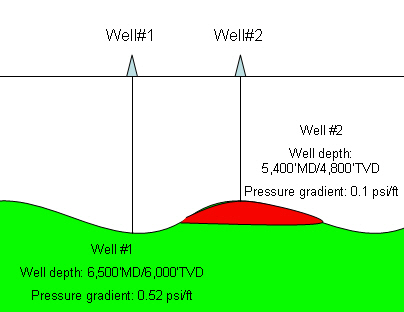
I got a question about how an anticline gas cap can create the abnormal pressure. The anticline with gas cap can be the potential high pressurized zone. Because of reservoir connectivity between fluid underneath gas and gas reservoir, it can generate abnormal pressure. This example below demonstrates you how this situation could happen.

Continue reading

Maximum Initial Shut-In Casing Pressure (MISICP)

Maximum Initial Shut-In Casing Pressure (MISICP) or Maximum allowable shut in casing pressure is the initial shut-in casing pressure that will exceed formation strength at the casing shoe resulting in broken formation at the shoe.

How can we know and calculate the MISICP?

Leak Off Test (LOT) will tell you the maximum pressure which the shoe can withstand before breaking formation at the shoe. The LOT is the combination of surface pressure and hydrostatic pressure therefore you can apply this principle to calculate the MISICP.

Continue reading

What are the differences between Formation Integrity Test (FIT) and Leak Off Test (LOT).?

You may confuse between Formation Integrity Test (FIT) and Leak Off Test (LOT).

They are different in this following aspect.

Leak Off Test – you pressure test shoe and formation until formation break down.

Let’s I explain more about it: Leak off Test is conducted in order to find the fracture pressure (fracture gradient) of formation and shoe. When conducting the LOT, you will pump drilling fluid to until you see the fracture trend of formation. Once formation is fractured, the first pressure that deviated from a trend is typically called Leak Off Pressure. We use the leak off pressure to calculate LOT.

Continue reading