Jack Up Rig for Oil Well Drilling: Let’s Get More Understanding about This Drilling Rig for Offshore Drilling

A jack up rig is a mobile offshore drilling platform commonly used for oil and gas exploration and production in shallow waters. It’s a versatile and efficient platform that offers several advantages over other types of drilling rigs.

Component of a Jack-Up Rig:

Barge or Hull: The primary structure of the rig contains machinery space, generators, mud pits, mud pumps, other drilling equipment, and crew living quarters.

Legs: Typically, three or four retractable legs that can be lowered to the seabed, enabling the rig to be elevated above the mean seal level.

Jacking System: Utilizing hydraulic jacks or electric motors, this system raises and lowers the rig’s legs as needed.

Drilling Equipment: This consists of the derrick, drawworks, mud pumps, and other essential tools for drilling oil and gas wells.

Cantilever: An extended platform over the water that facilitates drilling over the production platform or drilling in the open water location for exploration wells.

Advantages of a jack up rig are as follows;

Mobile: Easily transportable from one location to another.

Stable: Offers a reliable platform for drilling operations in shallow waters.

Self-Contained: Operates independently for extended periods without shore support.

Cost-Effective: Relative cost-efficiency compared to other offshore drilling rigs.

Disadvantages of a jack up rig are as follows;

Limited Water Depth: Operational up to approximately 400 feet of water depth.

Weather-Sensitive: Susceptible to the influence of strong winds and waves.

Environmental Impact:  The jacking process may disturb the seabed and marine life.

Exploring Jack-Up Rigs: Additional Facts:

The first jack-up rig was built in 1954! It was a significant milestone in offshore drilling, marking the beginning of a new era of mobility and efficiency for shallow-water operations.

There are a couple of different contenders for the exact title of the “first”:

  • DeLong Rig No. 1: Built by J.H. DeLong in 1954, this rig is often credited as the first true jack-up, with three retractable legs and a jacking system that allowed it to operate in water depths up to 15 feet.
  • McDermott No. 1: Developed by a joint venture between DeLong and McDermott in 1954, this rig also laid claim to the title of “first,” showcasing a similar jacking system and leg design as DeLong Rig No. 1.

The world’s largest jack-up rig is Maersk Invincible: This rig, built by DSME in South Korea and delivered to Maersk Drilling in 2016, has legs measuring 206.8 meters (678 feet) long, making it the rig with the longest legs in the world. It’s designed for year-round operation in the North Sea, in water depths up to 150 meters.

Maersk Invincible

Maersk Invincible

Beyond oil and gas, jack-up rigs find utility in wind farm construction and offshore platform maintenance.

Conclusion:

Jack-up rigs emerge as curtail offshore rigs in the realm of oil and gas exploration within shallow water area. Their mobility, stability, self-sufficiency, and cost-effectiveness underscore their value, despite limitations related to water depth and susceptibility to weather conditions. In addition to their primary role in hydrocarbon exploration and production, these versatile rigs continue to contribute to diverse applications, shaping the landscape of offshore engineering.

Why Do We Keep Cement Samples in Oil Well Operations?

We Keep Cement Samples Because of The Following Reasons

Cement samples are kept after pumping cement in oil well operations for several important reasons. The two images below shoes cement samples, one collected while cement is in liquid phase and another one is when cement is set for awhile.

Cement Sample in Liquid Phase

Cement Sample After Set

Cement Sample After Set

Continue reading

Example of Real Gas Calculation

This example will demonstrate how to calculate the compressibility of real gas in order to determine gas density and specific gravity at a specific condition.

Calculate the following based on the given condition:

1) Density of this gas under the reservoir conditions of 7,500psia and 220ºF,

2) Specific gravity of the gas.

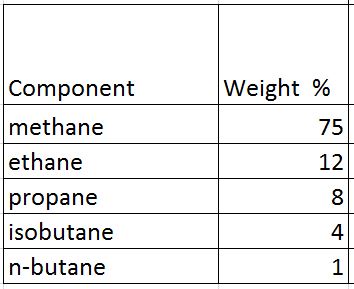
Gas component is shown in Table 1

Table 1 - Gas Component

Table 1 – Gas Component

Average density of air = 28.96 lb/cu-ft

Solution

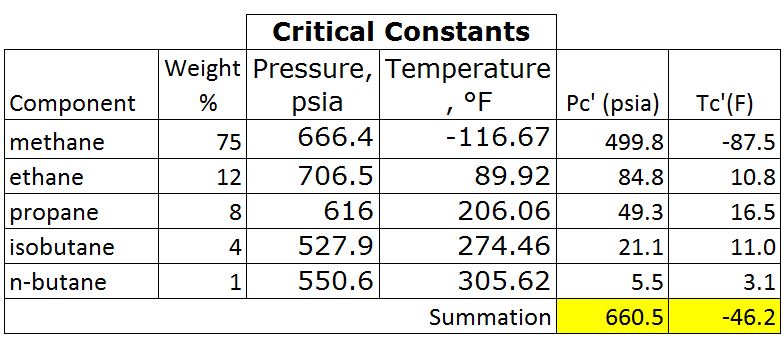
  • Determine critical pressure and temperature of gas mixtures using Kay’s rule
Table 2 - Critical Pressure and Temperature

Table 2 – Critical Pressure and Temperature

Note: critical pressure and temperature can be found from this link – https://www.drillingformulas.com/determine-compressibility-of-gases/

Pc’ = Σyipci = 660.5 psia

Tc’ = ΣyiTci = -46.2 F = -46.2 +460 F = 413.8 R

Table 3 - Pc' and Tr' by Kay's Rule

Table 3 – Pc’ and Tr’ by Kay’s Rule

  • Calculate Tr and Pr

Tr = T ÷Tc

Tr = (220+460) ÷ (-46.2+460)

Tr = 1.64

Note: temperature must be in Rankin.

Rankin = Fahrenheit + 460

For the critical temperature calculation, it can be converted the critical temperature from F to R before calculating Tc’. This will still give the same result. 

Pr = P ÷ Pc

Pr = 7500 ÷ 660.5 = 11.4

  • Read the compressibility factor (z) from the chart.

z = 1.22

Figure 1-z-factor from the Standing and Katz Chart

Figure 1-z-factor from the Standing and Katz Chart

  • Calculate average molar mass

Average Molar Mass = Σyi×Mi = 22.1 lb

Table 4 - Average Molar Mass of Gas

Table 4 – Average Molar Mass of Gas

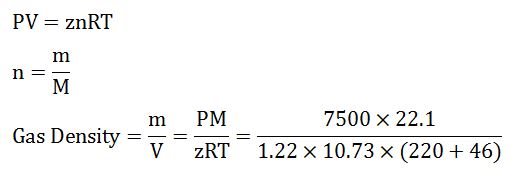
  • Calculate density of gas from the equation below;

gas density

Gas Density = 18.6 lb/cu-ft

  • Calculate gas specific gravity from the equation below;

SG = Gas Density ÷ Air Density

SG = 18.6 ÷ 28.96

SG = 0.64

Summary:

The answers for this answer are listed below;

Gas Density = 18.6 lb/cu-ft

SG = 0.64

We wish that this example will help you understand to determine z-factor and use it to calculate any related information.

References

Abhijit Y. Dandekar, 2013. Petroleum Reservoir Rock and Fluid Properties, Second Edition. 2 Edition. CRC Press.

L.P. Dake, 1983. Fundamentals of Reservoir Engineering, Volume 8 (Developments in Petroleum Science). New impression Edition. Elsevier Science.

Tarek Ahmed PhD PE, 2011. Advanced Reservoir Management and Engineering, Second Edition. 2 Edition. Gulf Professional Publishing.

Lost Circulation and Well Control

Lost circulation is a situation when drilling fluid losses downhole because formation(s) is fractured. There are three levels of lost circulation which are seepage loss, partial loss and total loss.

27-Lost-Circulation-and-Well-Control

Seepage loss is a situation when the mud volume loses into formation at very minimal and this will have no or little effect for a drilling operation.

Partial loss is a situation when some volume of drilling fluid loses into the well and you get some drilling mud volume back on surface. Not only do you lose the fluid volume, but you may have ballooning issue to deal. However, this type of fluid loss will not lead to well control situation because the total hydrostatic pressure does not decrease.

Total loss is the worst situation because there is no mud returning back to surface and the mud level will drop to any level down hole. Losing a lot of fluid into the well will directly affect hydrostatic pressure at the bottom. If you cannot keep the hole full, it might be a time when the hydrostatic pressure is less than the reservoir pressure. Eventually, a well control situation will be happened.

Additional information – What Cause Lost Circulation in Drilling Leading to a Well Control Situation

Continue reading

Determine Bottom Hole Pressure from Wellhead Pressure in a Dry Gas Well

Gas behaves differently from fluid therefore you cannot use a simple hydrostatic formula to determine reservoir pressure. Gas is compressible but fluid is incompressible.

Bottom-Hole-Pressure-from-Wellhead-Pressure-in-a-Dry-Gas-Well

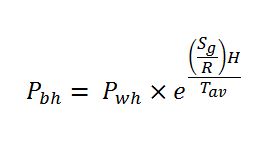
The formula to determine the bottom hole pressure of dry gas well is shown below;

equation 1


Where; Pbh = bottom hole pressure in psia (absolute pressure)

Pwh = wellhead pressure in psia (absolute pressure)

H = true vertical depth of the well

Sg = specific gravity of gas

R = 53.36 ft-lb/lb-R (gas constant for API standard condition air)

Tav = average temperature in Rankin (Rankin = Fahrenheit + 460) Continue reading