Drill Collar Weight Calculation To Prevent Drill Pipe Buckling

Drill collar provides weight to the bit for drilling and keep the drill string from buckling. Additionally, drill pipe should not run in compression because it can get seriously damaged therefore we need to know weight of drill collar that is enough to provide weight to the bit.


Drill-Collar-Weight-Calculation-1

Drill pipe buckle due to insufficient of drill collar

Drill-Collar-Weight-Calculation-2

Drill pipe straight because of sufficient drill collar weight

Continue reading

How to Select a Scientific Calculator for Oilfield Personnel

Working in the oilfield, you need a scientific calculator to help you solve problems with complex formulas. As you learn from this website, drillingformulas.com, you really need a scientific calculator to help you.

How-to-Select-a-Scientific-Calculator-for-Oilfield-Personnel

There are different brand companies that design scientific calculators. However, the difference in brand names might not alter the similarity in functions and programming. When you are choosing a small scientific calculator, there are a number of factors that you should consider. These factors include; functionality and efficiency, portability and durability.

Continue reading

Volumetric Well Control – When It Will Be Used

Volumetric well control method is a special well control method which will be used when the normal circulation cannot be done. It is not a kill method but it the method to control bottom hole pressure and allow influx to migrate without causing any damage to the well.

volumetric

There are several situations where you cannot circulate the well as follows:

• Pumps broken down

• Plugged drill string/bit

• Drill string above the kick

• Drill string is out of the hole completely

With the volumetric method, the volume of gas influx will allow migrating and casing pressure will increase till a certain figure then a specific amount of mud will bleed off to compensate the increase in casing pressure. The volumetric method will allow the kick to surface while the bottom hole pressure is almost constant. Successful use of volumetric method requires personnel understand three basic concepts – Continue reading

Equivalent Circulating Density (ECD) Using Yield Point for MW More than 13 ppg

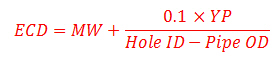
Another equation to determine equivalent circulating density is to use yield point.

This formula below is used to calculate the ECD and it is good for mud weight more than to 13.0 ppg

Where:

ECD is equivalent circulating density in ppg.

MW is mud weight in ppg.

Hold ID is inside diameter of hole in inch.

Pipe OD is outside diameter of pipe in inch.

YP is mud yield point.

YP can be calculated by these following equations.

YP = Reading at 300 rpm – PV

PV = Reading at 600 rpm – Reading at 300 rpm

AV is annular velocity in ft/min

AV can be determined by the following equation.

AV in ft/min = (24.5 x Q) ÷ (Dh2 – Dp2)

where

Q = flow rate in gpm

Dh = inside diameter of casing or hole size in inch

Dp = outside diameter of drill pipe, drill collars, or tubing in inch

Continue reading

Equivalent Circulating Density (ECD) Using Yield Point for MW less than 13 ppg

Another way to determine equivalent circulating density (ECD) is to use yield point.

This formula below is used to calculate the ECD and it is good for mud weight less than or equal to 13.0 ppg.

Where:

ECD is equivalent circulating density in ppg

MW is mud weight in ppg

Hold ID is inside diameter of hole in inch

Pipe OD is outside diameter of pipe in inch

YP is mud yield point

YP can be calculated by these following equations

YP = Reading at 300 rpm – PV

PV = Reading at 600 rpm – Reading at 300 rpm

Continue reading