Critical Flow Rate – Drilling Hydraulics

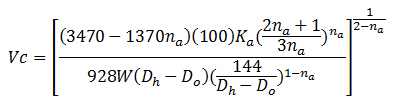
Critical flow rate is the flow rate at the transition point between laminar and turbulent flow. The first step of the critical flow rate determination is to figure out the critical velocity and then substitute it into the annular flow rate.

To get the point at the transition period, the critical Reynold Number for laminar flow must be around 3470 – 1370na. With this relationship, we can determine the critical velocity by rearranging the Reynold Number and Effective Viscosity equation.

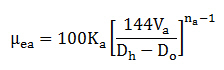
The effective viscosity equation for critical velocity is listed below:
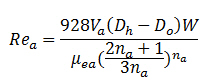
The Reynolds number equation for critical velocity is listed below:
The critical annular velocity equation is listed below:

Continue reading

Total Bit Revolution in When Running A Drilling Mud Motor and Rotating At Surface

I’ve got an email asking me about how to figure out the total bit revolution (RPM) at down hole when the mud motor is used in the drill string  and the rotating at surface is also conducted.

There are two components contributing in the total revolution of downhole drilling bit using mud motor.

1. The rotor RPM of drilling mud motor– each drilling mud motor has its specific performance data which will tell you how many revolutions per flow rate flowing through it.

For example (see the image below), it shows Rev/Gal which means the rotor will turn 0.147 turn/min per one gallon/min of drilling mud passing thought.

2. The rotary speed from top drive or rotary table.

The total drilling bit revolution downhole:

The total drilling bit revolution is equal to summation of the rotor RPM at specific flow rate and the rotary speed on surface.

Continue reading

How To Determine Hole Size By Fluid Caliper

This article will demonstrate you how to determine hole size by fluid caliper. First of all, you need to know what is the fluid caliper is. The fluid caliper is one simple way to calculate hole diameter. The concept is based on hole volume, annular capacity, and inner capacity. You pump any substance and when you seen it on surface, you back calculate the hole size based on strokes pumped. It is quite tricky to explain so I would like you to see the example below which it will make you clear about what I say.

116 How To Determine Hole Size Based On Carbide

Assumption for the calculation: No losses


7” casing shoe is set at 5000’MD/4500’TVD

7” casing 23 ppf, ID 6.33 inch

4” drill pipe is used to drill the well and its ID is 3.34 inch.

4-3/4” drill collar is used as BHA and its ID is 2.5 inch. The length of drill collar is 500 ft.

This hole section is used water based mud and the bit size is 6-1/8”

Drill to section TD at 10,000’MD/9,000’TVD then drop carbide once TD is reached.

Pump output is 0.1 bbl/stroke.

Surface line from pumps to rig floor is 20 bbl.

Carbide is detected by a gas sensor on surface after 4,000 strokes pump.

With the given information, determine what is the hole size of the open hole section.

Continue reading

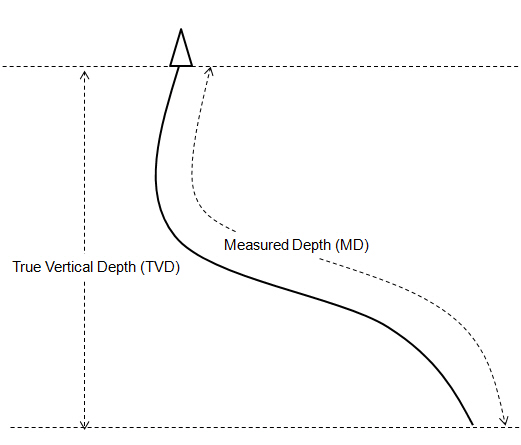
Difference between True Vertical Depth (TVD) and Measured Depth (MD)

I have a question asked regarding what the differences between True Vertical Depth (TVD) and Measured Depth (MD). Today, I will describe both definitions and their importance for calculation in a drilling field.

True Vertical Depth (TVD) is measured vertically from the surface down to a certain target down hole.

Measured Depth (MD) is the total length of the wellbore measured along the actual well path.

See the following illustration for more understanding.

Continue reading

How does the 0.052 constant come from?

In the hydro-static pressure formula, if you use an oil field unit, you must see the hydro-static formula like this

Pressure, psi = 0.052 x Mud Weight (ppg) x TVD (ft)

I got the question asking about how the constant 0.052 is figured out.

What is 0.052?

0.052 is a constant used for converting ppg-ft into pound per square inch (lb/in2)

Do you know how it comes from? Let’s get started

First of all, the unit conversions that you need to know are as follows:

1 gallon = 231 cubic inch (inch3)

1 ft = 12 inch

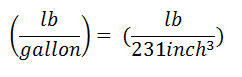
Convert density from ppg (pound per gallon) to lb per cubic inch

Basic hydrostatic pressure

The constant can be determined by substituting the unit conversion.

The constant is 0.051948 and if we round it up, it will be 0.052.