Drilling Formula Calculation Sheet Version 1

This is drilling formula calculation sheet v1 distributed on 28-Mar-10. I add many essential drilling formulas in to one Excel spread sheet and I would like to share with you for FREE. Please check this following link for download.


Drilling Formula Calculation Sheet v1


When you one the file Drilling-formulas-Calculation-shee-V1.xls, you will see the fist page call index page which shows you all of formulas like this.

Continue reading

Total Flow Area (TFA)

Total Flow Area (TFA) is summation of nozzle areas which fluid can pass through a bit. When you consider about the TFA, you need to count all nozzles that you have in a bit or a reamer.

Basically, you can determine flow area with a simple circle area formula.

Flow Area = (π × D2) ÷ 4

Where;

Area in square inch

π is a constant which approximately equates to 3.14159.

D is diameter in inch

Let’s make it easier for our life. Normally, a diameter of nozzle is reported in xx/32 inch. For example, a bit has 3 nozzles and each one of them has size of 20/32 inch.

The formula above can be simplified like this.

Oilfield Unit

Flow Area = N2 ÷ 1303.8

Where;

Flow Area for each nozzle in square inch

N is nozzle size in number/32 inch.

In order to find the total flow area of each bit or reamer, you must add all area of each nozzle.

Example

The bit that has a total of 5 nozzles. Three nozzles have a diameter of 10/32 inch and other 2 nozzles are 12/32 inch diameter.

Determine the total flow area (TFA) of the bit.

By the definition, you must sum every nozzle together in order to get the TFA; therefore, you can apply the formula above into this form.

Total Flow Area = (102 + 102 + 102 + 122 + 122 )÷ 1303.8

Total flow area = 0.451 square inch

Metric Unit

Flow Area = N2 × π ÷  4

Where;

Flow Area for each nozzle in square millimeter 

N is nozzle size in millimeter .

Example

The bit that has a total of 5 nozzles. Three nozzles have a diameter of 7.94 mm and other 2 nozzles are 9.53 mm diameter.

Determine the total flow area (TFA) of the bit.

Total Flow Area = (7.942 + 7.942 + 7.942 + 9.532 + 9.53 2 ) × π ÷  4

Total flow area =  291 square mm

Download Excel Spreadsheet for Total Flow Area Table in both oilfield and metric unit.

Ref books: 

Lapeyrouse, N.J., 2002. Formulas and calculations for drilling, production and workover, Boston: Gulf Professional publishing.

Bourgoyne, A.J.T., Chenevert , M.E. & Millheim, K.K., 1986. SPE Textbook Series, Volume 2: Applied Drilling Engineering, Society of Petroleum Engineers.

Mitchell, R.F., Miska, S. & Aadny, B.S., 2011. Fundamentals of drilling engineering, Richardson, TX: Society of Petroleum Engineers.

Estimated mud weight required to safely drill the well

I have an interesting question to share with you about how to estimate minimum mud weight required to safely TD the well.

The question is shown below.

7” casing shoe was set at 6,500’MD/5,000’ TVD. The geologist team in town expects 2 hydrocarbon reservoirs and information is listed below;

Formation sand A: Expected depth 5,500’ TVD, pressure gradient is 0.48 psi/ft.

Formation sand B: Expected depth 8,800’ TVD, pressure gradient is 0.49 psi/ft.

The planned TD is 9200’MD/9000’TVD and the drilling team requires 250 psi overbalance while drilling.

What is the mud weight required to drill the well with 250 psi overbalance?

First of all, let’s draw a simple diagram like this.

Continue reading

Effect of Frictional Pressure on ECD while Reverse circulation

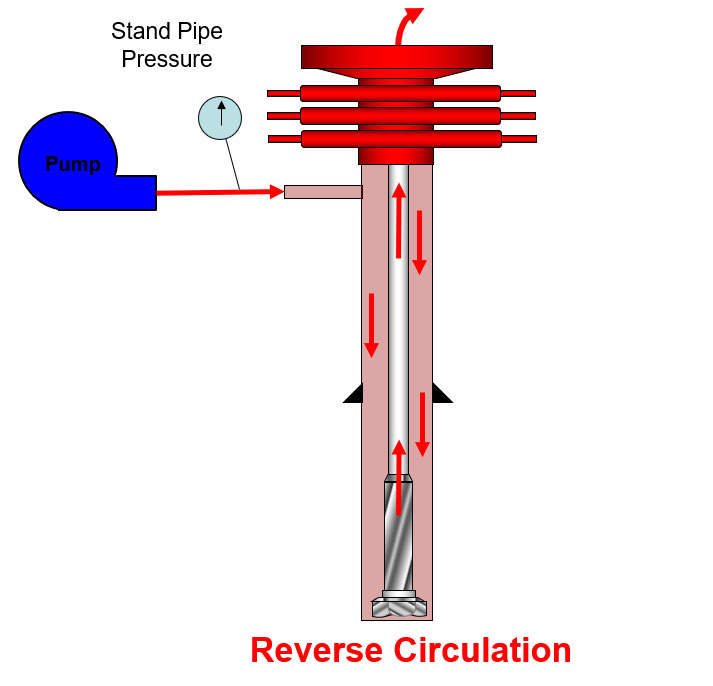
A reverse circulation is another way to circulate by circulating into annulus up to a bit and drill string. The fluid outlet is on surface. For drilling operation, we most of the time use forward circulation; however, in completion operation, the reverse circulation is utilized more often. For more understanding, we would like to show an image below (Figure 1) which demonstrates a flow path of the reverse circulation.

Figure 1 – Reverse Circulation

Continue reading

Effect of Frictional Pressure on ECD while Forward Circulation

In this article, we will describe the effect of friction pressure on bottom hole pressure and equivalent circulating density while performing forward circulation.

What is forward circulation?

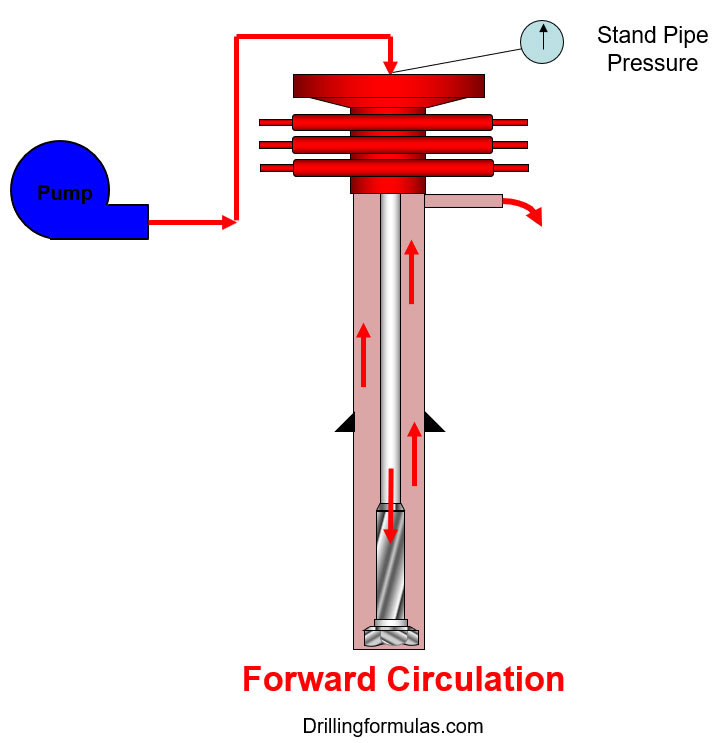
It is the typical circulating path which is from a mud pump into drill pipe. Mud is pumped down into drill string / BHA and come out of a bit.  Then, the mud is flown up the annulus and return back to surface as you can see in the diagram below (Figure 1).

Figure 1 – Forward Circulation Path

Continue reading