


We have learned 2 cases about shoe pressure when kick is underneath shoe, and kick is passing the shoe,
When gas kick is being move above the shoe, do you know how much pressure at shoe has?

I will explain this case via this blog post.
We have learned 2 cases about shoe pressure when kick is underneath shoe, and kick is passing the shoe,
When gas kick is being move above the shoe, do you know how much pressure at shoe has?
I will explain this case via this blog post.
For this case, we will consider the shoe pressure when the gas kick is passing the casing shoe. See the image below.
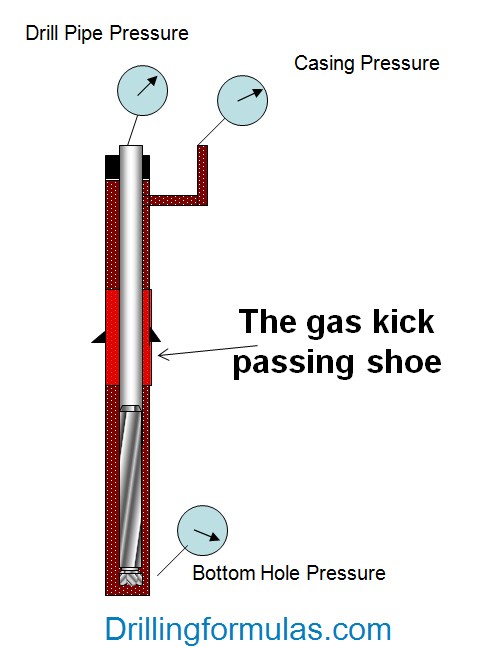
Let’s apply the hydrostatic pressure concept.
The formula for the bottom hole pressure is listed below:
Bottom Hole Pressure = Pressure at casing shoe + Hydrostatic Pressure in the open hole underneath the shoe
Understand about hydrostatic pressure in VDO format.
I wish you would enjoy learning it.
I would like to address about the shoe pressure concept while while circulating gas influx out of wellbore. This is the fist scenario – Top of the gas kick below the casing shoe

The hydrostatic pressure above the casing shoe remains constantly because the fluid column is the same. If we don’t let casing pressure increase, the over all hydrostatic pressure in the well will decrease because gas expansion when it is being circulated. In order to maintain the bottom hole pressure constant, casing pressure will increase to balance the loss of hydrostatic pressure in the wellbore due to gas expansion.
I would like to summarize about driller’s method with these simple steps as listed below;
1. Shut in the well and get pressure data (casing pressure and drill pipe pressure). The float bumping procedure may be conducted depending on whether you have a float in the drillstring or not.
2. Perform the well control calculations
3. Establish Circulation as per driller’s method
Fist circulation of Driller’s Method
a. Bring the pumps up by holding casing pressure constant
b. Circulate out the influx by holding drill pipe pressure constant
c. Shut down pumps by holding casing pressure constant
Second circulation of Driller’s Method
d. Raise mud weight up to desired kill mud weight
e. Bring the pumps up to speed by holding casing pressure constant
f. Circulate kill mud to the bit by holding casing pressure constant
g. Switch to hold drill pipe pressure
h. Circulate kill mud to surface by holding drillpipe pressure constant
i. Ensure that kill mud is all around by measurement, not by calculated stroke counts
j. Shut down pumps by holding casing pressure constant
k. Check casing pressure and drill pipe pressure. Both pressures must be 0 psi. You may see trapped pressure so as to make sure this is the trapped pressure, bleed pressure in small amount and observe pressure. Pressure should not increase after bleeding off. If pressure is building back after bleed off, there is still kick in the wellbore. You need to circulate more or raise the mud weight
Driller’s Method Rules
I also would like to emphasize these two vital rules of driller’s method that you need to keep in your mind all the time.
1st rule: Anytime you do something with pumps as start, stop or change pump speed, you must always hold casing pressure constant. This is very important.
2nd rule: For all other times, you always hold the side that has constant fluid density.
Reference book: Well Control Books
