What is “Background Gas”?

While we are drilling, there is a stable gas reading that is not connected with either bottoms up gas or drilled gas is generally called “Background Gas”. The background gas always shows every time while drilling and it is not a sign of considerable risk to well control situation. Nevertheless, we must always check changes in background gas value because it is able to help recognize underbalance situation while drilling, especially drilling into high pressure zone.

Remember – PLEASE ALWAYS KEEP TRACKING YOUR BACKGROUND GAS

Reference book: Well Control Books

What is “Drilled Gas”?

While drilling, there will be a certain amount of the gas in cuttings entering into drilling fluid when we drill through porous formations that contain gas. The gas showing on the surface due to drilling through formations is called “Drilled Gas”.

When gas from the cutting comes into drilling fluid, it will expand as it is circulated out of hole, hence, you will see the gas from the monitors at the flow line. Even though we have overbalance hydrostatic pressure exerted by mud column, gas showing on the surface by this mechanism always happens. You cannot rise mud weight up to make it disappear.

Continue reading

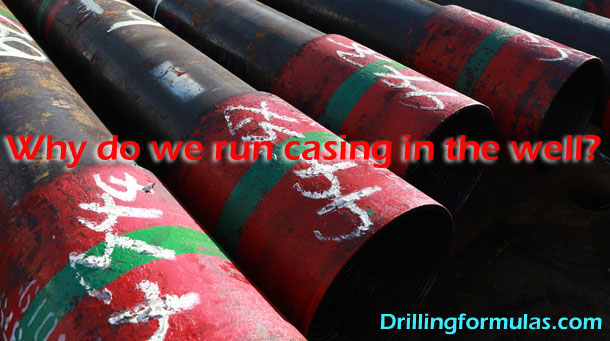
Why do we run casing in the well?

Simple question: “What are the reasons casing is run in the well?”

IMG_1119

There are several importance of casing as follow;

• To prevent collapse of the borehole

• To confine production to the wellbore

• To provide a flow path for drilling fluid

• To contain formation pressure and prevent fracturing of upper and weaker zones

• To provide an anchor for surface and sub surface equipment

• To provide a high strength flow conduit for drilling fluid to surface and ,with BOP , permit the safe control of formation pressure

• To prevent contamination of fluid in formations

• To exclude water zones from the producing formations


Any additional ideas are welcome.

Ref books: Cementing Technology Books

What are Lead and Tail Cement?

In some cementing operation, operators will pump 2 cement slurries, normally called “Lead Cement” and “Tail Cement”.  Both lead and tail cement have pro and con as described below.

Lead cement: Lead cement is in the top section of cement, where has lower both pressure and temperature (see figure above). It has lower density and strength than Tail cement; however, it is also cheaper than Tail cement.

Tail cement: Tail is pumped after lead cement because it must be settled at the lower section of well bore, where needs high strength cement (see figure above) . It has higher strength than lead cement, but it is more expensive than lead cement.

Ref books: Cementing Technology Books

What is Cement Bond Log?

Cement Bond Log: It measures integrity of cement bond between tubing/casing and well bore. The log is typically obtained from one of a variety of sonic-type tools. The newer versions, called “cement mapping”, can give detailed, 360-degree representations of the integrity of the cement job, whereas older versions may display a single line representing the integrated integrity around the casing (see Figure below).

Concept of CBL: Transmitter sends acoustic wave to casing/cement and then receivers receive acoustic signal that transfer through casing to cement and reflects to receivers. Acoustic wave at receivers is converted to amplitude (mv). Low amplitude represents good cement bond between casing and hole; however, high amplitude represents bad cement bond. The concept likes when we knock pipe. If there is something coverage around pipe, the reflection sound will be attenuated, and vice versa (see Figure below).

Tool component for CBL currently mostly consists of following equipment:

Gamma Ray/ CCL: It is used as correlation log. Gamma ray measures formation radiation and CCL records collar depth in tubing. Correlation log is a reference for a number of cased hole jobs as perforation, set plug, set patch, etc.

CBL/VDL: CBL measures cement bond integrity between casing/tubing and well bore. It apply concept of acoustic wave transferring through media. VDL is the top view of the cut away of upper part of acoustic wave that represents how cement bond from casing to wellbore

Caliper: Caliper measures wellbore diameter.

Example of CBL is shown below.

Downhole conditions that can cause errors in acoustic CBL interpretation or reliability are as follows:

Cement sheath thickness: Cement-sheath thickness may vary, causing changes in attenuation rate. The suitable cement thickness of 3/4 in. (2 cm) or more is required to achieve full attenuation.

Microannulus: A microannulus is a very small gap between casing and cement. This gap would affect the CBL presentation. Running the CBL under pressure can help eliminate the microannulus.

Centralize tool: Tool must be centralized in order to get the accurate amplitude and time.

Ref books: Cementing Technology Books