What is a Vertical Subsea Christmas Tree (Conventional Subsea Tree)?

Subsea tree (wet trees) is a system of valves, flow paths, piping, and connectors installed on a subsea wellhead to contain and control the flow of fluid from a reservoir or from the surface by injection. A control pod mounted on a subsea tree assembly provides a receptacle for an umbilical and contains the electronic and hydraulic components that control tree functions.

Two type of subsea Christmas tree are vertical Christmas trees and horizontal Christmas trees. They are different because of valves arrangement. The vertical trees have all valves arranged vertically; whereas, the valves in the horizontal tree are positioned horizontally.

In this part, it emphasizes on vertical subsea Christmas trees (conventional subsea trees). Vertical trees are manufactured in single bore and dual-bore configurations and pressure ratings are between 5,000 and 15,000 psi. The body of a Christmas tree can be made of carbon steel, low-alloy steel, or stainless steel depending on the operating environment. Figure 1 show the conventional single-bore subsea tree from DrillQuip.

Figure 1 – Conventional single-bore subsea tree. Courtesy of DrilQuip

Continue reading

Successful Topside Installation of the Ivar Aasen in the North Sea (Video)

The heavy lift crane vessel ‘Saipem 7000’ has completed the installation of all ‘Ivar Aasen’ topside modules at the Ivar Aasen oil field in the Norwegian sector of the North Sea.For the lift, the crane vessel used its dual 7,000t cranes to lift the combined 15,000t modules from a Cosco heavy lift vessel onto a steel jacket attached to the seafloor.

The main part of the topside was built in Singapore and transported through the Suez Canal to the North Sea aboard the MV Xiang Rui Kou. The living quarters along with the flare boom and other modules were picked up along the way. Ivar Aasen field operator Detnorske says first oil is expected in December 2016.

  Continue reading

Surface Christmas Tree (Dry Tree) Basic Knowlege

In the oil and gas industry, a Christmas tree is referred to as a series of valve & spool assembly fitted on top of the well.  A Christmas tree is installed on top of the last casing spool on a surface well or the high pressure wellhead housing for a subsea well. Figure 1 demonstrates the diagram of a Christmas tree and wellhead of a surface wellhead. The Christmas part is located at the top part (a blue box) and the wellhead part is the lower section (a red box). Many people get confused about what a Christmas tree and a wellhead are and many times they think of them as the same thing.

Its functions are as follows;

  • Allow reservoir fluid to flow from the well to the surface safely in a controlled manner.
  • Allow safe access to the wellbore in order to perform well intervention procedures.
  • Allow injections as water or gas injection.
  • Provide access to hydraulic line for a surface control sub surface safety valve (SCSSSV)
  • Provide electrical interface for instrumentation and electrical equipment for electrical submersible pump (ESP)

In this section, it will describe about a surface Christmas tree (Dry Tree) which is referred to as any Christmas tree used above water level. A Christmas Tree consists of a series of valves and the components are shown and described below; Continue reading

Suction Anchor Calculation

Suction anchor or suction caisson is an offshore foundation which is quite popular for offshore installation. It utilizes a negative pressure concept to drive the suction anchors down. This article will demonstrate some simple calculations used for the suction anchor.


Example:

A suction anchor, 40” OD x36” ID, is deployed as part of a mooring anchor for a floating production platform in 900 ft of water. The initial penetration due to its weight is 5 feet into the sea.  Soil resistance is 450 lb/ft2 by average.  Based on the given information, determine values from these two questions below;

  • What is the volume evacuated for each foot of penetration?
  • How long of a suction anchor will be needed so that the top of the suction anchor is 5 ft above the seabed at the end of the operation?
Figure 2 - Suction Anchor Submerse by Its Weight

Figure 2 – Suction Anchor Submerse by Its Weight

Important Information

The sea water density = 64.0 lb/cu-ft (8.6 ppg)

Steel specific gravity = 785

What is the volume evacuated for each foot of penetration?

Assumption: Impermeable formation
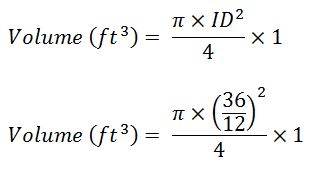
vol1

Volume (ft3) = 7.07

How long of a suction anchor will be needed so that the top of the suction anchor is 5 ft above the seabed at the end of the operation?

Figure 3 – Suction Anchor Diagram (Before and After)

Figure 3 – Suction Anchor Diagram (Before and After)

The initial penetration support weight of the suction anchor therefore is only the frictional force between soil at the seabed and the hydrostatic pressure from the water column will be taken into account.

L = the length of the suction anchor resisting the force from hydrostatic pressure applied at the top of the suction anchor.

This is assumed that the friction generated by initial penetration continues to oppose and equal the buoyed weight of the suction anchor.

Based on the assumption, the force from soil resistance is equal to force from the hydrostatic pressure acting against the top of the suction anchor.

450 × surface area = Hydrostatic pressure × area of top of the suction anchor

cal

L = 56.2 ft

Total length of the suction anchor = 5+ 56.2 + 5 = 66.2 ft

Figure 4 demonstrate the final condition compared to the initial condition.

Final Diagram

Final Diagram

References

James G. Speight, 2014. Handbook of Offshore Oil and Gas Operations. 1 Edition. Gulf Professional Publishing.

Trond Bendiksen, 2015. Commissioning of Offshore Oil and Gas Projects: The manager’s handbook. Edition. AuthorHouse.

Joseph A. Pratt, 1997. Offshore Pioneers: Brown & Root and the History of Offshore Oil and Gas. Edition. Gulf Professional Publishing.

SEMAR AS, (2013), Shelley Field [ONLINE]. Available at: http://www.semar.no/semar/bilder/Shelley-field.jpg [Accessed 29 July 2016].

Pipeline Towing Method for Pipeline Installation

Pipeline towing method is useful for bundled pipelines where several pipelines with different functions are packed together inside a large carrier pipe. The pipeline is constructed in a designed length onshore and towed into the sea.

Figure 1 – Bundled Pipeline Ref: https://anthropologyinthewind.files.wordpress.com

Since there are many pipelines bundled together inside a big carrier pipe, it is imperative to get everything right prior to installation.  Due to this reason, this installation technique allows the bundled pipeline to be welded, inspected and tested onshore prior to installation in order to minimize failure.

Four categories for the pipeline towing method are as follows; Continue reading