You Can Travel To North Sea’s Oil Platform as Tourists

You can imagine that you can travel to the Troll A platform in the North Sea without working in the oil and gas industry.  It cost you quite a lot of money 🙂

This is the news below.

Bored with palm-fringed beaches and turquoise seas? Then the gigantic oil platforms of the North Sea beckon. The first ever “rig-spotting” cruise just ended off the coast of Norway, and those onboard the four-day trip said it was jawdropping.

“I couldn’t believe that these big buildings could be made,” said passenger Kari Somme, 86, after seeing Statoil’s (STL.OL) Troll A platform – the heaviest structure ever moved by mankind – towering 200 meters (650 feet) above the surface of the sea.

Continue reading

Reel Lay Pipeline Installation Method

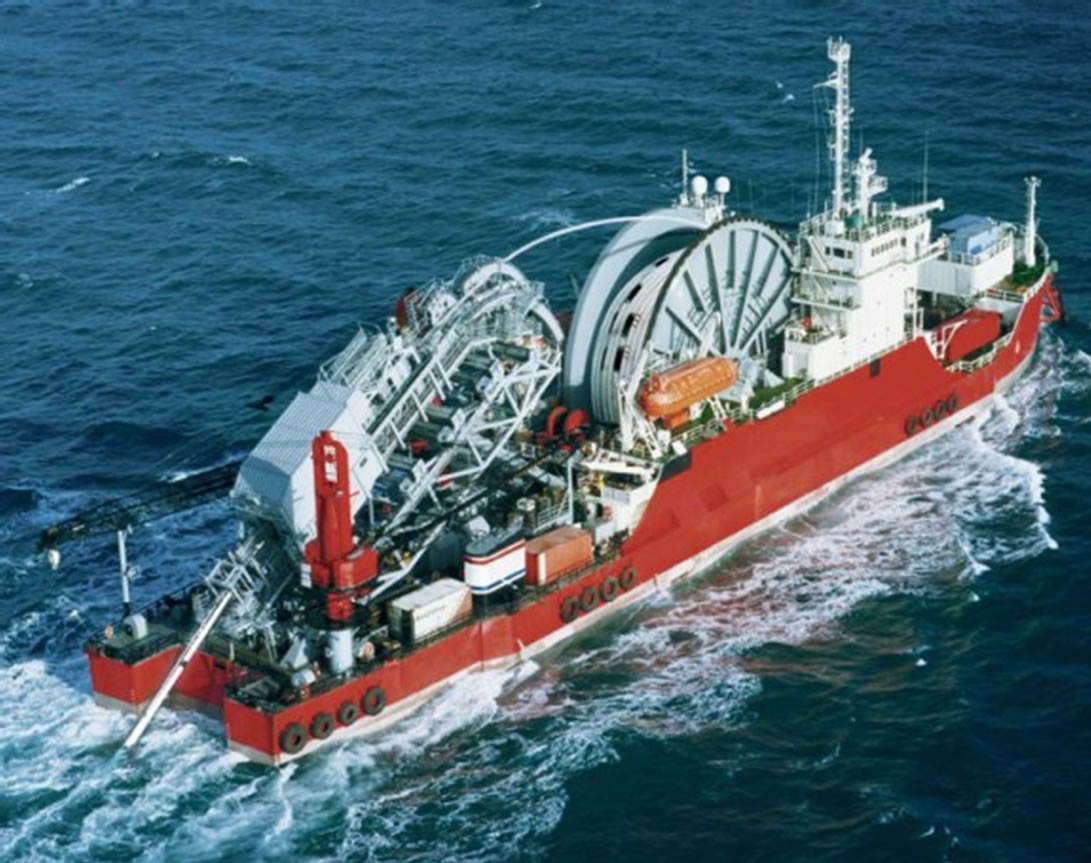
Reel lay method installs offshore pipeline by sending the pipeline from a reel mounted on a special pipeline installation vessel. Instead of connecting each joint of pipe line at an offshore location like other methods (S-lay and J-lay method), the pipeline is pre-assembled in a spool which is mounted on the deck of the reel barge. This method can lay pipe up to 16” diameter and water depth capacity for 16” pipeline is about 800 m (2,600 ft). This method cannot lay such a big size pipe because the big pipeline is not flexible enough to be rolled into a reel.

The reels can be installed either horizontal or vertical. Horizontal reel barges can do only S-lay installation; however, vertical reel barges can perform both J-lay and S-lay pipeline installation.

The reel lay method is considered to be the fastest laying method because the majority of welding and inspections are performed onshore in order to minimize time for installation. Once all pipe on the reel is laid, the barge either head back to shore of another reel or lift a new reel from a supply boat. This is dependent of each vessel.

Some of the images of reel lay barges are shown below;

Figure 1 – Vertical reel-lay barge in S-lay configuration

Continue reading

J-Lay Pipeline Installation

J-Lay pipeline installation method is frequently used in deep water pipeline installation. The curvature of pipe line is similar to J shape (Figure 1) while the subsea pipeline is being installed. J-Lay method can handle a full range of pipeline size and it is particularly suitable for deep water pipeline installation up to 2,000 m (6,560 ft).  Furthermore, the J-Lay method can withstand higher underwater current and sea state than the S-Lay method.

The J-lay method puts less stress on the pipe line because the pipeline is installed in an almost vertical position. Whereas the S-lay method puts on more stress due to two curvatures at the sag bend and over-bend region. The pipeline is sent into water at a small angle reference to a vertical line and continues at a steep angle until a sag bend is formed.

Figure 1- J-Lay pipeline vessel

Figure 1- J-Lay pipeline vessel

This works very well in deep water environment where distance from a vessel to a touchdown point is quite far because sag bend is not too much. If the short distance from a vessel to a touchdown point. Continue reading

Pipe Line S-Lay Method

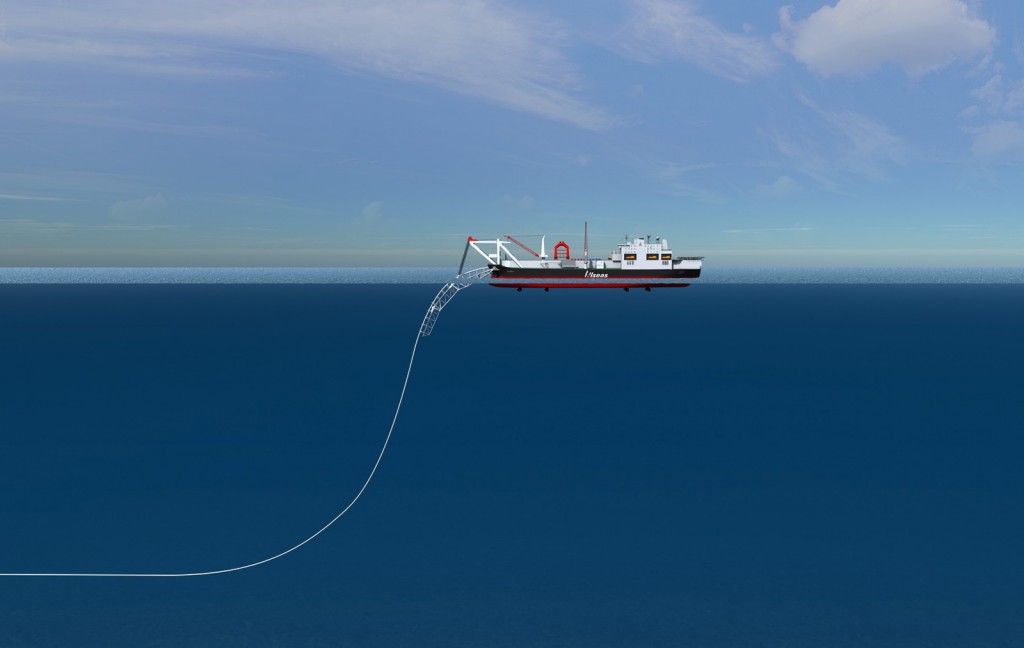
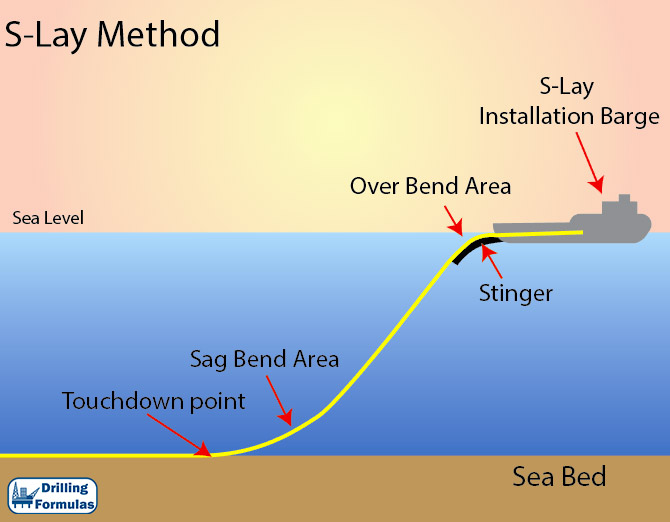
S-lay method is the oldest and the most commonly used method for offshore pipeline installation. This is named as “S-lay” because the shape of the pipe line while being installed looks like S-shape (Figure 1).

Figure 1 – S-Lay Method (Courtesy of Allseas) 

While installing pipe line using S-lay method, the pipe line is eased off the stern of a pipeline installation boat as the vessel moves forward. The pipe line is transferred into the sea until it reaches the sea bed which is called the “Touch down poin.t. Each joint of pipe line is welded on the installation vessel and eased off the boat. A stringer located at the stern, whose length can be up to 300 ft., helps supports the pipeline when it is transferred into the sea. Some installation barges can be equipped with an adjustable stringer which is used to control the length of a stringer. This stinger is vulnerable to damage in bad weather.

Figure 2 - S-Lay Diagram

Figure 2 – S-Lay Diagram

Continue reading

What is Pumpjack?

Pumpjack (also known as donkey pumper, oil horse, pumping unit, nodding donkey, horsehead pump, beam pump, rocking horse, dinosaur, Big Texan, grasshopper pump, jack pump or thirsty birds) is overground drive for reciprocating the piston pump in oil well.

pump-jack

It’s used for mechanically lifting the liquid out of a well if there isn’t enough bottom hole pressure for liquid to flow to the surface. Commonly this arrangement is used for the onshore wells that don’t produce much oil. The pumpjacks are quite common in the oil rich areas.

Generally a pumpjack produces 5 – 40 liters of liquid with each stroke. It is often an emulsion of water and crude oil. Couple of factors on which the size of the pump is determined are the weight and the depth of oil that is to be removed. More power is required to move increased weight of discharge head (discharge column), in deeper extractions.

The rotary mechanism of motor is converted to vertical reciprocating motion by a pumpjack in order to drive pump shaft and it is exhibited in characteristic nodding motion. ‘Walking beam’ is the engineering term used for such a mechanism. This mechanism was often employed in the marine and stationary designs of steam engines in 18th and 19th century. Continue reading