Cement Squeeze and Cement Balanced Plug Spreadsheet Free Download

Cement squeeze and balanced cement plug are one of the most critical cement jobs on drilling sites. It is very critical to have the correct volume of cement and displacement in order to be successful in this operation. We create simple Excel spread sheets for both operations and these sheets are free for you to download. However, you need to carefully read the details below to understand the limitation of these two files because the calculations are based on specific criteria.

Cement-Balance-Squeeze-and-Balanced-Plug-free-download

Cement Squeeze and Balanced Plug

Continue reading

Oil & Gas Well Cementing VDO Training

Cementing is very critical step of well construction. Bad cement job can lead to bad situations as well control, low productivity, gas channeling in annulus, etc. Therefore personnel in oilfield should learn and understand this topic. It is quite hard to find very good vdo training in the topic of oil well cementing but we finally find it. This VDO training is very excellent because it teaches all the basic with animations which absolutely helps learners fully understand this topic. Additionally, we add full VDO transcript so it will help some people who cannot catch all the wording in the VDO training. Please feel free to add comments and/or suggestions and we wish you would enjoy learning from this post.


  Full VDO Transcript

Oil-&-Gas-Well-Cementing

Here is an overview of casing cemented in a well called primary cementing. The cement’s main jobs are to completely isolate or totally seal off all the oil, gas and water zones from the well bore and to bond the casing firmly to the wall of the whole. Here the crew has drilled the well to the casing point, the depth at which they will set and cement casing. The driller circulates drilling mud to clean the hole and to make sure the mud is in good condition. Then the crew pulls the drill string out of the hole. The next step in primary cementing is for the casing crew to run the casing into the well, one joint at the time. Notice at the bottom of the casing, the guide shoe and float collar. Also notice the centralizers and scratchers. The guide shoe guides the first joint of casing into the well bore. A valve in the float color lets the crew float the casing into the well to lessen the load on the rig’s hoisting system.
Continue reading

Cement Transition Period in The Oil Well Can Cause Well Control Situation

When cement is in transition period (forming the bond), you will lose some hydrostatic pressure because cement becomes solid phase, therefore only water in the cement will provide hydrostatic pressure. In many cases happened, there is no issue while performing the cement job, however; once the cement is set after period of time, there is a casing pressure indicating that there is hydrocarbon in the annulus.

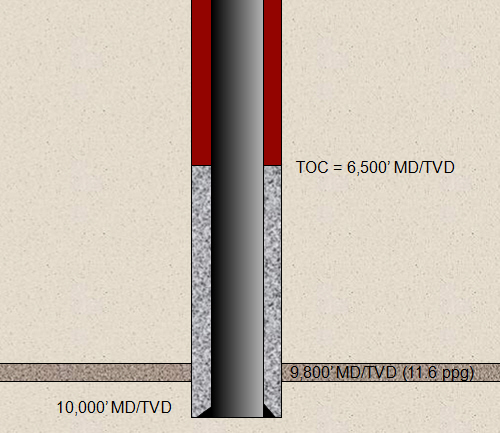
This example will demonstrate you why the well is in underbalance condition while waiting on cement.

Well information: Previous 9-5/8” casing shoe at 4000’ ft.

The vertical well (8.5” hole) is drilled to TD at 10,000ft with 12.1 ppg mud and the pay zone is at 9,800’ TVD with reservoir pressure of 11.6 ppg. The cement is planned to cover 3,500 ft in the annulus above the casing shoe. Water used to mix cement is 8.3 ppg weight.

 cement Transition Period

Continue reading

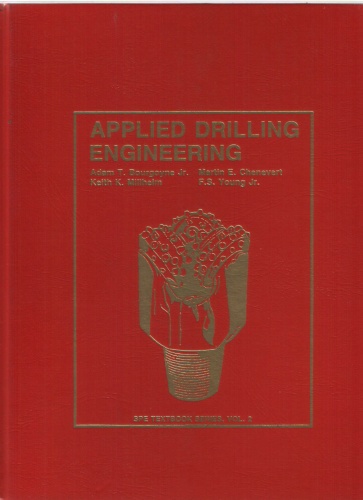
Applied Drilling Engineering (Spe Textbook Series, Vol 2) Review

If you would like to learn about drilling engineering, this book, Applied Drilling Engineering – Spe Textbook Series, is my recommendation. The book contains various topics regarding drilling engineering.

What will you learn from this book?

Rotary drilling – basic of drilling rigs, rig power system, hoisting system, circulating system, etc.

Drilling fluids – Mud test, pilot test, water based mud and oil based mud.

Cements – composition of cement, cement testing, cement additives, and cement placement techniques used in the drilling field.

Drilling hydraulics – Hydrostatic pressure, annular pressure during well control operation, buoyancy factor, non static well condition, flow through jet bits, rheology models, laminar and turbulent flow, surge/swab pressure and particle slip velocity.

Continue reading

Minimum strength to support casing string

One function of cement is to support casing string and the shear strength of cement holds casing string once cement is set. You may think about other load supporting casing as compressive loading at coupling areas or thermal movement. They are the part of the supporting force as well but the most support is from the cement shear strength.

(Diagram above shows how shear strength of cement supports casing string)

We don’t normally measure shear strength of cement but we can apply knowledge from Civil engineer to estimate the shear strength from the compressive strength. Generally, cement has the shear strength approximately 1/12 of compressive strength. For instant, if the cement 1000 psi compressive strength, its shear strength is 83.3 (1000 x 1/12) psi.

Continue reading