What is a Chemical Cutter? and How It Works?

Chemical pipe cutting is a wireline operation that utilizes an electric tool and a halogen fluoride chemical reactant to perforate and weaken pipe, enabling its subsequent removal (pipe recovery). Originally introduced in the 1950s as a patented process exclusive to a single wireline company, chemical cutting has now become widely adopted across the industry. Today, most electric-wireline service providers offer this technique, making it the predominant method for cutting pipes due to its efficiency and effectiveness.

Courtesy of Versa-line – https://versa-line.com/ Continue reading

What is backoff operation for fishing job?

What is backoff operation?

The backoff operation is a procedure used in oil and gas well fishing jobs to unscrew a stuck pipe string at a specific threaded joint above the stuck point. This method is particularly popular for drill pipes and drill collars because it leaves a threaded connection at the top of the remaining pipe, making it possible to screw back into the fish with a workstring and fishing tools.

Continue reading

The Essential Guidelines for Successful Fishing Operations

Successful Fishing Operations are required a lot of effort from every party. Therefore, we provide the guideline which will help you get higher chance of success to fish your tool out of the hole. Fishing operations demand adherence to specific guidelines and protocols applicable across various scenarios. Challenges like downhole issues, equipment malfunctions, geological formations, and human error may necessitate fishing interventions or hinder completion. By following the guidelines outlined in this chapter, one can maximize the likelihood of a successful fishing endeavor.

The Essential Guidelines for Successful Fishing Operations

While all aspects are significant, certain principles merit special attention. Skilled and seasoned personnel play a pivotal role, capable of executing most fishing tasks, including engaging a specialist if needed, or preempting the need for fishing altogether. Preparedness is key, as fishing often arises unexpectedly. Understanding the situation thoroughly, promptly taking appropriate actions, expediting operations, and knowing when to pivot or cease efforts are critical. Post-job analysis is essential for preventing future mishaps or improving efficiency. Familiarity with common drilling or workover operations prone to fishing is invaluable for success. Continue reading

Different Types of API Ring Gaskets Used in Well Control Equipment, Wellhead, Riser, and Xmas Tree

For well control equipment or pressure containment for oil and gas, ensuring reliable sealing solutions is paramount to maintaining operational integrity and safety standards. Among the array of sealing mechanisms employed, API ring gaskets stand out for their versatility and effectiveness in various applications, including wellheads, risers, and Xmas trees.

These ring gaskets, designated by different API types such as ‘R’, ‘RX’, ‘BX’, ‘AX’, ‘VX’, and ‘CX’, each offer unique sealing characteristics tailored to specific operational requirements. Understanding the intricacies of these API ring gaskets is essential for ensuring optimal performance and mitigating potential risks associated with leaks and equipment failures.

In this comprehensive exploration, we delve into the different types of API ring gaskets, their design principles, sealing mechanisms, and practical applications in well control equipment. From the traditional ‘R’ type gasket to the advanced ‘CX’ pressure-energized gasket, we examine their features, benefits, and challenges, providing insights to aid industry professionals in selecting the most suitable sealing solution for their specific operational needs.

API Type ‘R’ Ring Joint Gasket

The ‘R’ type ring joint gasket doesn’t rely on internal pressure for its sealing. It seals through small bands of contact between the grooves and the gasket’s OD and ID. The gasket can be octagonal or oval in cross-section. Due to its design, ‘R’ type gaskets don’t allow face-to-face contact between hubs or flanges, so external loads are managed through the sealing surfaces. However, vibration and external loads may deform the small bands of contact, potentially leading to leaks unless the flange bolting is regularly tightened.

API Type ‘RX’ Pressure-Energized Ring Joint Gasket

The ‘RX’ type gasket, developed by Cameron Iron Works and adopted by API, is pressure-energized. Sealing occurs along small contact bands between the grooves and the gasket’s OD, with the gasket slightly larger in diameter than the grooves, compressed slightly during joint tightening. ‘RX’ gaskets are designed to withstand external loads without deforming the sealing surfaces. It’s recommended to use a new gasket for each joint assembly.

API Type ‘BX’ Pressure-Energized Ring Joint Gasket

Similar to ‘RX’, ‘BX’ gaskets rely on pressure energization and sealing along small contact bands. However, achieving face-to-face contact between hubs or flanges can be challenging due to tolerance variations. Without proper contact, vibration and external loads may cause deformation and eventual leakage. ‘BX’ gaskets often feature axial holes to ensure pressure balance.

API Face-to-Face Type ‘RX’ Pressure-Energized Ring Joint Gasket

This ‘RX’ variant aims for face-to-face contact between hubs, with sealing occurring along small contact bands. However, the gasket may lack support on its ID, potentially leading to deformation during tightening and subsequent leaks. This type is not widely accepted in the industry.

‘CIW’ Type ‘RX’ Pressure-Energized Ring Joint Groove

Modified by CIW, these grooves aim to prevent gasket buckling and consequent leaks. While similar to standard ‘RX’ gaskets, these grooves offer improved support, reducing the likelihood of gasket deformation and leaks.

Type ‘AX’ and ‘VX’ Pressure-Energized Ring Joint Gasket

Developed by Cameron Iron Works and Vetco respectively, ‘AX’ and ‘VX’ gaskets seal along small contact bands, with the gasket slightly larger than the grooves. They feature smooth IDs and grooved ODs, allowing for minimal axial pressure loading. They’re designed to maintain face-to-face contact between hubs with minimal clamping force, with external loads transmitted through the hub faces.

‘CIW’ Type ‘CX’ Pressure-Energized Ring Joint Gasket

Similar to ‘AX’ and ‘VX’, ‘CX’ gaskets seal along small contact bands and are slightly larger than the grooves, with recessed designs for protection against keyseating. They allow for face-to-face contact between hubs with minimal clamping force and are suitable for use throughout the BOP and riser system.

Application of Type ‘AX’, ‘VX’, and ‘CX’ Pressure-Energized Ring Joint Gaskets

These gaskets facilitate face-to-face contact between hubs with minimal clamping force and are suitable for various applications, including at the base of the wellhead, side outlets on the BOP stack, and throughout the BOP and riser system.

Key Takeaways:

  • Pressure-energized gaskets generally offer better performance than non-energized ones.
  • Face-to-face contact, when achieved, distributes loads better and reduces gasket damage.
  • Each type has its own strengths and weaknesses, requiring careful selection based on application.

References 

Cormack, D. (2007). An introduction to well control calculations for drilling operations. 1st ed. Texas: Springer.

Crumpton, H. (2010). Well Control for Completions and Interventions. 1st ed. Texas: Gulf Publishing.

Grace, R. (2003). Blowout and well control handbook [recurso electrónico]. 1st ed. Paises Bajos: Gulf Professional Pub.

Grace, R. and Cudd, B. (1994). Advanced blowout & well control. 1st ed. Houston: Gulf Publishing Company.

Watson, D., Brittenham, T. and Moore, P. (2003). Advanced well control. 1st ed. Richardson, Tex.: Society of Petroleum Engineers.

What Factors To Be Considered When to Change Annular Preventer Element

An annular rubber element stands as a pivotal component within an annular blowout preventer (BOP), playing a crucial role in safeguarding oil well drilling operations by preventing the uncontrolled release of formation fluids, such as oil, gas, or water, from the wellbore.

When to Change Annular Preventer Element

When to Change Annular Preventer Element

Crafted from a high-performance elastomer compound, these elements are engineered to withstand the demanding conditions of the downhole environment. Subjected to high pressures, extreme temperatures, and exposure to corrosive fluids, they are strategically placed around the wellbore within the BOP body to forge a seal between the drill pipe or casing and the wellbore wall.

Upon activation of the BOP, the element undergoes compression, forming a tight seal that effectively halts the flow of fluids up the wellbore. Available in various sizes and configurations, annular rubber elements cater to diverse wellbore conditions and applications.

Here are some primary functions of annular rubber elements:

  1. Primary Pressure Barrier: The element serves as the primary barrier against the upward flow of formation fluids throughout drilling, completion, and production phases.
  2. Accommodation of Different Pipe Sizes: Designed to adapt to a range of pipe diameters, ensuring a secure seal irrespective of the size of the drill pipe or casing utilized.
  3. Resistance to Wear and Tear: Manufactured from robust materials capable of withstanding the abrasive downhole conditions.
  4. Maintenance of Flexibility: Flexibility is paramount for the element to conform to the irregularities of the wellbore wall and pipe while maintaining a tight seal.

The decision to replace an annular rubber element in an annular BOP is critical for wellbore safety and should be approached on a case-by-case basis, taking into account various factors. Here are key indicators that replacement might be necessary:

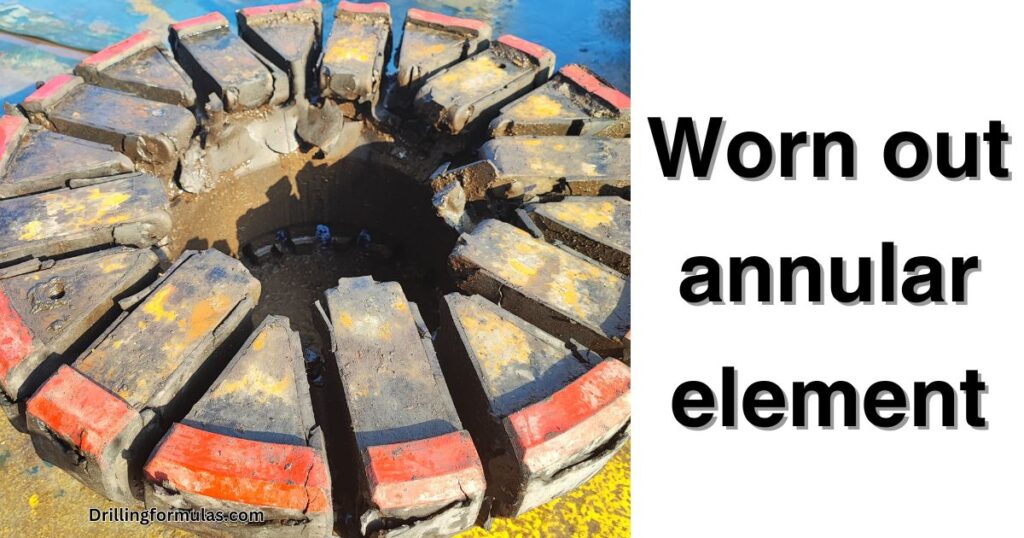
This is an example of worn out annular rubber element.

This is an example of worn out annular rubber element.

Visual Inspection:

  • Visible Damage: Any cuts, tears, abrasions, nicks, or physical damage compromise the sealing ability and warrant replacement.
  • Excessive Wear: Significant or uneven wear suggests the end of the element’s useful life.
  • Swelling or Softening: Signs of exposure to incompatible fluids or excessive heat indicate weakening and necessitate replacement.

Performance Issues:

  • Leaks: Even minor leaks around the element necessitate investigation and potential replacement.
  • Increased Activation Pressure: Elevated pressure requirements could signify wear or damage, reducing sealing effectiveness and calling for replacement.

Preventative Maintenance:

  • Manufacturer Recommendations: Adhering to recommended replacement intervals ensures optimal performance and safety.
  • Pre-operational Inspections: Scheduled inspections before each operation enable early detection of potential issues.
  • Records and History: Detailed records of element usage aid in predicting replacement needs.

Additional Factors:

  • Wellbore Conditions: Harsh environments accelerate wear, necessitating more frequent replacements.
  • Drilling Operations: Operations involving abrasive materials or frequent pressure cycling influence replacement decisions.

Replacing an annular rubber element is a critical safety measure. Consultation with experienced personnel, qualified inspectors, and adherence to industry regulations is imperative for informed replacement decisions. Never delay replacement if there are suspicions regarding the integrity or performance of the element.

References 

Cormack, D. (2007). An introduction to well control calculations for drilling operations. 1st ed. Texas: Springer.

Crumpton, H. (2010). Well Control for Completions and Interventions. 1st ed. Texas: Gulf Publishing.

Grace, R. (2003). Blowout and well control handbook [recurso electrónico]. 1st ed. Paises Bajos: Gulf Professional Pub.

Grace, R. and Cudd, B. (1994). Advanced blowout & well control. 1st ed. Houston: Gulf Publishing Company.

Watson, D., Brittenham, T. and Moore, P. (2003). Advanced well control. 1st ed. Richardson, Tex.: Society of Petroleum Engineers.