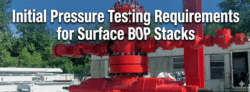
Initial Pressure Testing Requirements for Surface Blowout Preventer (BOP) Stacks as per API Standard 53 Fifth Edition 2018

This article will describe the initial pressure testing requirements for surface Blowout Preventer (BOP) stack components as outlined in standardized regulatory guidance. The specifications differentiate between low-pressure and high-pressure testing thresholds and incorporate operational conditions such as component replacement, elastomer changes, and system integrity considerations. The intent of these requirements is to ensure functional reliability, containment assurance, and conformity with well control safety practices.

Continue reading

Functions of Annular Preventer BOP

The annular preventer, also known as an annular BOP, is a large, donut-shaped device installed at the top of the BOP stack. It uses a rubber sealing element reinforced with steel, known as a packing unit, which is hydraulically compressed to form a tight seal around the drill pipe or completely across the open wellbore. This action prevents the uncontrolled escape of formation fluids—such as oil, gas, or water—that could lead to a blowout.

Unlike ram-type BOPs, which require specific-sized rams to seal around different diameters of pipe, the annular preventer can accommodate a wide range of pipe sizes and shapes. This adaptability is one of its most significant advantages. Continue reading

Tripping Considerations in Drilling Operations

Tripping operations in drilling are critical phases where the drill string is either pulled out of the well (tripping out) or run back into the well (tripping in). These operations require good planning and execution to maintain well control and prevent issues such as kicks or swabbing. This article outlines essential tripping considerations for effective tripping, focusing on trip tanks, slugs, pumping out, tripping-in techniques, and breaking circulation.

Continue reading

Slow Circulating Rates (SCRs) in Well Control Operations

Slow Circulating Rates (SCRs) refer to the use of slow pump rates during circulation to manage wellbore pressure, especially during situations where there is a need to control or “kill” the well. SCRs are integral in maintaining stability and safety in drilling environments, as they help manage bottom hole pressure, mitigate friction in the annulus, and provide additional control over circulation pressures. Let’s delve deeper into why SCRs are essential, how they are applied, and the importance of accounting for friction pressures, particularly in subsea operations.

Continue reading

Well Control Responsibilities on a Rig

Well control responsibilities on a rig involve a coordinated effort by multiple personnel, each tasked with critical roles during well control operations. These responsibilities are vital in managing potential risks and ensuring that the well is controlled and stabilized effectively.

Continue reading