About DrillingFormulas.Com

Working in the oil field and loving to share knowledge.

Dogleg Severity Calculation Based on Tangential Method

From the previous post, I posted about how to calculate dogleg severity based on Radius of Curvature Method. What’s more, there is another way to calculate dogleg severity based on the concept of Tangential Method.

The following formula provides dogleg severity in degrees/100 ft and is based on the Tangential Method:

Dogleg severity (DLS) = 100 ÷ {MD x [(sin I1 x sin I2) x (sin Az1 x sin Az2 + cos Az1 x cos Az2) + (cos I1 x cos I2)]}
directional survey photo

where

DLS = dogleg severity in degrees/l00 ft

MD = measured depth between survey points, ft

I1 = inclination (angle) at upper survey in degrees

I2 = inclination (angle) at lower in degrees

Az1= Azimuth direction at upper survey

Az2 = Azimuth direction at lower survey


Calculation example for dogleg severity based on Tangential Method

Survey 1

Depth = 7500 ft

Inclination = 45 degree (I1)

Azimuth = 130 degree (Az1)

Survey 2

Depth = 7595 ft

Inclination = 52 degree (I2)

Azimuth = 139 degree (Az2)

Dogleg severity (DLS) = 100 ÷ {95 x [(sin 45 x sin 52) x (sin 130 x sin 139 + cos 130 x cos 139) + (cos 45 x cos 52)]}

Dogleg severity (DLS) = 1.07 degree/100 ft

Please find the Excel sheet for calculating dogleg severity with the concept of Tangential Method

Ref book: Formulas and Calculations for Drilling, Production and Workover, Second Edition

Directional Drilling Books
Dogleg Severity Calculation based on Radius of Curvature Method

Dogleg severity (DLS) is a normalized estimation, normally described in degrees per 100 feet or degree per 30 meters, of the overall well bore curvature between two consecutive directional surveys. Regarding a planned well path, dogleg severity may be synonymous about build and/or turn. The following formula provides dogleg severity in degrees/100 ft  based on the Radius of Curvature Method.

directional survey photo

Dogleg severity (DLS) = {cos-1 [(cos I1 x cos I2) + (sin I1 x sin I2) x cos (Az2 – Az1)]} x (100 ÷ MD)

Where;

DLS = dogleg severity in degrees/l00 ft

MD = Measured Depth between survey points in ft

I1 = Inclination (angle) at upper survey in degrees

I2 = Inclination (angle) at lower in degrees

Az1= Azimuth direction at upper survey

Az2 = Azimuth direction at lower survey

Example for dogleg severity based on Radius of Curvature Method

Survey 1

Depth = 7500 ft

Inclination = 45 degree (I1)

Azimuth = 130degree (Az1)

Survey 2

Depth = 7595 ft

Inclination = 52 degree (I2)

Azimuth = 139 degree (Az2)

Dogleg severity (DLS) = {cos-1 [(cos 45 x cos 52) + (sin 45 x sin 52) x cos (139 – 130)]} x (100 ÷ 95)

Dogleg severity (DLS) =  10.22 degree/100 ft

Please find the Excel sheet used to calculate dogleg severity based on Radius of Curvature Method.


Ref book: Formulas and Calculations for Drilling, Production and Workover, Second Edition

Directional Drilling Books
Radius of Curvature Method

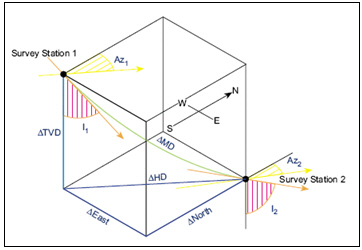
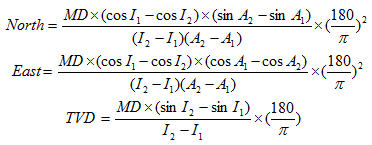
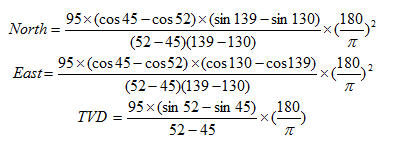
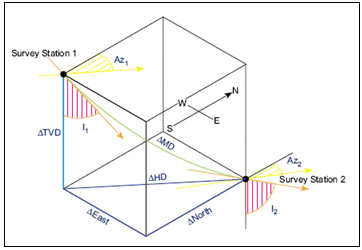
Radius of Curvature Method is the most famous method for directional survey calculation. You can calculate North, East and TVD between directional surveys based on the Radius of Curvature Method as per formula below:

directional survey photo

Where;

MD = measured depth between surveys in ft

I1 = inclination (angle) at upper survey in degrees

I2 = inclination (angle) at lower in degrees

Az1= Azimuth direction at upper survey

Az2 = Azimuth direction at lower survey

Calculation example for Radius of Curvature Method

Survey 1

Depth = 7500 ft

Inclination = 45 degree (I1)

Azimuth = 130degree (A1)

Survey 2

Depth = 7595 ft

Inclination = 52 degree (I2)

Azimuth = 139 degree (A2)

MD = 7595 – 7500 = 95 ft

As per the calculation above,

North = -49.97 ft

East = 50.66 ft

TVD = 62.91 ft

Please find the Excel sheet used for directional survey calculation with Radius of Curvature Method.

Ref book: Formulas and Calculations for Drilling, Production and Workover, Second Edition

Directional Drilling Books
Angle Averaging Method in Directional Drilling Calculation

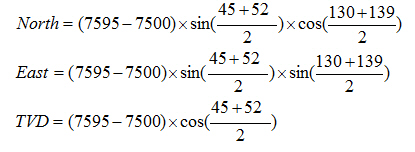
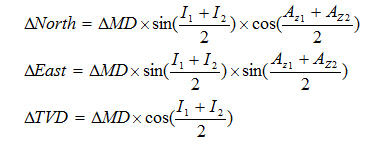
You can calculate North, East and TVD between directional surveys based on the Angle Averaging Method as per formula below:

directional survey photo

angle averaging method

Where;

MD = measured depth between surveys in ft

I1 = inclination (angle) at upper survey in degrees

I2 = inclination (angle) at lower in degrees

Az1= Azimuth direction at upper survey

Az2 = Azimuth direction at lower survey

Calculation example for Angle Averaging Method

Survey 1

Depth = 7500 ft

Inclination = 45 degree

Azimuth = 130degree

Survey 2

Depth = 7595 ft

Inclination = 52 degree

Azimuth = 139 degree

angle averaging method number

As per formula above,

North = -49.87 ft

East = 50.74 ft

TVD = 62.95 ft

Please find the Excel sheet used for directional survey calculation with Angle Averaging Method


Ref book: Formulas and Calculations for Drilling, Production and Workover, Second Edition

Directional Drilling Books
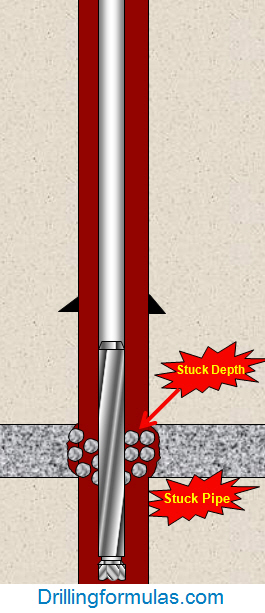
Determine how many feet of free pipe without free pipe constant table

You may sometimes find the table for Free Point Constant for your stuck pipe calculation so you use the formula from the previous post to determine Free Point Constant and apply it into free pipe formula to determine where the depth of stuck pipe is.

Stuck Pipe Calculation - Stuck Depth

Stuck Pipe Calculation – Stuck Depth

The steps of calculation are as follows:

1 ) Determine the free point constant (FPC) by this following formula:

FPC = As x 2500

where: As = pipe wall cross sectional area, sq in.

As = (OD2-ID2) x 0.7854

OD and ID are inch unit

2) Determine depth of stuck pipe by this following formula:

Depth of stuck pipe = (Pipe stretch in inch x free point constant (FPC)) ÷ Pull force in thousands of pounds

Please see the example below to demonstrate you how to apply those 2 formulas above into real drilling operation.

Example#2: Determine the free point constant (FPC) and the depth the pipe is stuck using the following information:

3-1/2” tubing # 9.5 lb/ft

3-1/2” tubing ID = 2.992 inch

20 inch of stretch with 25 Klb of pulling force

a) Determine free point constant (FPC):

FPC = (3.52 – 2.9922) x 0.7854 x 2500

FPC = 6475.5

b) Determine the depth of stuck pipe:

Feet of free pipe (ft) = (20 inch x 6475.5) ÷ 25

** 25 is the kilo-force to pull to 20 inch **

Feet of free pipe (ft) = 5,180 ft

Please find the Excel sheet used for calculating depth of stuck pipe.

Ref book: Formulas and Calculations for Drilling, Production and Workover, Second Edition