Material Balance for Gas Cap Drive Mechanism

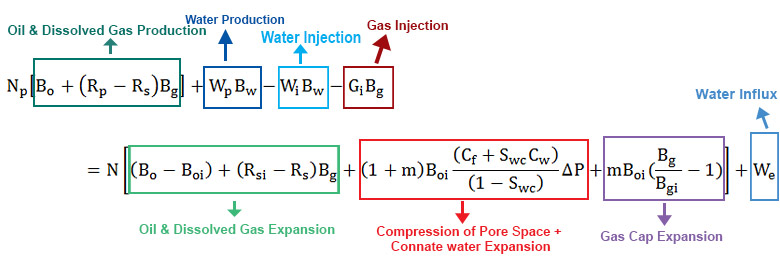
This article will demonstrate a material balance equation in gas cap drive mechanism.  First, we start with a full material balance equation.

Figure 1 - Full Material Balance Equation

Figure 1 – Full Material Balance Equation

Assumptions

  • No water production
  • No water injection
  • No gas injection
  • No water influx
  • Neglect formation and connate water compressibility (Cf and Cw have little effect for a gas cap drive mechanism.)
Continue reading

Solution Gas Drive Mechanism Explained in Material Balance Equation

Material balance equation can be applied for any drive mechanism and this article demonstrates how to apply the material balance equation in a solution drive mechanism. For a solution drive mechanism, there are 2 cases. The first case is when reservoir pressure is above a bubble point and the second case is when reservoir pressure is below a bubble point.

Solution Gas above Bubble Point

Start with a full material balance equation.

Figure 1 - Full Material Balance Equation

Figure 1 – Full Material Balance Equation

Assumptions Continue reading

Material Balance Equation in Reservoir Engineering

Material balance is a mathematic way to express mass conservation in a reservoir and a simple key principle is “what reservoir is produced must be replaced by other mass.

Volume Produced = Volume Replaced

Volume Produced comes from Gas Production, Oil Production, and Water Production.

Volume Replaced comes from volume expansion, water in flux and water/gas injection.

Figure 1 shows the relationship of the material balance.

Figure-1---Concept-of-Material-Balance

Figure 1 – Concept of Material Balance

Let’s take a look at each component of equation. Continue reading

Water Drive Reservoir

Some reservoirs have communication with a water zone (aquifer) underneath. When reservoir pressure drops due to production, the compressed water in an aquifer expands into a reservoir and it helps pressure maintenance. This mechanism is called “water drive”.

Water drive mechanism will be effective if an aquifer contacting reservoir is very large because water compressibility is very low. For example, an anticline structure with extensive water zone (aquifer) will have the most advantage from the use of a water drive mechanism. Conversely, stratigraphic reservoirs or highly-faulted reservoirs will have limited aquifer volume so water drive is insignificant.

Figure 1 - Water Drive Mechanism

Figure 1 – Water Drive Mechanism

Continue reading

Gas Cap Drive Mechanism

Some reservoirs have a gas cap, which provides energy from gas expansion to help production from a wellbore; therefore, this is called “gas cap drive”. When oil is being produced, the gas cap expands and pushes oil downwards to a producing well (Figure 1).

Figure-1---Gas-Cap-Drive

Figure 1 – Gas Cap Drive

For this type of drive mechanism, it is imperative to keep gas within a reservoir as long as possible since it is an excellent energy source of the reservoir. Wells which are drilled into a high structure area where the gas cap is located must be closely monitored because this well will have more of a chance to produce gas. Continue reading