How to Prevent Well Ballooning

This topic will you describe how to prevent well ballooning. There are several items that you can manage in order to prevent or minimize well ballooning.

Trying not to lose fluid or to minimize drilling mud loss into formation is the best way to prevent well ballooning. As you may know from the previous topic, well ballooning basic, before ballooning will happen, you must have downhole losses. Then, flow back will occur when pumps are off.

There are several ways that can help you on this issue as listed below:

Continue reading

How to Identify Well Ballooning

It is not simple to identify well ballooning because the well acts almost like well control situation (taking kick). Therefore, this topic describe how to identify well ballooning and important rules when you face with well ballooning situation.


These following guidelines will help you identify ballooning.


• Drilling mud losses – you must have mud loss into formation in order to have mud flow back when pumps off.


• Flow back when pump off and flow rate decrease over time – you must line the well up into a trip tank and monitor well. Tracking volume flow back every minutes help you understand if flow back trend decreases. The key thing is “flow back rate must reduce over time”. If not, you will have well control situation instead. Monitoring well takes time and personnel must be patient.

Continue reading

Well ballooning (wellbore breathing or micro fracture)

This topic describes about well ballooning. You may hear several terms besides well ballooning as wellbore breathing or micro fracturing phenomenon.

What is well ballooning?

The well ballooning effect is a natural phenomenon occurring when formations take drilling mud when the pumps are on and the formations give the mud back when the pumps are off.

What is mechanism of well ballooning?

While pumps are on, if Equivalent Circulating Density (ECD) exceeds formation fracture, micro fractures are created and drilling mud will lose into small induced formation fractures. The micro fractures can be propagated and it may cause a lot of mud volume losses down hole. Micro fracture will not cause severe losses or totally losses.

Continue reading

Adjusted maximum allowable shut-in casing pressure

You calculate the maximum initial shut-in casing pressure (MISICP) based on the original mud weight before you start drilling ahead. Once you drill deeper, you may increase mud weight. With new mud weight, you are not able to use the MASICP calculated by the initial weight because higher mud weight will reduce the MASCIP. The formula below demonstrates you how to adjust the MASICP with new mud weight.

Adjusted MASICP = Leak off pressure – [Shoe TVD x (MW2 – MW1)] x 0.052

Continue reading

Determine the actual gas migration rate

You have learned how to estimate the gas migration rate. Today, I would like to show you how to figure out the actual gas migration rate after you shut the well in due to well control.
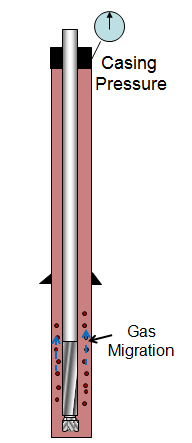
The concept of this topic is to measure the pressure increment in a hour and divided by gradient of mud weight that you have in the well.

Let’s look at the formula:

Actual gas migration rate = Increase in casing pressure ÷ Pressure gradient of drilling mud

Where;

Actual gas migration rate in ft/hr

Increase in casing pressure in psi/hr

Pressure gradient of drilling mud in psi/ft

Let’s try to determine the actual gas migration rate with this following information:

Initial shut in casing pressure = 450 psi

Shut in casing pressure after half an hour shut in = 650 psi

Current mud weight = 12.5 ppg

Solution:

Pressure increase in half an hour = 650 – 450 = 200 psi

It means that pressure increase in an hour is 400 psi. Therefore, you get the increase in casing pressure = 400 psi/hr.

You need to calculate your mud weight in to ppg with this formula:

Mud gradient = 0.052 x mud weight

Mud gradient = 0.052 x 12.5 = 0.65 psi/ft

Note: you can read more about it via this link: how to convert mud weight to pressure gradient.

Actual gas migration rate = 400 (psi/hr) ÷ 0.65 (psi/ft) = 616 ft/hr

References

Cormack, D. (2007). An introduction to well control calculations for drilling operations. 1st ed. Texas: Springer.

Crumpton, H. (2010). Well Control for Completions and Interventions. 1st ed. Texas: Gulf Publishing.