List of Major Offshore Drilling Companies

Working offshore is an interesting opportunity because you can get some good experiences and high salary which you can rarely find from other jobs. Most of people think that there are few companies in the world involving offshore drilling but actually there are many of them. Currently, those offshore drilling companies are looking for personnel because the oilfield work over the world is getting higher every day.
Nowadays, offshore drilling plays a big part of our drilling industry therefore I would like to share top offshore drilling companies. If you are interested in working with offshore drilling companies, please check out the following companies. There are websites and company profile for each company. If you are interested in any company, we also provide you their company website links so it makes you life easy to contact the companies.

Drilling companies (drilling contractors) are people providing drilling services, equipment, experience to oil companies as Shell, BP, Exxon, Chevron, etc. Working with drilling companies has a lot of advantages as international experience, good income, job challenges, etc.


 Aban Loyd Chiles Offshore Limited, Chennai, India

http://www.abanoffshore.com/

Aban Loyd Chiles Offshore Limited is India’s largest offshore drilling contractor in the private sector, offering world-class drilling and oil field services for offshore exploration and production of hydrocarbons to the oil industry in India and abroad. Our innovative and cost effective solutions make us one of the most efficient international drilling contractors. Thanks to a highly qualified professional team backed by years of experience and expertise, we continue to foray into newer waters. Continue reading

Key Seat Causes Stuck Pipe

While drilling, with high tension and torsion in a drilling string, the drill string creates wear, called “key seat “ at wellbore where there are changes in the direction. The soft to medium hard formation has a great tendency to get key seat. While pulling out of the hole, BHA gets stuck into the key seat.

Key Seat

Key Seat

Warning signs when you get stuck due to Key Seat

  • High dog leg severity
  • Long drilling hours without reaming back through the high dog leg area

 Stuck identification for Key Seat

  • This situation occurs when pulling out of the hole only.
  • Circulation is not restricted.
  • High over pull is suddenly seen when the BHA is pulled into the key seat.
  • Tripping back is possible.

 What should you do for this situation?

  1. Because the drill sting gets stuck while moving up, jar down with maximum trip load, which must be applied. Torque while jarring down can be applied as well.
  2. Bring the rotation at a slow speed and attempt to ream back with a small over pull into the key seat areas.

 Preventive actions:

  1. Do not try to drill with a lot of dog leg severity
  2. Back ream some areas where high dog leg severity is presented.
  3. Run a short trip or wiper trip to minimize the key seat.
  4. Utilize a reamer in high dog leg zones.

References

John Mitchell Drilbert Engineering, 2002. Trouble-Free Drilling Volume 1: Stuck Pipe Prevention. Edition. Drilbert Engineering Inc.

Fanarco.net. 1999. Stuck Pipe Prevention Self-Learning Course. [ONLINE] Available at: http://www.fanarco.net/books/drilling/stuck-pipe.pdf. [Accessed 21 June 2016

Steve Devereux, 2012. Drilling Technology in Nontechnical Language, 2d Ed.. 2 Edition. PennWell Corp.


Underbalanced Drilling – Watch This VDO To Get Clear Idea

Underbalanced drilling is a drilling technique that hydrostatic pressure from drilling mud is less than reservoir pressure. The underbalanced drilling can be created by using low weight fluids as base oil, fresh water which has less hydrostatic pressure than the expected formation pressure. Additionally, this drilling method is achieved by using low density drilling fluids as gas, foam, combination between conversional drilling fluid and foam/air.

The main advantage of Underbalanced drilling is to minimized formation damage in reservoir. With underbalanced drilling, the reservoir fluid is allowed to flow out into the well therefore the chance of mud invasion into the reservoir is minimal. Hence, the production from the well from this technique is higher than normal wells. Conversely, drilling with conventional method (overbalanced drilling) creates near wellbore damages which affect hydrocarbon production.

The underbalanced drilling is often applied to horizontal drilling wells because long horizontal reservoir will not be damaged with drilling fluid. Only few inches of near wellbore damage in the horizontal section can drastically reduce the reservoir performance.

This video from Shell demonstrates you regarding underbalanced drilling and there is one section showing comparison between conventional and underbalanced drilling. This short VDO will definitely give you clear picture of this technique.

How does the 0.052 constant come from?

In the hydro-static pressure formula, if you use an oil field unit, you must see the hydro-static formula like this

Pressure, psi = 0.052 x Mud Weight (ppg) x TVD (ft)

I got the question asking about how the constant 0.052 is figured out.

What is 0.052?

0.052 is a constant used for converting ppg-ft into pound per square inch (lb/in2)

Do you know how it comes from? Let’s get started

First of all, the unit conversions that you need to know are as follows:

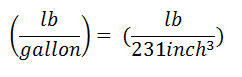
1 gallon = 231 cubic inch (inch3)

1 ft = 12 inch

Convert density from ppg (pound per gallon) to lb per cubic inch

Basic hydrostatic pressure

The constant can be determined by substituting the unit conversion.

The constant is 0.051948 and if we round it up, it will be 0.052.