Why do we run casing in the well?

Simple question: “What are the reasons casing is run in the well?”
IMG_1119

There are several importance of casing as follow;

• To prevent collapse of the borehole

• To confine production to the wellbore

• To provide a flow path for drilling fluid

• To contain formation pressure and prevent fracturing of upper and weaker zones

• To provide an anchor for surface and sub surface equipment

• To provide a high strength flow conduit for drilling fluid to surface and ,with BOP , permit the safe control of formation pressure

• To prevent contamination of fluid in formations

• To exclude water zones from the producing formations


Any additional ideas are welcome.

Ref books: Cementing Technology Books

Pressure Loss and Equivalent Circulating Density Review – Reverse Circulation

We still have the same question as the previous post, Pressure Loss and Equivalent Circulating Density Review, but this case we will do reverser circulation, circulating from annulus to tubing , and see how much pressure and equivalent circulating density at bottom hole.

Continue reading

Pressure Loss and Equivalent Circulating Density Review

This example that I got from my junior member is very simple but it helps you a lot to understand about how to determine pressure loss during normal circulation.

Information given is listed below;

Pressure Loss and Equivalent Circulating Density Review

Circulate at 3 bottom up through open end tubing (Down tubing and up annulus) with 12.7 ppg mud.

Pump pressure = 1000 psi

Annulus friction loss = 50 psi

Inside tubing friction loss = 925 psi

Surface line friction loss = 25 psi

Continue reading

How much pressure will we see at cement head in case of float shoe fail?

I still have the simple but interesting question about hydrostatic pressure which you can apply this calculation into drilling/cementing operation. The question I got about how much pressure we will see at cement head in case of float shoe fail.

Continue reading

What are Lead and Tail Cement?

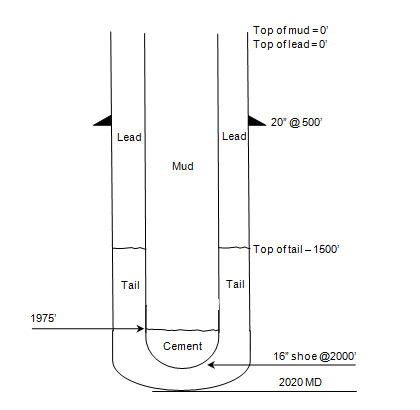
In some cementing operation, operators will pump 2 cement slurries, normally called “Lead Cement” and “Tail Cement”.  Both lead and tail cement have pro and con as described below.

Lead cement: Lead cement is in the top section of cement, where has lower both pressure and temperature (see figure above). It has lower density and strength than Tail cement; however, it is also cheaper than Tail cement.

Tail cement: Tail is pumped after lead cement because it must be settled at the lower section of well bore, where needs high strength cement (see figure above) . It has higher strength than lead cement, but it is more expensive than lead cement.

Ref books: Cementing Technology Books