What Cause Lost Circulation in Drilling Leading to a Well Control Situation

Lost circulation whole mud (whether to depleted reservoirs or to natural/induced fractures)is one of biggest causes of well kicks. In the wellbore, fluid levels can decrease and this lowers the hydrostatic pressure. Once hydrotatic pressure is less than formation pressure, it will cause a flow from the formation in permeable zones. Figure 1 illustrates loss of fluid level into a weak zone which will lead a well control incident if a wellbore is not filled up on time with correct mud weight.

Lost Circulation in Drilling Leading to a Well Control Situation

Figure 1 – Lost Circulation in Drilling Leading to a Well Control Situation

Continue reading

How To Ensure Effective Primary Well Control

Primary well control is the most important barrier while drilling and completing any wells so it is imperative to ensure that the primary well control is effectively maintained.

When various precautions and procedures have been followed, effective primary well control can be achieved. These procedures can be seen below;

Tripping Procedures

 Using a trip sheet (an accurate log), it is possible to maintain tripping both in and out of the well. A trip sheet can help to record the volume of mud that not only enters the well but also that is displaced when tripping. During tripping, the changes in mud volume can be measured using a calibrated trip tank.

For any steel removed, a specific amount of mud is entered into the well when the tripping pipe or drill collars from the hole. To ensure proper well monitoring, tripping may need to be stopped whenever the volume of removed steel significantly outweighs the volume of mud required. After stopping, consideration should also be made towards returning back to bottom in order to condition the mud (and find the cause of the issue). At all times, the drill floor should have the required crossover subs and a full opening safety valve readily available. Continue reading

What is Leg Punch Through (Rapid Penetration) for Jack Up Rigs ?

Leg punch through which is one of the biggest dangers of a Jack Up is happened when a jack up leg or more legs rapidly penetrates into formation underneath a spud can(s). This will result in damage in legs, loss of balance of a rig, and potential harm people life.  Whether higher environmental loads or larger water depths, this increases demand on Jack Ups, leads to higher elevated weights, and creates more pronounced consequences of a punch.

As depth increases, so does a typical soil’s bearing capacity. Soil strength also sees a rapid reduction when a soil layer is underlain by a weaker layer. The weaker soil eventually gives way as the spud can reaches the interface and the jacking system can’t cope with the speed at which the support of the leg moves downwards; the leg isn’t able to maintain the hull level. The hull then sways after it rotates and bends the legs. Relative to the supports, a weight shift occurs and to maintain equilibrium the required footing reaction increases. This process will only end when any hull buoyancy (from the hull now in the water) or the soil’s bearing capacity allows an equilibrium to be reached.

Figure 1 - Soil Bearing

Figure 1 – Soil Bearing, Apvandenberg.com. (2008).

Continue reading

Overall Drilling Process Video Training with Full Video Transcript

This is one of the best drilling 101 videos showing you drilling process from the beginning phase to plug and abandonment phase.  Not only do you learn about drilling, this video briefly shows the overall field development phase. This video tends to focus on unconventional well. For educational purposes, our team provides full video transcript to help anybody learn the content clearly and effectively.

Please see the video below.

Continue reading

Site Specific Assessment and Class Approval for Jack up Rigs

When it comes to safety for Jack Ups, there is a rigorous process in place including International Bodies (International Codes), Class Societies (Class Rules), National Legislation (Shelf States), and National Maritime Legislation (Flag States). Although they don’t require a flag, having one enables them to move freely across international waters. When this is planned, the Maritime Authority regulations must be adhered to according to the Flag State (the country whose flag they are flying).

Normally, each drilling unit will be registered with a Flag State Governmental Administration. Essentially, the role of this administration is to set the requirements for each registering unit and these requirements generally follow the lead of the International Maritime Organization (IMO) since these are internally-agreed suggestions. More recently, the responsibility of verifying compliance has been awarded to classification societies and they also issue Marpol certificates, Loadline, and Tonnage.

Moving away from the flag, there are some governments who also request all drilling units to adhere to their own safety regulations when working in their waters. For example, the United Kingdom has a Health and Safety Offshore Division which ensures the safety of all drilling equipment in UK waters.

In terms of classification societies, these are largely independent and have no relation to any other party and this is important because their sole priority is the quality of the Jack Ups. In addition to authorities, these societies could be the owners, insurance underwriters, charterers, sub-contractors, building yards, and finance institutions.
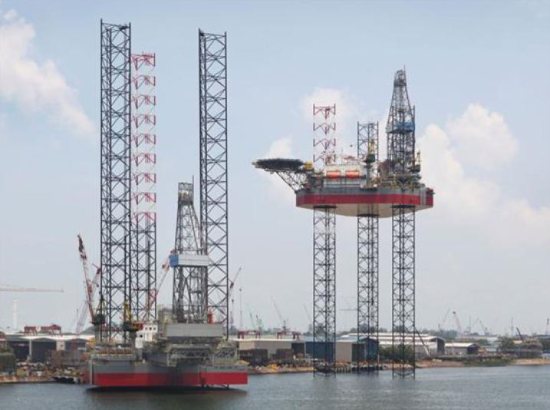
Figure 1 - Jack up Rigs in a Shipyard (gcaptain.com, 2018)

Figure 1 – Jack up Rigs in a Shipyard (gcaptain.com, 2013)

Continue reading