Buoyancy Factor with Two Different Fluid Weights in The Well

Buoyancy Factor is the factor that is used to compensate loss of weight due to immersion in drilling fluid and you can find more information from this article > buoyancy factor calculation .  In that article, it demonstrates the buoyancy formula only for one fluid in the wellbore. However, this time, we will have the details about buoyancy factor when inside and outside fluid are different.

Buoyancy factor with different fluid inside and outside of tubular is listed below;

equation 1

Where;

Ao is an external area of the component.

Ai is an internal area of the component.

ρo is fluid density in the annulus at the component depth in the wellbore.

ρi is fluid density in the component depth in the wellbore.

ρs is steel weight density. Steel density is 65.4 ppg.

If you can the same mud weight inside and outside, the equation 1 will be like this

equation 2

This is the same relationship as this article buoyancy factor calculation.

Let’s take a look at the following example to get more understanding.

Example

13-3/8” casing shoe was at 2,500’MD/2,000’TVD

9-5/8” casing was run to 6,800’MD/6,000 TVD.

9-5/8” casing weight is 40 ppf and casing ID is 8.835 inch.

Current mud weight is 9.5 ppg oil based mud.

The well bore diagram is show below (Figure 1).
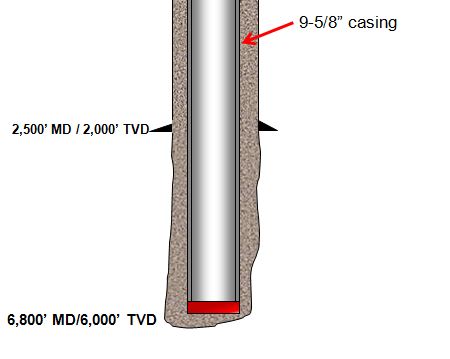
 Figure 1 - Wellbore Diagram

Figure 1 – Wellbore Diagram

The well is planned to cement from shoe to surface and the planned cement weight is 14.0 ppg. The displacement fluid is drilling mud currently used.

Please determine the following items.

  • Air weight of casing string
  • Buoyed weight of casing in drilling mud
  • Buoyed weight of casing when cement is inside casing and drilling mud is outside casing
  • Buoyed weight of casing when cement is outside casing and drilling mud is inside casing

Air weight of casing string

Air weight of casing string, lb = length of casing, ft × casing weight, lb/ft

Air weight of casing string, lb = 6,800 × 40 = 272,000 lb

Buoyed weight of casing in drilling mud

 Figure 2 - Bouyed Weight When Submersed In Drilling Mud

Figure 2 – Buoyed Weight When Submersed In Drilling Mud

Buoyed weight = Buoyancy Factor (BF) × Air Weight of Casing
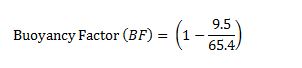
equation 2.5

Buoyancy Factor (BF) = 0.855

Buoyed weight = 0.855 × 272,000 = 232,489 lb

Buoyed weight of casing when cement is inside casing and drilling mud is outside casing
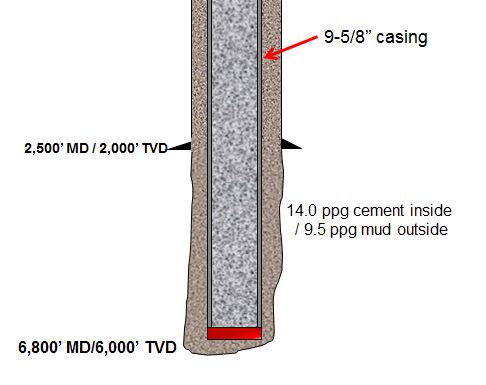
 Figure 3 - Buoyed weight of casing when cement is inside casing and drilling mud is outside casing

Figure 3 – Buoyed weight of casing when cement is inside casing and drilling mud is outside casing

 We will apply the Equation-1 for this case.

Ao is an external area of the component.

Ao = π × (Outside Diameter of casing)2 ÷ 4

Ao = π × (9.625)2 ÷ 4 = 72.76 square inch

Ai is an internal area of the component.

Ai = π × (Inside Diameter of casing)2 ÷ 4

Ai = π × (8.835)2 ÷ 4 = 61.31 square inch

ρo = 9.5 ppf (mud in the annulus)

ρi = 14.0 ppg (cement inside casing)

ρs = 65.4 ppg.
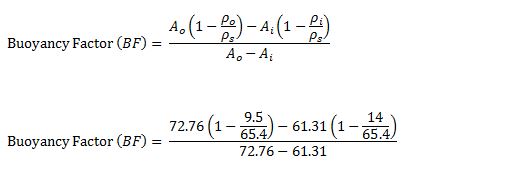
equation 3

Buoyancy Factor (BF) = 1.22

Buoyed weight = 1.22 × 272,000 = 331,840 lb


Buoyed weight of casing when cement is outside casing and drilling mud is inside casing
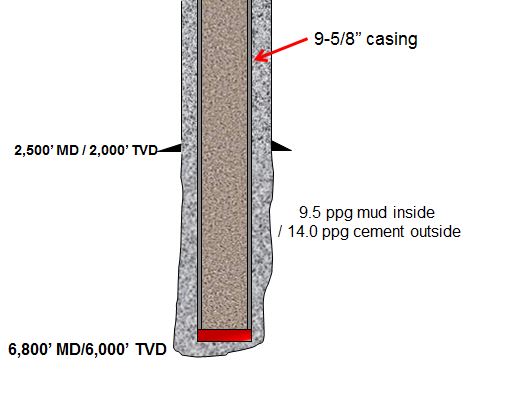
 Figure 4 - Buoyed weight of casing when cement is outside casing and drilling mud is inside casing

Figure 4 – Buoyed weight of casing when cement is outside casing and drilling mud is inside casing

We will apply Equation-1 for this case as well.

All the calculation parameters are the same.

Ao = π × (9.625)2 ÷ 4 = 72.76 square inch

Ai = π × (8.835)2 ÷ 4 = 61.31 square inch

ρo = 9.5 ppg (mud in the annulus)

ρi = 14.0 ppg (cement inside casing)

ρs = 65.4 ppg.
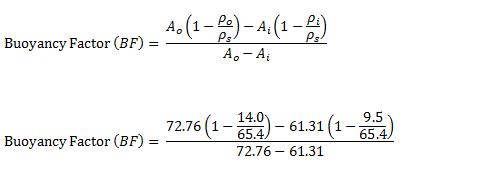
equation 4

Buoyancy Factor (BF) = 0.42

Buoyed weight = 0.42 × 272,000 = 114,240 lb

Conclusion: At different stage of the well, you may have different buoyed weight depending on density of fluid inside and outside of the component and it is not always that buoyed weight is less than air weight.

Reference book => formulas-and-calculationFormulas and Calculations for Drilling Operations
How Does Deep Water Drilling Work

Nowadays deep water drilling is one of vital players for oil and gas exploration and production industry and there are many people who would like to know how deep water drilling works. We’ve found one excellent VDO demonstrates the deep water drilling process in a simple way. This VDO will give you clearer picture about the topic and we also add full VDO transcript in order to help more people understand the content clearly. We wish you would enjoy learning from this VDO and please feel free to give us feedback : )

Full VDO Transcript – How Does Deep Water Drilling Work

deep-water-drilling

Credit: Image from Wikipeida

How does the deep sea drilling vessel Chikyu drill into the sea floor? When the vessel arrives at the drilling site it receives a satellite signal that helps the vessel moves into the exact position required. The vessel has six propellers that rotate a full 360 degrees and keep the vessel in one position preventing it from drifting due to the wind, waves or sea current.

Continue reading

Maximum ROP Before Fracture Formation

In this topic, we will apply the effective mud density formula to determine maximum ROP before fracturing formation.

Figure 1 - Max ROP before Fracturing FormationFigure 1 – Max ROP before Fracturing Formation


These two equations that will be used to determine the maximum ROP are listed below;

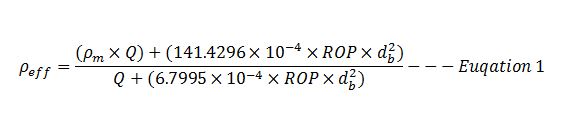
Effective mud density due to cuttings in the hole can be determined by the empirical equation below;

equation 1

Where;

ρeff is effective mud density in ppg.

ρm is mud density in ppg.

Q is flow rate in gpm.

ROP is rate of penetration in fph.

db is wellbore diameter or bit diameter in inch.

Continue reading

Increase In Mud Weight Due To Cutting

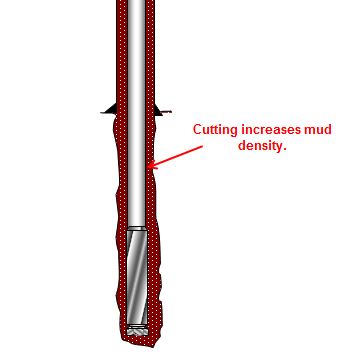
Cutting generated while drilling will increase drilling fluid density and it will finally affect equivalent circulating density while drilling. In this topic, we will talk about how to determine mud weight increase due to cutting.

 Figure 1 - Cutting Increases Mud Density

Figure 1 – Cutting Increases Mud Density


Effective mud density due to cuttings in the hole can be determined by the empirical equation below;

euqation pm

Continue reading

How To Free Stuck Pipe (Oilfield)

This article is a summary of how to free stuck pipe caused by three main mechanisms which are wellbore geometry, differential sticking and packing/bridging off. It will give you some ideas which you can apply for your operation.

How-to-free-a-stuck-pipe2


Free Stuck Pipe Caused By Wellbore Geometry

These following instructions are guide lines on how to free the stuck drill string caused by wellbore geometry.

What should you  do to free the stuck pipe caused by wellbore geometry ?

• If the drill string gets stuck while moving up, jar down with maximum trip load and torque can be applied into drill string while jarring down. Be caution while applying torque, do not exceed make up torque.

• On the other hand, if the drill string gets stuck while moving down, jar up with maximum trip load. DO NOT apply torque in the drill string while jarring up.

• Flow rate must be reduced while attempting to free the drill string. Do not use high flow rate because it will make the stuck situation became worse and you will not be able to free the pipe forever.

Continue reading