Ledges Cause Stuck Pipe

Ledges are occurred while drilling in sequential formations which have soft, hard formations, and naturally fractured formations. Stabilizers in BHA and tool joint easily wear soft formations and naturally fractured formations, however, the hard formations are still in gauge (hole size not change). If there are a lot of ledges in the wellbore, the drillstring can get stuck under ledges.

Continue reading

How to Identify Stuck Pipe Mechanism

When a stuck pipe situation  happens, personnel on the rig must correctly identify a stuck pipe mechanism.

Why is it so important to determine the mechanism of stuck pipe?

If you know the cause of stuck pipe, you will be able to free your pipe correctly. However, if you cannot correctly identify a root cause of stuck pipe, your drill string may be in the hole forever!!!

Many people in the oil field, including me, use the guidelines from the famous stuck pipe prevention book, named “TRUE,” which belongs to Amoco. It is extremely useful and so easy to understand.

This is the stuck pipe table.

How can you use the table?

  1. Select the situations that you see and circle all the figures in the same row.
  2. Add all figures for each column
  3. The highest score indicates the stuck pipe mechanism

Let’s see the example

Pipe motion prior to sticking? – The pip can be moved down before sticking = Move down (1, 0, 2)

Pipe motion after sticking? – The pipe has restriction while moving down= Down Restricted (1, 0, 2)

Pipe rotation after sticking? – The pipe can be rotated freely after sticking = Rotate Free (0, 0, 2)

Circulating pressure after sticking? – The circulation can be done without any pressure changes = Circulation Free (0, 2, 2)

Total score = (2,2,8)

The highest score is wellbore geometry; therefore, the most likely possible mechanism of stuck pipe is wellbore geometry.

Drilling formulas Stuck Pipe Prevention Book => Stuck Pipe Prevention Book  Stuck Pipe Prevention Book

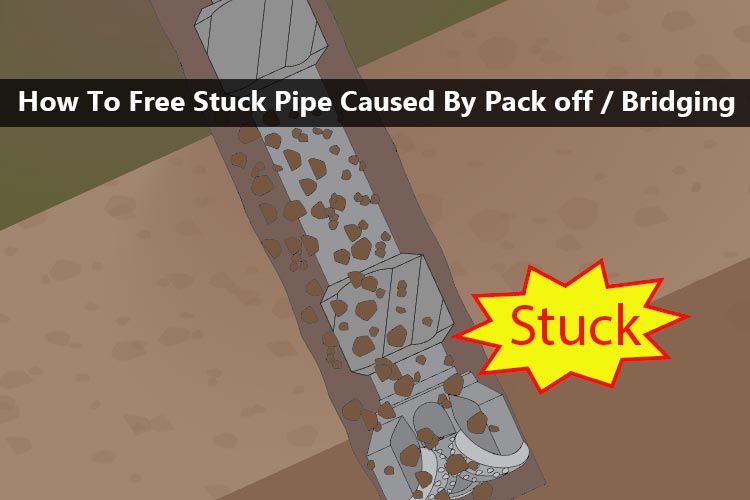
How to Free Stuck Pipe Caused by Pack off / Bridging

If you already know that the stuck pipe is caused by wellbore geometry, the following instructions are guidelines on how to free the stuck drill string.


What should you do to free the stuck pipe caused by Pack off / Bridging?

  • Circulate with low flow rate (300 – 400 psi pumping pressure). It is very important to apply low flow rate because if high flow rate is applied, the stuck situation becomes worse.
  • If the drill string gets stuck while moving up or with the string in static condition, jar down with maximum trip load and torque can be applied into drill string while jarring down. DO NOT JAR UP. Be cautious while applying torque, do not exceed make up torque.
  • On the other hand, if the drill string gets stuck while moving down, jar up with maximum trip load. DO NOT apply torque in the drill string while jarring up.
  • To free the string, jarring operation may take a long time (10 hours +) so please be patient.

What should you do after the string becomes free?

  • Increase flow rate and circulate to clean wellbore at maximum allowable flow rate. Flow rate must be more than cutting slip velocity in order to transport cuttings effectively.
  • Reciprocate and rotate while circulating to improve hole cleaning ability. Work the drill string with full stand if possible.
  • Ensure that the wellbore is clean prior to continuing the operation. You can see from the sale shaker whether the hole is clean or not.
  • Sweep may be utilized to improve hole cleaning.
  • Back ream or make a short trip through the area where it caused the stuck pipe issue.

Drilling formulas Stuck Pipe Prevention Book => Stuck Pipe Prevention Book  Stuck Pipe Prevention Book

How To Free Stuck Pipe Caused By Differential Sticking

These following guidelines help you free stuck drill string caused by differential sticking.


The first action that you should do to free the stuck pipe caused by differential sticking.

  • Apply maximum flow rate as much as you can. High flow rate hopefully can wash the contact area so the effect of differential stuck is reduced.
  • Apply maximum allowable torque in the drill string and work down torque to the stuck depth. Torque in the string will improve chances of freeing the pipe.
  • Slack off weight of string to maximum sit down weight.
  • Jar down with maximum trip load. Torque may be applied by jarring down with caution. The chance of freeing the pipe by jarring down is more than jarring up. Please be patient when a hydraulic jar trips because it may take around 5 minutes each circle.

The secondary action to free the pipe that you may try

  • Reduce hydrostatic pressure by pumping low weight mud/pill. You must ensure that overall hydrostatic pressure is still able to control reservoir fluid to accidentally come into the wellbore.
  • Continue jarring down with maximum trip load and apply torque into drill string.
  • It may take a long time to free the pipe; therefore, personnel must be patient.

What should you do after the string becomes free?

  • Circulate at maximum allowable flow rate. Flow rate must be more than cutting slip velocity in order to transport cuttings effectively.
  • Reciprocate and work pipe while cleaning the hole. Ensure that you can work pipe with full stand or joint while circulating.
  • Condition mud prior to drilling ahead because if you still drill with poor mud properties, the differential sticking will be re-occurred.

Drilling formulas Stuck Pipe Prevention Book => Stuck Pipe Prevention Book  Stuck Pipe Prevention Book

How To Free Stuck Pipe Caused By Wellbore Geometry

If you already know that the stuck pipe is caused by wellbore geometry, these following instructions are guide lines on how to free the stuck drill string.

What should you  do to free the stuck pipe caused by wellbore geometry?

  • If the drill string gets stuck while moving up, jar down with maximum trip load and torque can be applied into the drill string while jarring down. Be cautious while applying torque, do not exceed make up torque.
  • On the other hand, if the drill string gets stuck while moving down, jar up with maximum trip load.DO NOT apply torque in the drill string while jarring up.
  • Flow rate must be reduced while attempting to free the drill string.Do not use a high flow rate because it will make the stuck situation become worse and you will not be able to free the pipe ever.
  • To free the string, a jarring operation may take a long time, so please be patient.
  • If a formation that gets stuck is limestone or chalk, acid can be spotted to dissolve cuttings around the pipe.
  • If the drill string is stuck in a salt formation, spotting fresh water is another choice to clear the salt in the annulus.
  • Please always seriously consider the situation regarding well control prior to spotting lightweight stuff (acid or fresh water) around the drill string. You must ensure that you are still over balance formation pressure otherwise you will be dealing with well control too.

What should you do after the string becomes free?

  • Increase flow rate and circulate to clean wellbore. Flow rate must be more than the cutting slip velocity in order to transport cuttings effectively.
  • Reciprocate and work pipe while cleaning the hole.
  • Ensure that the wellbore is clean prior to continuing the operation.
  • Back ream or make a short trip to the section that caused the problem.

References

John Mitchell Drilbert Engineering, 2002. Trouble-Free Drilling Volume 1: Stuck Pipe Prevention. Edition. Drilbert Engineering Inc.

Fanarco.net. 1999. Stuck Pipe Prevention Self-Learning Course. [ONLINE] Available at: http://www.fanarco.net/books/drilling/stuck-pipe.pdf. [Accessed 21 June 2016

Steve Devereux, 2012. Drilling Technology in Nontechnical Language, 2d Ed.. 2 Edition. PennWell Corp.