Jul 5

I created summary page for drilling formulas and calculations (http://www.drillingformulas.com/drilling-formulas-and-calculation-sheets/). I wish these excel sheets would be helpful for you.

Amount of cuttings produced per foot of hole drilled
Annular Pressure Loss
Annular-Capacity
Annular-velocity
Bulk Density Calculation
Buoyancy Factor Oilfield
Convert Pressure to Equivalent Mud Weight
Convert-Specific-Gravity
Cost Per Foot Calculation
Critical RPM
D Exponent Calculation
D Exponent Corrected Calculation
Decrease Oil Water Ratio
Density of Oil Water Mixture
Depth of Washout
Read the rest of this entry »

  • Share/Bookmark
May 24

We still have the same question as the previous post, Pressure Loss and Equivalent Circulating Density Review, but this case we will do reverser circulation, circulating from annulus to tubing , and see how much pressure and equivalent circulating density at bottom hole.

Read the rest of this entry »

  • Share/Bookmark
May 20

This example that I got from my junior member is very simple but it helps you a lot to understand about how to determine pressure loss during normal circulation.

Information given is listed below;

Circulate at 3 bottom up through open end tubing (Down tubing and up annulus) with 12.7 ppg mud.

Pump pressure = 1000 psi

Annulus friction loss = 50 psi

Inside tubing friction loss = 925 psi

Surface line friction loss = 25 psi

Read the rest of this entry »

  • Share/Bookmark
May 17

I still have the simple but interesting question about hydrostatic pressure which you can apply this calculation into drilling/cementing operation. The question I got about how much pressure we will see at cement head in case of float shoe fail.

Read the rest of this entry »

  • Share/Bookmark
May 12

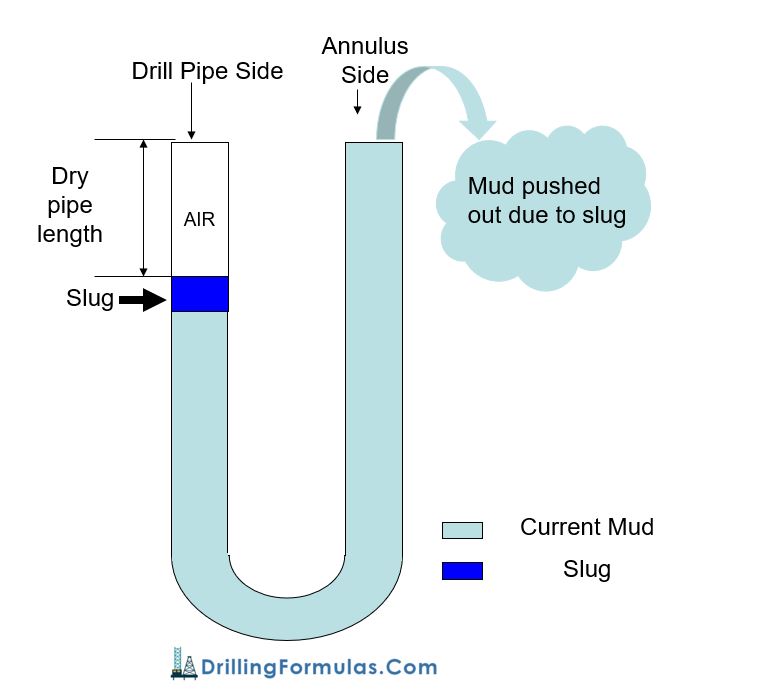
I just got the question from my junior asking me about relationship between hydrostatic pressure and U-tube. I think this might be good idea for us to review these 2 important concepts.

Referring to the figure below, the well is shut in and there are 2 gauges showing different numbers. Gauge#1 shows 600 psi and gauge#2 shows 100 psi.

Read the rest of this entry »

  • Share/Bookmark
Apr 1

I got an email from Sanan asking me about how to calculate lag time. First of all, you need to know what the lag time is.

Lag time is traveling time interval required for pumping cuttings from each particular depth to surface. It can be expressed in terms of time (minutes) and pump strokes.

The lag time always changes when a well becomes deeper and/or pumping speed change. Two factors, affecting lag time calculation, are annulus volume of drilling fluid in and drilling mud flow rate.

With certain annular volume, the lag time, normally expressed in minutes, can be determined by dividing the annular volume (bbls) by the flow rate (bbl/min).

If there are changes in mud flow rate, the lag time figure will be changed as well. In order compensate for any changes, the lag time is transformed into pump strokes too; therefore, a change in speed of pump will not affect the lag time.

How to Calculate Theoretical Lag Time

There are 3 steps to do in order to calculate lag time as listed below;

1. Calculate pump output
2. Calculate annular volume at certain depth of hole
3. Calculate the theoretical lag time

Example – Determine lag time from bottom to surface with the following information;

Bit depth = 9500’ MD
Pump rate = 300 GPM
Annular volume at 9500’ MD = 250 bbl
Pump details: Triplex pump, 97% efficiency, liner size 6” and stroke length 12”

Solution;

Triplex Pump Output Formula is listed below;

Triplex Pump Output in bbl/stk = efficiency x 0.000243 x (liner diameter in inch) 2 X (stroke length in inch)

Triplex Pump Output in bbl/stk = 0.97x 0.000243 x (6) 2 X (12)
Triplex pump output = 0.102 bbl/stroke

Pump rate = 300 GPM ÷ 42 = 7.14 bbl / minute

Lag time in minutes = 250 bbl ÷ 7.14 bbl / minute = 35 minutes
Lag time in strokes = 250 bbl ÷ 0.102 bbl/stroke = 2451 strokes

Please find the lag time calculation sheet

Ref book: Drilling Formula Book Formulas and Calculations for Drilling, Production and Workover, Second Edition

  • Share/Bookmark
Mar 19

The ton-miles of work performed in short trip operation is also in term of round trips.

The ton-miles of work done in making a short trip is equal to the difference between round ton-miles of end depth and starting depth. The formula for short trip ton-miles is listed below;

Tst = T6 – T5

Where; Tst = ton-miles for short trip
T6 = ton-miles for one round trip at the deeper depth
T5 = ton-miles for one round trip at the shallower depth

Example;

Please determine short trip ton-miles from 8000 ft to 8050 ft
Ton-miles @ 8050 ft = 200
Ton-miles @ 8000 ft = 190
Tst = (200 – 190)
Tst = 10 ton-miles

Ref book: Drilling Formula Book Formulas and Calculations for Drilling, Production and Workover, Second Edition

  • Share/Bookmark
Mar 16


For the setting casing operation, the ton-miles calculation of this operation is similar to round trip ton-miles calculation. Nevertheless, buoyed weight of the casing will be used into calculation instead of buoyed weight of drill pipe and with the result will be multiplied by 0.5, because setting casing is just only one-way operation (1/2 round trip).

Ton-miles for setting casing can be determined from the following formula:

Tc = {Wp x D x (Lcs + D) + D x Wb} x 0.5 ÷ (5280 x 2000)

Where; Tc = ton-miles setting casing
Wp = buoyed weight of casing in lb/ft
Lcs = length of one joint of casing in ft
Wb = weight of travelling block assembly in lb
D = depth of casing in ft
2000 = number of pounds in one ton
5280 = number of feet in one mile

Example: Ton-Miles for Setting Casing

Mud weight = 10.0 ppg
Casing weight = 25.0 lb/ft
Depth of casing = 5200 ft
Travelling block assembly = 95,000 lb
Length of one joint of casing = 42 ft

Solution:

a) Buoyancy factor:
BF = (65.5 – 10.0) ÷ 65.5
BF = 0.8473

b) Buoyed weight of casing in mud, lb/ft (Wp):
Wp = 25.0 lb/ft x 0.8473
Wp = 21.18 lb/ft

c) Casing ton-miles
Tc = {21.18 x 5,200 x (42 + 5,200) + 5,200 x 95,000} x 0.5 ÷ (5280 x 2000)
Tc = 50.73 tone-miles

Ton-Mile (TM) for Setting Casing Calculation Sheet

Ref book: Drilling Formula Book Formulas and Calculations for Drilling, Production and Workover, Second Edition

  • Share/Bookmark
Mar 12

For coring operation, the ton-miles calculation is also expressed in terms of work in round trip ton-miles. In order to determine the coring ton-miles, you need to figure out ton-miles for one round trip at the depth where coring stopped minus ton-miles for one round trip at the depth where coring began and the multiplied that value by 2.

The formula for calculating ton-mile for coring operation is shown below;

Tc = 2 x (T4 – T3)

Where;

Tc = ton-miles for coring operation
T4 = ton-miles for one round trip at depth where coring operation stopped before coming out of hole
T3 = ton-miles for one round trip at depth where coring get started

Example – Please determine coring ton-mils from 8000 ft to 8050 ft.

Ton-miles @ 8050 ft (end of coring operation) = 200
Ton-miles for trip @ 8000 ft (start of coring operation) = 190

Tc = 2 x (T4 – T3)
Tc = 2 x (200 – 190)
Tc = 20 ton-miles


Ton-Mile (TM) for Coring Operation Calculation Sheet

Ref book: Drilling Formula Book Formulas and Calculations for Drilling, Production and Workover, Second Edition

  • Share/Bookmark
Mar 6

Drilling or Connection ton-miles is  ton-miles of work in drilling operations. These are the actual ton-miles of work in drilling down the length of a section of drill pipe, usually around +/- 31 ft, plus picking up, connecting, and starting to drill again. In order to figure out connection or drilling ton-miles, it takes 3 times of ton-miles for current round trip minus ton-miles for previous round trip. The formula for calculating drilling ton mile is listed below;

Td = 3 x (T2 – T1)
Where;
Td = Ton-miles for drilling
T2 = Ton-miles for one round trip of last depth before coming out of hole.
T1 = Ton-miles for one round trip of first depth that drilling is started.

Example;
Please determine drilling tome-miles from 8000 ft to 9000 ft.
Ton-miles for trip @ 9000 ft = 230
Ton-miles for trip @ 8000 ft = 195
Td = 3 x (T2 – T1)
Td = 3 x (230 – 195)
Td = 3 x 35
Td = 105 ton-miles
Download the Excel sheet for calculating drilling or connection ton-mile.

Ref book: Drilling Formula Book Formulas and Calculations for Drilling, Production and Workover, Second Edition

  • Share/Bookmark

« Previous Entries