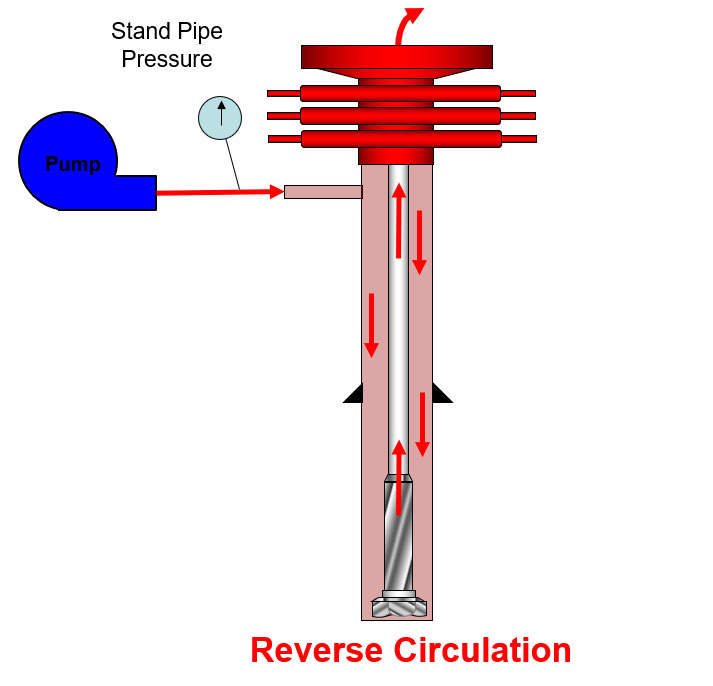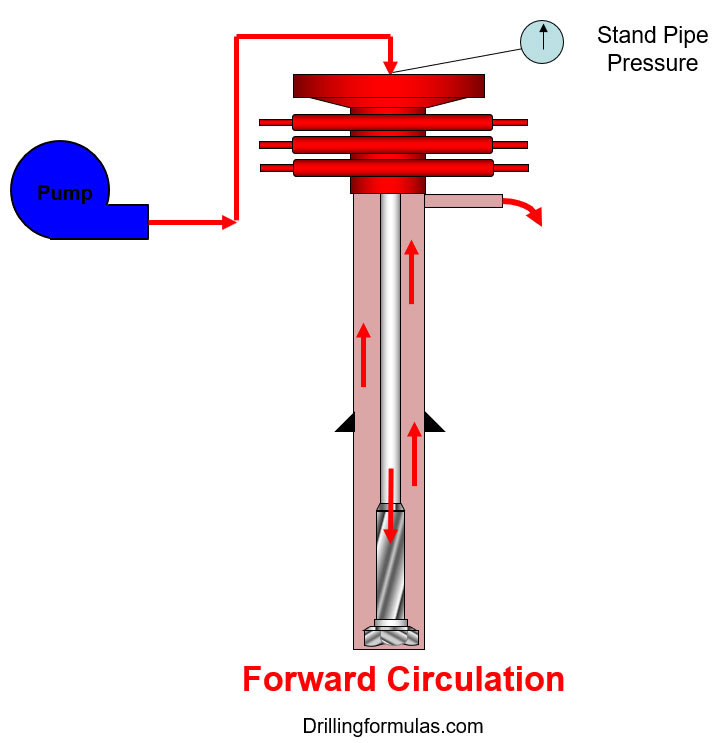
This is a an example demonstrating how bottom hole pressure will be due to gas migration in a shut in well. This is very important concept in well control.

This example will demonstrate the gas behavior in a shut in well.
The well is shut-in without pipe in hole. 5 bbl of gas kick is taken and initial shut in casing pressure is equal to 400 psi. Hydrostatic head on top of gas is 4,000 psi (see figure 1). The well is shut in and gas migrates up until where hydrostatic pressure underneath gas is 2000 psi. What will happen to bottom hole pressure and shut in pressure?
Assumptions:
- Volume not change
- No temperature change
- Formation not broken
- No must loss

Figure 1 – Well Shut In Diagram
Determine Gas Kick Pressure
Gas kick pressure at the bottom is equal to hydrostatic pressure above gas kick plus shut in pressure
Gas kick pressure = 4,000 + 400
Gas kick pressure = 4,400 psi

Figure 2 – Gas Pressure at The Bottom
Determine Bottom Hole Pressure and Shut In Pressure at The Second Condition
Even though the well is shut in, the gas influx is able to move upwards due to gas migration.
In this case, we will not allow any gas expansion and let the gas gradually migrate.
The well is shut in and gas is allowed to migrate up hole until hydrostatic pressure underneath gas is 2000 psi (see the figure 3).

Figure 3 – Gas Migrate up
What will happen to bottom hole pressure and shut in pressure?
Determine gas kick pressure – With Bolye’s Law concept, we will apply it see how much gas bubble should be.
According to this example,
Pressure of gas (P1) is 4,400 which equates to the bottom hole pressure.
Volume of gas at beginning (V1) is 5 bbl.
Volume of gas at this condition (V2) is 5 bbl (volume not change).
P1 × V1 = P2 × V2
4,400 × 5 = P2 × 5
P2 = 4,400 psi ->Gas pressure remains constant.
Determine hydrostatic pressure above kick –
Since there is no change in volume of fluid, total hydrostatic pressure remains constant. With this relationship, we can calculate hydrostatic pressure above migrated kick.
Total hydrostatic pressure = Hydrostatic pressure above kick + Hydrostatic pressure below kick
4,000 = Hydrostatic pressure above kick + 2,000
Hydrostatic pressure above kick = 2,000 psi
You have total of hydrostatic pressure of 4,000 psi at the beginning. Currently, you have 2,000 psi of hydrostatic at the bottom therefore you have 2,000 psi of hydrostatic on top of gas. See the figure 4 below.

Figure 4 – Hydrostatic Pressure above Gas Kick
Determine Shut in Pressure
Let’s see how much shut in pressure will be.
Apply hydrostatic pressure concept to solve this problem.
Gas Kick Pressure = Hydrostatic Pressure above the gas kick+ Shut in Pressure
4400 = 2000 +Shut in pressure
Shut in pressure = 2,400 psi
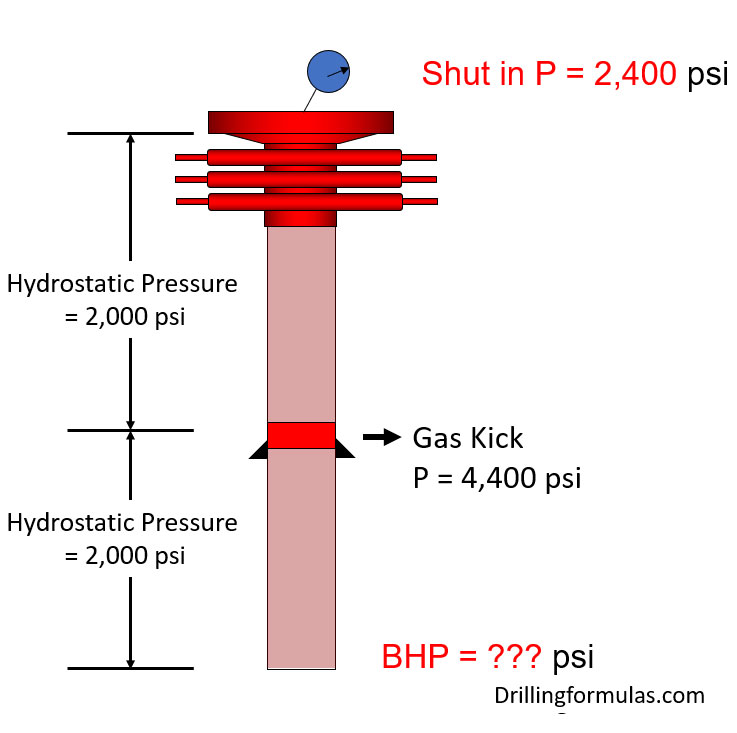
Figure 5 – Shut In Pressure
Determine Bottom Hole Pressure
Moreover, you can calculate the bottom hole pressure by applying the same concept.
Bottom Hole Pressure = Hydrostatic Pressure + Shut in Pressure
Bottom hole pressure = 4,000 + 2,400
Bottom hole pressure = 6,400 psi.

Figure 6 – New Bottom Hole Pressure
Conclusions
- If gas migrates in a shut-in well without allowing it to expand, pressures everywhere in the well will go up, except in the gas bubble it self.
- If a well is shut in and the gas influx is allowed to migrate, gas pressure will remain constant; however, bottom hole pressure and casing pressure will be increased.
- If casing pressure (surface pressure) increases too much, you can break formation or damage surface equipment.
- Surface pressure will be increased by the amount of hydrostatic pressure that gas migrates past.
- If there is no change in total hydrostatic pressure in the well, the increase in surface pressure causes a corresponding increase in bottom hole pressure.
References
Cormack, D. (2007). An introduction to well control calculations for drilling operations. 1st ed. Texas: Springer.
Crumpton, H. (2010). Well Control for Completions and Interventions. 1st ed. Texas: Gulf Publishing.
Grace, R. (2003). Blowout and well control handbook [recurso electrónico]. 1st ed. Paises Bajos: Gulf Professional Pub.
Grace, R. and Cudd, B. (1994). Advanced blowout & well control. 1st ed. Houston: Gulf Publishing Company.
Watson, D., Brittenham, T. and Moore, P. (2003). Advanced well control. 1st ed. Richardson, Tex.: Society of Petroleum Engineers.