About DrillingFormulas.Com

Working in the oil field and loving to share knowledge.

What is Primary Well Control?

Primary Well Control is hydrostatic pressure provided by drilling fluid more than formation pressure but less than fracture gradient while drilling. If hydrostatic pressure is less than reservoir pressure, reservoir fluid may influx into wellbore. This situation is called “Loss Primary Well Control”.

Not only is hydrostatic pressure more than formation pressure, but also hydrostatic pressure must not exceed fracture gradient. If mud in hole is too heavy, it will cause a broken wellbore, you will face with loss circulation problem (may be partially lost or total lost circulation). When fluid is losing into formation, mud level in well bore will be decreased that will result in reducing hydrostatic pressure. For the worst case scenario, you will lose the primary well control and wellbore influx or kick will enter into wellbore.

Typically, slightly overbalance of hydrostatic pressure over reservoir pressure is normally desired. You must keep in mind about the basic of maintaining primary well control that you must maintain hole with drilling fluid that will be heavy enough to overbalance formation pressure but not fracture formations.

References

Coleman, S. (2018). Well Control Quiz Online. [online] Well Control Quiz Online – Test Your Well Control Knowledge for Free. Available at: http://wellcontrolquiz.com/ [Accessed 2 Aug. 2018].

Cormack, D. (2007). An introduction to well control calculations for drilling operations. 1st ed. Texas: Springer.

Crumpton, H. (2010). Well Control for Completions and Interventions. 1st ed. Texas: Gulf Publishing.

Grace, R. (2003). Blowout and well control handbook [recurso electrónico]. 1st ed. Paises Bajos: Gulf Professional Pub.

Grace, R. and Cudd, B. (1994). Advanced blowout & well control. 1st ed. Houston: Gulf Publishing Company.

Watson, D., Brittenham, T. and Moore, P. (2003). Advanced well control. 1st ed. Richardson, Tex.: Society of Petroleum Engineers.
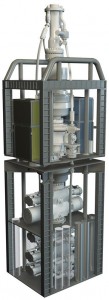
Accumulator Capacity – Usable Volume per Bottle Calculation for Subsea BOP

For subsea applications, hydrostatic pressure exerted by the hydraulic fluid must be accounted for calculation.

th_277868

In this case, we assume water depth at 1500 ft, therefore hydrostatic pressure exerted by hydraulic fluid (hydraulic fluid pressure gradient = 0.445 psi/ft) = 0.445×1500 = 668 psi. Besides of that, the concept for calculation is as same as surface accumulator. So please take a look about how to calculate usable volume per bottle as following steps.

Step 1 Adjust all pressures for the hydrostatic pressure of the hydraulic fluid:

Pre-charge pressure = 1000 psi + 668 psi = 1668 psi

Minimum system pressure = 1200 psi + 668 psi = 1868 psi

Operating pressure = 3000 psi + 668 psi = 3668 psi

Step 2 Determine hydraulic fluid required to increase pressure from pre-charge pressure to minimum system pressure:

Boyle’s Law for ideal gase: P1 V1 = P2 V2

1668 psi x 10 = 1868 x V2

16,680 ÷1,868 = V2

V2 = 8.93 gal

It means that N2 will be compressed from 10 gal to 8.93 gal in order to reach minimum operating pressure. Therefore, 1.07 gal (10.0 – 8.93 = 1.07 gal) of hydraulic fluid is used for compressing to minimum system pressure.

Step 3 Determine hydraulic required increasing pressure from pre-charge to operating pressure:

P1 V1 = P2 V2

1668 psi x 10 gal = 3668 psi x V2

16,680 ÷ 3668 = V2

V2 = 4.55 gal

It means that N2 will be compressed from 10 gal to 4.55 gal in order to reach operating pressure. Therefore, 5.45 gal (10.0 – 4.55 = 5.45 gal) of hydraulic fluid is used for compressing to operating pressure.

Step 4 Determine usable fluid volume per bottle:

Usable volume per bottle = Total hydraulic fluid/bottle – Dead hydraulic fluid/bottle

Usable volume per bottle = 5.45 – 1.07

Usable volume per bottle = 4.38 gallons

Reference book: Well Control Books

Formulas and Calculations for Drilling, Production and Workover, Second Edition

Accumulator Capacity – Usable Volume per Bottle Calculation (Surface Stack)

Accumulator (Koomey) is a unit used to hydraulically operate Rams BOP, Annular BOP, HCR and some hydraulic equipment. There are several of high pressure cylinders that store gas (in bladders) and hydraulic fluid or water under pressure for hydraulic activated systems. The primary purpose of this unit is to supply hydraulic power to the BOP stack in order to close/open BOP stack for both normal operational and emergency situation. Stored hydraulic in the system can provide hydraulic power to close BOP’s in well control operation, therefore, kick volume will be minimize. Accumulators should have sufficient volume to close/open all preventers and accumulator pressure must be maintained all time.

koomey-unit

This post you will learn how to calculate usable volume per bottle by applying Boyle’s gas law:

Use following information as guideline for calculation:

Volume per bottle = 10 gal

Pre-charge pressure = 1000 psi

Operating pressure = 3000 psi

Minimum system pressure = 1200 psi

Pressure gradient of hydraulic fluid = 0.445 psi/ft

For surface application

Step 1 Determine hydraulic fluid required to increase pressure from pre-charge pressure to minimum:

Boyle’s Law for ideal gase: P1 V1 = P2 V2

P1 V1 = P2 V2

1000 psi x 10 gal = 1200 psi x V2

10,000 ÷ 1200 = V2

V2 = 8.3 gal

It means that N2 will be compressed from 10 gal to 8.3 gal in order to reach minimum operating pressure. Therefore, 1.7 gal (10.0 – 8.3 = 1.7 gal) of hydraulic fluid is used for compressing to minimum system pressure.

Step 2 Determine hydraulic required increasing pressure from pre-charge to operating pressure:

P1 V1 = P2 V2

1000 psi x 10 gals = 3000 psi x V2

10,000 ÷3000 = V2

V2= 3.3 gal

It means that N2 will be compressed from 10 gal to 3.3 gal. Therefore, 6.7 gal (10.0 – 3.3 = 6.7 gal) of hydraulic fluid is used for compressing to operating pressure.

Step 3 Determine usable fluid volume per bottle:

Usable volume per bottle = Hydraulic used to compress fluid to operating pressure – hydraulic volume used to compress fluid to minimum pressure

Usable volume per bottle = 6.7 – 1.7

Usable volume per bottle = 5.0 gallons

Reference book: Well Control Books
Formulas and Calculations for Drilling, Production and Workover, Second Edition

Oil Field Coversion Part 3 Oil Field Conversion Part 3 – Pressure,Velocity,Volume,Weight

The last part of unit conversion is the conversion for  Pressure,Velocity, Volume and Weight specially used in the oilfield.

The RED number is the conversion unit.

Pressure

Atmospheres x 14.696 = Pounds/sq inch

Atmospheres x 1.033 = Kilograms/sq cm

Atmospheres x 101300 = Pascals

Kilograms/sq cm x 0.9678 = Atmospheres

Kilograms/sq cm x 14.223 = Pounds/sq inch

Kilograms/sq cm x 0.9678 = Atmospheres

Pounds/sq inch x 0.068 = Atmospheres

Pounds/sq inch x 0.0703 = Kilograms/sq cm

Pounds/sq inch x 0.006894 = Pascals

Velocity

Feet/sec x 0.305 = Meters/sec

Feet/mm x 0.00508 = Meters/sec

Meters/sec x 196.8 = Feet/mm

Meters/sec x 3.28 = Feet/sec

Volume

Barrels x 42 = Gallons

Cubic centimeters x 0.00003531 = Cubic feet

Cubic centimeters x 0.06102 = Cubic inches

Cubic centimeters x 0.000001 = Cubic meters

Cubic centimeters x 0.000264 = Gallons

Cubic centimeters x 0.001 = Litters

Cubic feet x 28320 = Cubic centimeters

Cubic feet x 1728 = Cubic inches

Cubic feet x 0.02832 = Cubic meters

Cubic feet x 7.48 = Gallons

Cubic feet x 28.32 = Litters

Cubic inches x 16.39 = Cubic centimeters

Cubic inches x 0.0005787 = Cubic feet

Cubic inches x 0.00001639 = Cubic meters

Cubic inches x 0.004329 = Gallons

Cubic inches x 0.01639 = Liters

Cubic meters x 1000000 = Cubic centimeters

Cubic meters x 35.31 = Cubic feet

Cubic meters x 264.2 = Gallons

Gallons x 0.0238 = Barrels

Gallons x 3785 = Cubic centimeters

Gallons x 0.1337 = Cubic feet

Gallons x 231 = Cubic inches

Gallons x 0.003785 = Cubic meters

Gallons x 3.785 = Liters

Weight

Pounds x 0.0004535 = Tons (metric)

Tons (metric) x 2205 = Pounds

Tons (metric) x 1000 = Kilograms

Ref book: Formulas and Calculations for Drilling, Production and Workover, Second Edition

Oil Field Conversion Part 2 – Length,Mud Weight,Power

The second part of unit conversion is the conversion for  Length,Mud Weight and Power specially used in the oil field.

The RED number is the conversion unit.

Length

Feet x 0.305 = Meters

Inches x 25.4 = Millimeters

Inches x 2.54 = Centimeters

Centimeters x 0.394 = Inches

Millimeters x 0.03937 = Inches

Meters x 3.281 = Feet

Mud Weight

Pounds/gallon x 7.48 = Pounds/cu ft

Pounds/gallon x 0.12 = Specific gravity

Pounds/gallon x 0.1198 = Grams/cu cm

Grams/cu cm x 8.347 = Pounds/gallon

Pounds/cu ft x 0.134 = Pounds/gallon

Specific gravity x 8.34 = Pounds/gallon

Power

Horsepower x 1.014 = Horsepower (metric)

Horsepower x 0.746 = Kilowatts

Horsepower x 550 = Foot-pounds/sec

Horsepower (metric) x 0.986 = Horsepower

Horsepower (metric) x 542.5 = Foot-pounds/sec

Kilowatts x 1.341 = Horsepower

Foot pounds/sec x 0.00181 = Horsepower

Ref book: Formulas and Calculations for Drilling, Production and Workover, Second Edition