Round trip ton-miles Calculation

All types of ton-mile service should be calculated and recorded in order to obtain a true picture of the total service received from the rotary drilling line. There are several types of ton miles as follows;

1. Round trip ton-miles
2. Drilling or “connection” ton-miles
3. Coring ton-miles
4. Ton-miles setting casing
5. Short-trip ton-miles

For this time, I will show how to calculate round trip ton-mile.

Round Trip Ton-Miles Calculation
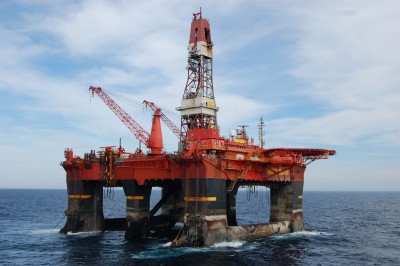
semi

The formula for round trip ton-miles is listed below;

RTTM = (Wp x D x (Lp + D) + (2 x D) x (2 x Wb + Wc)) ÷ (5280 x 2000)

where
RTTM = Round Trip Ton-Miles
Wp = buoyed weight of drill pipe in lb/ft
D = hole measured depth in ft
Lp = Average length per stand of drill pipe in ft
Wb = weight of travelling block in lb
Wc = buoyed weight of BHA (drill collar + heavy weight drill pipe + BHA) in mud minus the buoyed weight of the same length of drill pipe in lb
** If you have BHA (mud motor, MWD, etc) and HWDP, you must add those weight into calculation as well not just only drill collar weight. **
2000 = number of pounds in one ton
5280 = number of feet in one mile

Note: One ton-mile equals 10,560,000 foot- pounds, and is equivalent to lifting 2,000 pounds a distance of 5,280 feet

Example: Round trip ton-miles

Mud weight = 10.0 ppg
Average length per stand = 94 ft
Drill pipe weight = 13.3 lb/ft
Hole measure depth = 5500 ft
Drill collar length = 120 ft
Drill collar weight = 85 lb/ft
HWDP length = 49 lb/ft
HWDP weight = 450 ft
BHA weight from directional driller = 8,300 lb
BHA length = 94 ft
Travelling block assembly = 95,000 lb

Solution:

a) Buoyancy factor:
BF = (65.5 – 10.0) ÷ 65.5
BF = 0.847

b) Buoyed weight of drill pipe in mud, lb/ft (Wp):
Wp = 13.3 lb/ft x 0.847
Wp = 11.27 lb/ft

c) buoyed weight of BHA (drill collar + heavy weight drill pipe + BHA) in mud minus the buoyed weight of the same length of drill pipe in lb (Wc):

Wc = {[(120×85) + (49×450) + (8300)] x 0.847} – [(120+450+94) x13.3x 0.847]
Wc = 26,866 lb

Round trip ton-miles = [(11.27 x 5500 x (94+ 5500)) + (2 x 5500) x (2 x 95000 + 26,866)] ÷ (5280 x 2000)
RTTM = 258.75 ton-mile

Please find the excel sheet for round trip ton-miles calculation via click this link.
Ref book: Formulas and Calculations for Drilling, Production and Workover, Second Edition
Accumulator Capacity – Usable Volume per Bottle Calculation for Subsea BOP

For subsea applications, hydrostatic pressure exerted by the hydraulic fluid must be accounted for calculation.

th_277868

In this case, we assume water depth at 1500 ft, therefore hydrostatic pressure exerted by hydraulic fluid (hydraulic fluid pressure gradient = 0.445 psi/ft) = 0.445×1500 = 668 psi. Besides of that, the concept for calculation is as same as surface accumulator. So please take a look about how to calculate usable volume per bottle as following steps.

Step 1 Adjust all pressures for the hydrostatic pressure of the hydraulic fluid:

Pre-charge pressure = 1000 psi + 668 psi = 1668 psi

Minimum system pressure = 1200 psi + 668 psi = 1868 psi

Operating pressure = 3000 psi + 668 psi = 3668 psi

Step 2 Determine hydraulic fluid required to increase pressure from pre-charge pressure to minimum system pressure:

Boyle’s Law for ideal gase: P1 V1 = P2 V2

1668 psi x 10 = 1868 x V2

16,680 ÷1,868 = V2

V2 = 8.93 gal

It means that N2 will be compressed from 10 gal to 8.93 gal in order to reach minimum operating pressure. Therefore, 1.07 gal (10.0 – 8.93 = 1.07 gal) of hydraulic fluid is used for compressing to minimum system pressure.

Step 3 Determine hydraulic required increasing pressure from pre-charge to operating pressure:

P1 V1 = P2 V2

1668 psi x 10 gal = 3668 psi x V2

16,680 ÷ 3668 = V2

V2 = 4.55 gal

It means that N2 will be compressed from 10 gal to 4.55 gal in order to reach operating pressure. Therefore, 5.45 gal (10.0 – 4.55 = 5.45 gal) of hydraulic fluid is used for compressing to operating pressure.

Step 4 Determine usable fluid volume per bottle:

Usable volume per bottle = Total hydraulic fluid/bottle – Dead hydraulic fluid/bottle

Usable volume per bottle = 5.45 – 1.07

Usable volume per bottle = 4.38 gallons

Reference book: Well Control Books

Formulas and Calculations for Drilling, Production and Workover, Second Edition

Accumulator Capacity – Usable Volume per Bottle Calculation (Surface Stack)

Accumulator (Koomey) is a unit used to hydraulically operate Rams BOP, Annular BOP, HCR and some hydraulic equipment. There are several of high pressure cylinders that store gas (in bladders) and hydraulic fluid or water under pressure for hydraulic activated systems. The primary purpose of this unit is to supply hydraulic power to the BOP stack in order to close/open BOP stack for both normal operational and emergency situation. Stored hydraulic in the system can provide hydraulic power to close BOP’s in well control operation, therefore, kick volume will be minimize. Accumulators should have sufficient volume to close/open all preventers and accumulator pressure must be maintained all time.

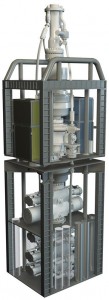
koomey-unit

This post you will learn how to calculate usable volume per bottle by applying Boyle’s gas law:

Use following information as guideline for calculation:

Volume per bottle = 10 gal

Pre-charge pressure = 1000 psi

Operating pressure = 3000 psi

Minimum system pressure = 1200 psi

Pressure gradient of hydraulic fluid = 0.445 psi/ft

For surface application

Step 1 Determine hydraulic fluid required to increase pressure from pre-charge pressure to minimum:

Boyle’s Law for ideal gase: P1 V1 = P2 V2

P1 V1 = P2 V2

1000 psi x 10 gal = 1200 psi x V2

10,000 ÷ 1200 = V2

V2 = 8.3 gal

It means that N2 will be compressed from 10 gal to 8.3 gal in order to reach minimum operating pressure. Therefore, 1.7 gal (10.0 – 8.3 = 1.7 gal) of hydraulic fluid is used for compressing to minimum system pressure.

Step 2 Determine hydraulic required increasing pressure from pre-charge to operating pressure:

P1 V1 = P2 V2

1000 psi x 10 gals = 3000 psi x V2

10,000 ÷3000 = V2

V2= 3.3 gal

It means that N2 will be compressed from 10 gal to 3.3 gal. Therefore, 6.7 gal (10.0 – 3.3 = 6.7 gal) of hydraulic fluid is used for compressing to operating pressure.

Step 3 Determine usable fluid volume per bottle:

Usable volume per bottle = Hydraulic used to compress fluid to operating pressure – hydraulic volume used to compress fluid to minimum pressure

Usable volume per bottle = 6.7 – 1.7

Usable volume per bottle = 5.0 gallons

Reference book: Well Control Books
Formulas and Calculations for Drilling, Production and Workover, Second Edition
Understand Hydrostatic Pressure

In a well, any pressure created by a static column of fluid is called ‘Hydrostatic Pressure’ (HP); at any given True Vertical Depth (TVD). With ‘hydro’ representing water, which exerts pressure, ‘static’ means it has no movement. Any pressure developed by a column of fluid that isn’t moving, therefore, can be considered hydrostatic pressure; fluid in this sense can be either liquid or gas.

The relationship of hydrostatic pressure is shown in the equation below.

HP (Hydrostatic Pressure) = density x g (gravity acceleration) x h (True Vertical Depth, TVD)

In oilfield term, the formula above is modified so that people can use it easily. The formulas are as follows:

HP (Hydrostatic Pressure) = Constant x MW (Mud Weight or Mud Density)  x TVD (True Vertical Depth)

HP (psi)  = 0.052 x MW (ppg) x TVD (ft) ** Most frequent used in the oilfield **

HP (psi) = 0.007 x MW (pcf) x TVD (ft)

HP (kPa) = 0.00981 x MW (kg/m3) x TVD (m)

Depending on which unit is used for calculation, there are several conversion factors such as 0.052, 0.007, 0.00981 for instant as you can see from the equations above.

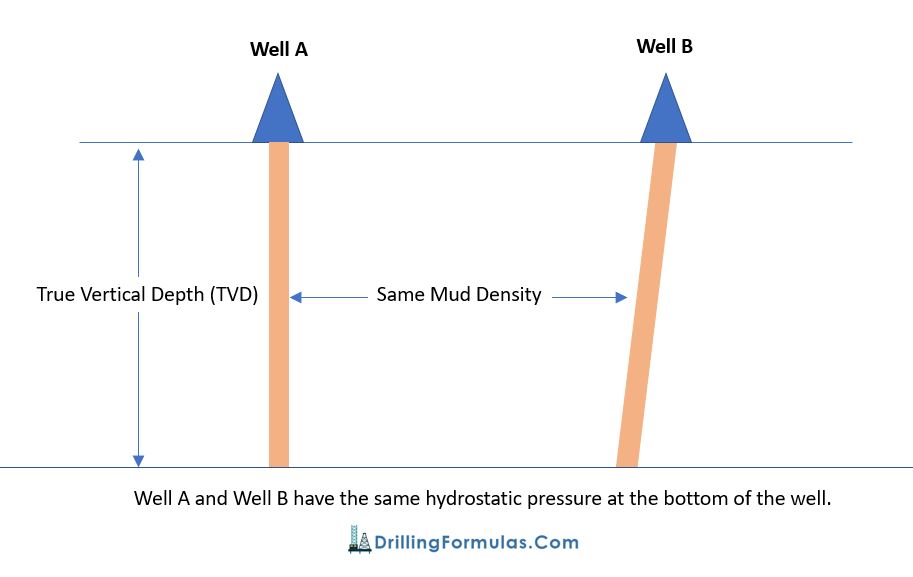
According to the equations above, Hydrostatic Pressure is not a function of hole geometry. Only mud weight and True Vertical Depth (TVD) affect on Hydrostatic Pressure. For example (a picture below); well A and well B have the same vertical depth. With the same mud density in hole, the bottom hole pressure due to hydrostatic pressure is the same. The only different between Well A and Well B is mud volume.

This concept is basic and very important for many aspects such as well control, balance cementing, u-tube, etc.

You can learn more about hydrostatic pressure calculation from the following article – Hydrostatic Pressure Calculation

Pressure in a well

In a static condition

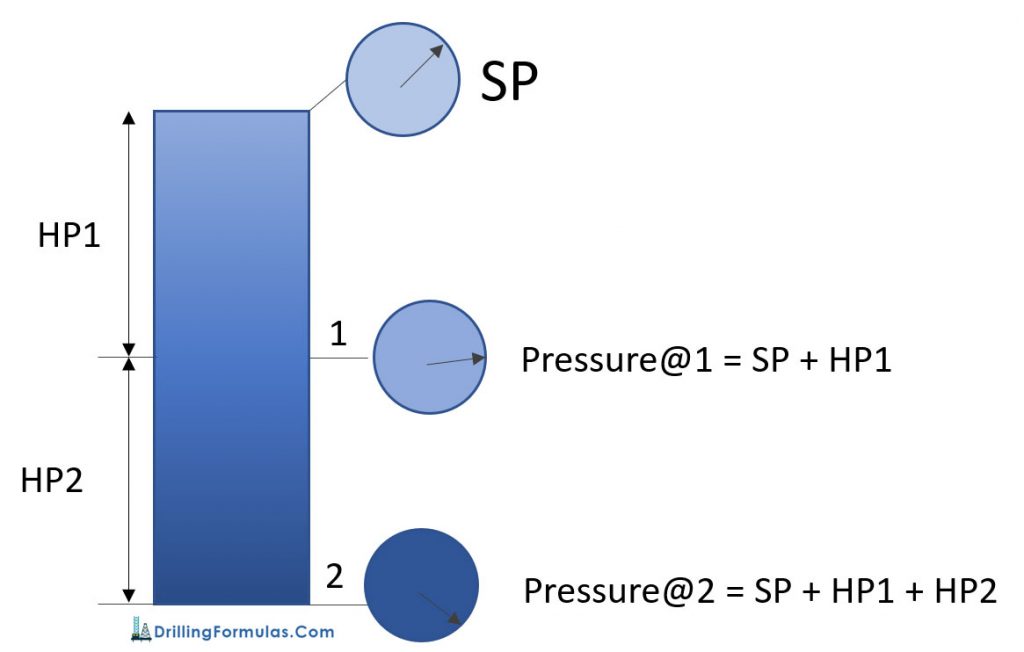
  • Pressure at any depth = Hydrostatic Pressure (HP) + Surface Pressure (SP)
  • Pressure between 2 points is HP between these points

The diagram below demonstrates the relationship of pressure in a well.

At point 1, Pressure@1 = Surface Pressure (SP) + Hydrostatic Pressure @ 1 (HP1)

At point 1, Pressure@2 = Surface Pressure (SP) + Hydrostatic Pressure@1 (HP1) + Hydrostatic Pressure@2 (HP2)

Ref books: 

Lapeyrouse, N.J., 2002. Formulas and calculations for drilling, production and workover, Boston: Gulf Professional publishing.

Bourgoyne, A.J.T., Chenevert , M.E. & Millheim, K.K., 1986. SPE Textbook Series, Volume 2: Applied Drilling Engineering, Society of Petroleum Engineers.

Mitchell, R.F., Miska, S. & Aadny, B.S., 2011. Fundamentals of drilling engineering, Richardson, TX: Society of Petroleum Engineers.

Corrected D exponent

The original “d” exponent is good for constant mud weight but in reality several drilling operations drill with various mud weights in hole due to weight up. In order to account for mud weight variation, so modification of d exponent, called “corrected d exponent”, has been made to correct for mud weight changes.

The corrected d-exponent is listed below.

dc = log (R ÷ 60N) ÷ log (12W ÷ 1000D) x (MW1 ÷ MW2)

Where;

dc = corrected “d” exponent

R = penetration rate in feet per hour

d = exponent in drilling equation, dimensionless

N = rotary speed in rpm

W = weight on bit in kilo pound

D = bit size in inch

MW1 = initial mud weight in ppg

MW2 = actual mud weight in ppg


Example: Determine the corrected d-exponent from following information.

Rate of penetration (R) = 90 ft/hr

Rotary drilling speed (N) = 110 rpm

Weight on bit (W) = 20 klb

Bit Diameter (D) = 8.5 in

MW1 = 9.0 ppg

MW2 = 12.0 ppg

Solution: dc = log [90÷ (60 x 110)] ÷ log [(12 x 20) ÷ (1000 x 8.5)] x (9.0 ÷ 12.0)

dc = 1.20 x 0.75

dc = 0.9

** Please remember that single d exponent or corrected d exponent valve does not help identify abnormal pressure. The trend of d exponent will help drilling personnel detect high formation pressure zones while drilling.

Please find the excel sheet for calculating the corrected D Exponent

Ref book: Formulas and Calculations for Drilling, Production and Workover, Second Edition