Determine the actual gas migration rate

You have learned how to estimate the gas migration rate. Today, I would like to show you how to figure out the actual gas migration rate after you shut the well in due to well control.
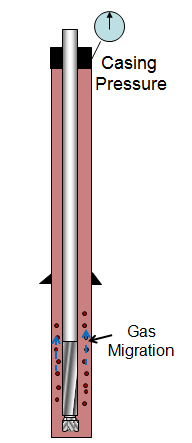
The concept of this topic is to measure the pressure increment in a hour and divided by gradient of mud weight that you have in the well.

Let’s look at the formula:

Actual gas migration rate = Increase in casing pressure ÷ Pressure gradient of drilling mud

Where;

Actual gas migration rate in ft/hr

Increase in casing pressure in psi/hr

Pressure gradient of drilling mud in psi/ft

Let’s try to determine the actual gas migration rate with this following information:

Initial shut in casing pressure = 450 psi

Shut in casing pressure after half an hour shut in = 650 psi

Current mud weight = 12.5 ppg

Solution:

Pressure increase in half an hour = 650 – 450 = 200 psi

It means that pressure increase in an hour is 400 psi. Therefore, you get the increase in casing pressure = 400 psi/hr.

You need to calculate your mud weight in to ppg with this formula:

Mud gradient = 0.052 x mud weight

Mud gradient = 0.052 x 12.5 = 0.65 psi/ft

Note: you can read more about it via this link: how to convert mud weight to pressure gradient.

Actual gas migration rate = 400 (psi/hr) ÷ 0.65 (psi/ft) = 616 ft/hr

References

Cormack, D. (2007). An introduction to well control calculations for drilling operations. 1st ed. Texas: Springer.

Crumpton, H. (2010). Well Control for Completions and Interventions. 1st ed. Texas: Gulf Publishing.

Estimate gas migration rate in a shut in well

Migration is natural behavior of gas. It means that when you shut the well in, gas will migrate from bottom to top of the well.

We can estimate the gas migration rate in a shut-in well with this following equation.

Continue reading

Estimate Type of Influx (kick)

From the previous topic, estimate Height of Influx, you can use influx height to estimate type of influx.

The following equation is used for estimating type of influx:

Note: You can prove the equation by using the U-tube concept.

Where;

Influx weight in ppg

Current mud weight in ppg

SICP stands for Shut In Casing Pressure in psi.

SIDPP stands for Shut In Drill Pipe Pressure in psi.

Influx height in ft

Continue reading

Bottom hole pressure change while performing well control operation with driller’s method

In the first circulation of driller’s method, driller circulates gas kick with 25 spm and the initial circulating pressure (ICP) is 1600 psi. The initial shut in drill pipe pressure is 450 psi. After shift change, another driller accidentally changes pump rate to 30 spm but he still holds drill pipe pressure constant.

What will happen to bottom hole pressure?

Continue reading

Kick Tolerance Calculation

This post will teach you how to calculate kick tolerance. This concept is very important to well design and will give you an idea how much kick you can take at particular parameters.

Firstly, I would like to be clear about the following terms;

Kick tolerance is the maximum gas influx volumes (bbl) for a designed kick intensity that can be successfully shut the well in and circulated out without breaking formation pressure at the casing shoe.

Kick intensity is the different between the maximum anticipated formation pressure and planned mud weight.

Secondly, learn how to determin kick tolerance by following steps below:

Continue reading