Type of Flow in Drilling Hydraulics

Flow of drilling fluids can be classified into one of three phases which are laminar, transition and turbulent flow.

Laminar Flow
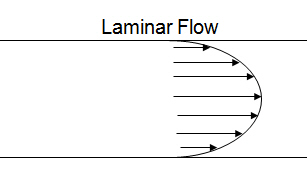
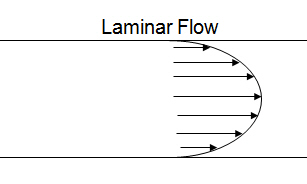
Laminar flow, sometimes known as streamline flow, occurs when a fluid flows in parallel layers, with no disruption between the layers. At low velocities the fluid tends to flow without lateral mixing, and adjacent layers slide past one another like playing cards. There are no cross currents perpendicular to the direction of flow, nor eddies or swirls of fluids. In laminar flow the motion of the particles of fluid is very orderly with all particles moving in straight lines parallel to the pipe walls.

Transition Flow

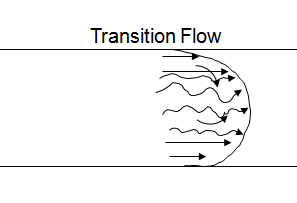
Transitional flow exhibits characteristics of both laminar and turbulent flow. The edges of the fluid flow in a laminar state, while the center of the flow remains turbulent. Like turbulent flows, transitional flows are difficult, if not impossible, to accurately measure.
Continue reading

Flow Regime and Critical Reynolds Number for Drilling Hydraulics

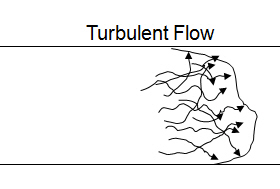
Drilling fluid has three flow regimes which are laminar, transition or turbulent flow. The following illustrations demonstrate three types of flow

In 1883 when Mr Osborne Reynolds did the fluid study, he discovered Reynolds number describing flow of water in a circular pipe. From his experiment, the turbulent flow starts at the Reynolds Number of 2,000 and the complete turbulent flow occurs at the Reynolds Number of 4,000. Therefore, when the calculated Reynolds number of fluid is between 2,000 and 4,000, the transition flow is called.

Continue reading

Reynold Number for Drilling Hydraulics

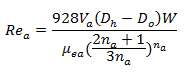
Reynold number is the important figure because it demonstrates the flow regimes of drilling mud as laminar, transition or turbulent flow in annulus of the wellbore. In order to correctly calculate the Reynolds number, you need to use the effective viscosity, µea, which we already discuss about it from the previous topic.

The following equation is for Reynolds number in the annulus.

Where:

Rea = Reynold Number in the annulus

Va = Annular velocity, ft/min

Dh = Diameter of wellbore, inch

Do = Outside Diameter of tubular, inch

W = mud weight, ppg

µea = effective viscosity in the annulus, centi-poise

na = power law constant

Continue reading

Stuck Pipe Prevention Book Kindle Version from Drillingformuls.com

We have create a kindle book in the topic of “Stuck Pipe Prevention“. Please click at the image below to buy the book.

Stuck Pipe is one of major problem in drilling operations and every day people spent a lot of money and resource due to this problem. Therefore, this book is created to help personnel in the drilling field mitigate this problem.

The Stuck Pipe Prevention book contains 3 major categories of stuck pipe which divide into 19 sub categories of stuck pipe. In each stuck pipe topic, readers will lean the root cause of stuck pipe, warning signs, indications, what personnel should do to free the stuck pipe and learn how to prevent the stuck pipe situation. The book is written in simple language so learners can understand everything clearly. Additionally, there are a lot of illustrations assisting readers to easily learn the content.

The contents in the book are as follows:

  • Definition of Stuck Pipe
  • Stuck Pipe Categories
  • Stuck Pipe Caused by Pack off and Bridging
  • Cutting Settling in a Vertical or Near Vertical Wellbore Causes Stuck Pipe
  • Cutting Settling in deviated wells Cause Stuck Pipe
  • Shale Instability Causes Stuck Pipe
  • Unconsolidated Formation Causes Stuck Pipe
  • Fractured Formation Causes Stuck Pipe
  • Cement Blocks Causes Stuck Pipe
  • Soft Cement Causes Stuck Pipe
  • Junk Causes Stuck Pipe
  • How to Free Stuck Pipe Caused by Pack off / Bridging
  • Stuck Pipe Caused By Differential Sticking
  • How To Free Stuck Pipe Caused By Differential Sticking
  • Stuck Pipe Caused By Wellbore Geometry
  • Stiff BHA Causes Stuck Pipe
  • Key Seat Causes Stuck Pipe
  • Micro Dogleg Causes Stuck Pipe
  • Ledges Cause Stuck Pipe
  • Mobile Formation Causes Stuck Pipe
  • Undergauge Hole Causes Stuck Pipe
  • Hydro-Pressured Shale Causes Stuck Pipe
  • Geo-Pressured Shale Causes Stuck Pipe
  • Overburden Stress Shale Causes Stuck Pipe
  • Tectonic Stress Causes Stuck Pipe
  • Unconsolidated Formation Causes Stuck Pipe
  • How To Free Stuck Pipe Caused By Wellbore Geometry
  • How To Determine Stuck Depth
  • First Method of Stuck Depth Calculation
  • Second Method of Stuck Depth Calculation


Effective Viscosity Calculation

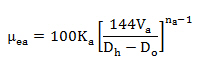
The viscosity of drilling mud will change with a change in the shear rate because in some degree drilling fluids are shear-thinning. Because of its nature of drilling mud, people create the new term of viscosity called “Effective Viscosity” to compensate the change in shear rate of viscosity. By definition, the effective viscosity means the viscosity of Newtonian fluid that gives the same shear stress at the same shear rate.

The following equation is the effective viscosity equation.


Continue reading