


Thanks for Al.K. for sharing the BOP drawing template which might be advantageous for you all.
This template was created by Benny Mason.
Valves and BOP component.

Riser, RAMs BOP, Annular Preventer, Spool

BOP stack, Small BOP for wireline and riser

Thanks for Al.K. for sharing the BOP drawing template which might be advantageous for you all.
This template was created by Benny Mason.
Valves and BOP component.
Riser, RAMs BOP, Annular Preventer, Spool
BOP stack, Small BOP for wireline and riser
I’ve got some pictures of the Rig 325 in Mexico. I don’t know much details about it and it looks like the TDS hits the crown.
I wish those following images would help our people in the drilling industry raise the safe work practice awarness.


This topic will demonstrate how to determine optimum drilling flow rate for both drilling hydraulic optimization methods (the maximum hydraulic horse power and the maximum impact force). If you don’t know the equations, please read this article first, Determine Optimum Drilling Flow Rate for Basic System – Drilling Hydraulics.
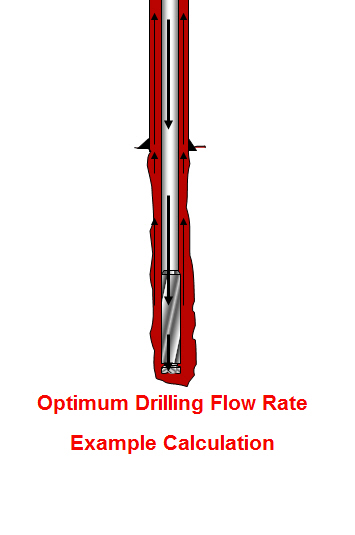
The information is listed below:
Hole size = 8.5 inch
Depth In = 2,000 ft
Depth out = 6,000 ft
Mud properties at starting point
Mud weight = 9.2 ppg
PV = 13
YP = 10
From the previous post (total pressure loss excluding the bit), we know the equation (shown below)

We can solve the equation to get the flow rate (Q) that match with optimization criteria (Maximum Hydraulic Horsepower or Maximum Impact Force)
Maximum Hydraulic Horsepower will be happened when the pressure drop across the bit is equal to 65% of total pressure loss; therefore, 35% of total pressure loss (Ps) occurs through the drill stem (Po). The equation will be like this Po = 0.35 x Ps. By substituting Po with 0.35Ps into the Equation#1, you can solve for the optimum flow rate which will give you the maximum hydraulic horsepower.

Solve for Q

Maximum Impact Force can be obtained when 48% of total pressure loss is at the bit so 52% of total pressure loss (Ps) occurs through the drill stem (Po). Substituting 52% of Ps into the Equation#1 will allow you to get the optimum flow rate at maximum impact force.

Solve for Q

We’ve learned several calculations regarding pressure loss in the drilling system and today, we will combine all knowledge together so we will get the total pressure loss in the system excluding the bit.
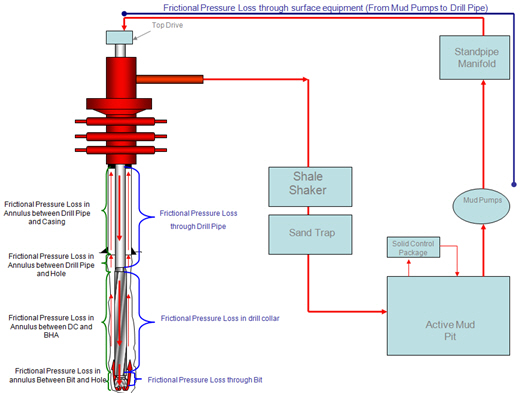
Without downhole tool, the total pressure loss without bit is equal to summation of pressure loss at the surface equipment, pressure loss through drill string (drillpipe and drill collar) and pressure loss in the annulus.
The equation below demonstrates the system pressure loss excluding the bit:

