Adjusted maximum allowable shut-in casing pressure

You calculate the maximum initial shut-in casing pressure (MISICP) based on the original mud weight before you start drilling ahead. Once you drill deeper, you may increase mud weight. With new mud weight, you are not able to use the MASICP calculated by the initial weight because higher mud weight will reduce the MASCIP. The formula below demonstrates you how to adjust the MASICP with new mud weight.

Adjusted MASICP = Leak off pressure – [Shoe TVD x (MW2 – MW1)] x 0.052

Continue reading

Determine the actual gas migration rate

You have learned how to estimate the gas migration rate. Today, I would like to show you how to figure out the actual gas migration rate after you shut the well in due to well control.

The concept of this topic is to measure the pressure increment in a hour and divided by gradient of mud weight that you have in the well.

Let’s look at the formula:

Actual gas migration rate = Increase in casing pressure ÷ Pressure gradient of drilling mud

Where;

Actual gas migration rate in ft/hr

Increase in casing pressure in psi/hr

Pressure gradient of drilling mud in psi/ft

Let’s try to determine the actual gas migration rate with this following information:

Initial shut in casing pressure = 450 psi

Shut in casing pressure after half an hour shut in = 650 psi

Current mud weight = 12.5 ppg

Solution:

Pressure increase in half an hour = 650 – 450 = 200 psi

It means that pressure increase in an hour is 400 psi. Therefore, you get the increase in casing pressure = 400 psi/hr.

You need to calculate your mud weight in to ppg with this formula:

Mud gradient = 0.052 x mud weight

Mud gradient = 0.052 x 12.5 = 0.65 psi/ft

Note: you can read more about it via this link: how to convert mud weight to pressure gradient.

Actual gas migration rate = 400 (psi/hr) ÷ 0.65 (psi/ft) = 616 ft/hr

References

Cormack, D. (2007). An introduction to well control calculations for drilling operations. 1st ed. Texas: Springer.

Crumpton, H. (2010). Well Control for Completions and Interventions. 1st ed. Texas: Gulf Publishing.

Estimate gas migration rate in a shut in well

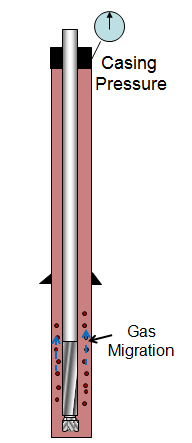
Migration is natural behavior of gas. It means that when you shut the well in, gas will migrate from bottom to top of the well.

We can estimate the gas migration rate in a shut-in well with this following equation.

Continue reading

Free Drilling Formulas Spread Sheet Will be Launched Next Week

I said about drilling formula software few weeks ago but my friend and I had limited time to write software. Therefore, we decide that we will give drilling formula in Excel spread sheet for FREE instead of software.

The advantages of Excel sheets over the general software are as follows:

• People can use it easily without any installation required and most of computers have MS Excel or Office program that can run the files. Moreover, some people may face the hassle because their company computes will not allow any installation.

• It is easy ways for us to update the Excel spread sheet and deliver to you.

Currently, we are trying to integrate useful drilling formulas from drillingformulas.com into the Excel file. And we expect that the drilling formula spread sheet will be launched on Monday, 28 March 2011. Everything is FREE and hopefully our file will help you and your work.
If you don’t’ want to miss our FREE and useful drilling formula spread sheet, please LIKE us on our facebook.

Click Here!!!

The following formulas will be in the Drilling Formula Excel sheet.
Continue reading

Total Flow Area (TFA)

Total Flow Area (TFA) is summation of nozzle areas which fluid can pass through a bit. When you consider about the TFA, you need to count all nozzles that you have in a bit or a reamer.

Basically, you can determine flow area with a simple circle area formula.

Flow Area = (π × D2) ÷ 4

Where;

Area in square inch

π is a constant which approximately equates to 3.14159.

D is diameter in inch

Let’s make it easier for our life. Normally, a diameter of nozzle is reported in xx/32 inch. For example, a bit has 3 nozzles and each one of them has size of 20/32 inch.

The formula above can be simplified like this.

Oilfield Unit

Flow Area = N2 ÷ 1303.8

Where;

Flow Area for each nozzle in square inch

N is nozzle size in number/32 inch.

In order to find the total flow area of each bit or reamer, you must add all area of each nozzle.

Example

The bit that has a total of 5 nozzles. Three nozzles have a diameter of 10/32 inch and other 2 nozzles are 12/32 inch diameter.

Determine the total flow area (TFA) of the bit.

By the definition, you must sum every nozzle together in order to get the TFA; therefore, you can apply the formula above into this form.

Total Flow Area = (102 + 102 + 102 + 122 + 122 )÷ 1303.8

Total flow area = 0.451 square inch

Metric Unit

Flow Area = N2 × π ÷  4

Where;

Flow Area for each nozzle in square millimeter 

N is nozzle size in millimeter .

Example

The bit that has a total of 5 nozzles. Three nozzles have a diameter of 7.94 mm and other 2 nozzles are 9.53 mm diameter.

Determine the total flow area (TFA) of the bit.

Total Flow Area = (7.942 + 7.942 + 7.942 + 9.532 + 9.53 2 ) × π ÷  4

Total flow area =  291 square mm

Download Excel Spreadsheet for Total Flow Area Table in both oilfield and metric unit.

Ref books: 

Lapeyrouse, N.J., 2002. Formulas and calculations for drilling, production and workover, Boston: Gulf Professional publishing.

Bourgoyne, A.J.T., Chenevert , M.E. & Millheim, K.K., 1986. SPE Textbook Series, Volume 2: Applied Drilling Engineering, Society of Petroleum Engineers.

Mitchell, R.F., Miska, S. & Aadny, B.S., 2011. Fundamentals of drilling engineering, Richardson, TX: Society of Petroleum Engineers.