Equivalent Circulating Density (ECD) in both Oilfield and Metric Unit

Equivalent Circulating Density (ECD) is the effective density that combines current mud density and annular pressure drop. ECD is vital for drilling engineering since it limits how depth of each section to be drilled and leads to losses.

The equivalent circulating density formula is shown below;

Oilfield Unit

Equivalent Circulating Density (ECD) = (Annular Pressure Loss ÷ 0.052 ÷ True Vertical Depth (TVD)) + (Current Mud Weight)

Equivalent Circulating Density (ECD) in ppg

Annular Pressure Loss in psi

True Vertical Depth (TVD) in ft

Current Mud Weight in pppg

Example:

Annular pressure loss = 400 psi
True Vertical Depth = 8,000 ft
Current mud weight in ppg = 10 ppg

ECD in ppg =   (400 psi ÷ 0.052 ÷ 8,000 ft) +10.0 ppg 

ECD = 11.0 ppg

Metric Unit

Equivalent Circulating Density (ECD) = (Annular Pressure Loss × 1000 ÷ 9.81÷ True Vertical Depth (TVD) ) + (Current Mud Weight)

Equivalent Circulating Density (ECD) in kg/m3

Annular Pressure Loss in KPa

True Vertical Depth (TVD) in m

Current Mud Weight in kg/m3

Example:

Annular pressure loss = 2760 KPa
True Vertical Depth = 2,440 m
Current mud weight in ppg = 1200  kg/m3

ECD in ppg =  (2,760 Kpa  × 1000 ÷ 9.81÷ 2,440 m )  + 1,200 kg/m3

ECD = 1,315 kg/m3

Please find the Excel sheet to calculate Equivalent Circulating Density (ECD) 

https://www.drillingformulas.com/wp-content/uploads/2009/04/7.Equivalent-Circulating-Density.xlsx

Ref books: 

Lapeyrouse, N.J., 2002. Formulas and calculations for drilling, production and workover, Boston: Gulf Professional publishing.

Bourgoyne, A.J.T., Chenevert , M.E. & Millheim, K.K., 1986. SPE Textbook Series, Volume 2: Applied Drilling Engineering, Society of Petroleum Engineers.

Mitchell, R.F., Miska, S. & Aadny, B.S., 2011. Fundamentals of drilling engineering, Richardson, TX: Society of Petroleum Engineer

Annular Velocity (AV) Calculation

Annular Velocity (AV) is how fast of fluid flow in  the annulus while pumping.
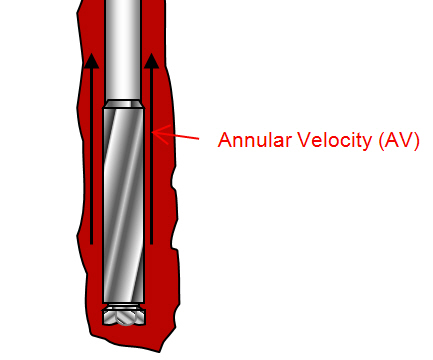
Three main factors affecting annular velocity are size of hole (bigger ID), size of drill pipe (smaller OD) and pump rate. This post will show you how to calculate annular velocity in feet per minute with different formulas.

Annular Velocity Formula

Oilfield Unit

Formula#1: Annular velocity (AV) in ft/min


Annular velocity = Flow Rate÷ Annular Capacity 

where;

Annular velocity in ft/min

Flow rate in bbl/min

Annular capacity in bbl/ft

Example:
Flow rate = 10 bbl/min
Annular capacity = 0.13 bbl/ft
AV = 10 bbl/min ÷ 0.13 bbl/ft
AV = 76.92 ft/min

Formula#2: Annular velocity (AV) in ft/min

Annular velocity = (24.5 × Flow Rate) ÷ (Dh2 – Dp2)

where;
Annular velocity in ft/min
Flow Rate in gpm
Dh = inside diameter of casing or hole size in inch
Dp = outside diameter of pipe, tubing or collars in inch

Example:
Flow rate = 800 gpm
Hole size = 10 in.
Drill pipe OD = 5 in.
AV = (24.5 × 800) ÷ (102 – 52)
AV = 261 ft/mim

Formula#3: Annular velocity (AV) in ft/min

Annular Velocity  = Flow Rate × 1029.4÷ (Dh2 – Dp2)

Where;
Annular Velocity in ft/min
Flow Rate in bbl/min

Example:
Flow rate = 13 bbl/min
Hole size = 10 in.
Drill pipe OD = 5 in.
Annular Velocity = 13 bbl/min × 1029.4 ÷ (102 – 52)
Annular Velocity = 178.43 ft/min

Metric Unit

Formula#1: Annular velocity (AV) in m/min


Annular velocity = Flow Rate÷ Annular Capacity 

where;
Annular velocity in m/min
Flow rate in liters/min
Annular capacity in liters/m

Example:
Flow rate = 1600 liters/min
Annular capacity = 68 liters/m
Annular Velocity = 1600 liters/min÷ 68 liters/m
Annular Velocity = 23.5 m/min

Formula#2: Annular velocity (AV) in m/min

Annular velocity = (4000× Flow Rate) ÷ (π×(Dh2 – Dp2))

where;
Annular velocity in m/min
Flow Rate in liters/min
Dh = inside diameter of casing or hole size in mm
Dp = outside diameter of pipe, tubing or collars in mm

Example:
Flow rate = 3000 liters/min
Hole size = 254 mm
Drill pipe OD = 127 mm
Annular Velocity = (4000 × 3000) ÷ (π×(2542 – 1272))
Annular Velocity = 78.9 m/min

Formula#3: Annular velocity (AV) in m/min

Annular Velocity  = (Flow Rate × 4 ×10⁶ ) ÷ (π×(Dh2 – Dp2))

Where;
Annular Velocity in m/min
Flow Rate in m³/min
Dh = inside diameter of casing or hole size in mm
Dp = outside diameter of pipe, tubing or collars in mm

Example:
Flow rate = 2 m³/min
Hole size = 254 mm
Drill pipe OD = 127 mm
AV = (2 m³/min 4 ×10⁶ ) ÷ (π×(102 – 52))
AV = 52.6 m/min

Flow Rate to Achieve Require Annular Velocity 

Oilfield Unit

Flow rate required in gpm = (Annular Velocity ) × (Dh2 – DP2) ÷ 24.5

Where;
Flow rate in gpm
Annular Velocity in ft/min
Dh = inside diameter of casing or hole size in inch
Dp = outside diameter of pipe, tubing or collars in inch

Example:
Desired annular velocity = 120 ft/mm
Hole size = 10 in
Drill pipe OD = 5 in.
Flow rate required in gpm = 120 × (102– 52) ÷ 24.5
Flow rate required in gpm = 367.4 gpm

Metric Unit

Flow rate required in gpm = (Annular Velocity × π) × (Dh2 – DP2) ÷ 4000

Where;
Flow rate in liters/min
Annular Velocity in m/min
Dh = inside diameter of casing or hole size in mm
Dp = outside diameter of pipe, tubing or collars in mm

Example:
Desired annular velocity = 37 m/min
Hole size = 254 mm
Drill pipe OD = 127 mm
Flow rate required  = (37 × π) × (2542– 1272) ÷ 4,000
Flow rate required  = 1,406 liters/min

Stroke per Minute to Achieve Require Annular Velocity 

Oilfield Unit

SPM = (Annular Velocity × Annular Capacity) ÷ Pump Output 

Where;
Annular Velocity in ft/min
Annular Capacity in bbl/ft
Pump output in bbl/stk

Example:
Desired annular velocity in ft/min = 120 ft/min
Dh = 12-1/4 in.
Dp = 4-1/2 in.
Annular capacity = 0.1261 bbl/ft
Pump output = 0.136 bbl/stk
SPM = (120 ft/min× 0.1261 bbl/ft) ÷ 0.136 bbl/stk
SPM = 111.3 spm

Metric Unit

SPM = (Annular Velocity × Annular Capacity) ÷ Pump Output 

Where;
Annular Velocity in m/min
Annular Capacity in liters/m
Pump output in liters/stk

Example:
Desired annular velocity in m/min = 46 m/min
Hole size = 254 mm
Drill pipe OD = 127 mm
Annular capacity = 0.0380 m³/m
Pump output = 0.0156 m³/stk
SPM = (46 m/min × 0.0380 bbl/ft) ÷ 0.0156 m³/stk
SPM = 112 spm

Please find the Excel sheet  for calculating annular velocity

Ref books: Lapeyrouse, N.J., 2002. Formulas and calculations for drilling, production and workover, Boston: Gulf Professional publishing.

Bourgoyne, A.J.T., Chenevert , M.E. & Millheim, K.K., 1986. SPE Textbook Series, Volume 2: Applied Drilling Engineering, Society of Petroleum Engineers.

Mitchell, R.F., Miska, S. & Aadny, B.S., 2011. Fundamentals of drilling engineering, Richardson, TX: Society of Petroleum Engineers.

Pump Output Calculation for Duplex Pump and Triplex Pump

Rig pump output, normally in volume per stroke, of mud pumps on the rig is  one of important figures that we really need to know because we will use pump out put figures to calculate many parameters such as bottom up strokes,  wash out depth, tracking drilling fluid, etc. In this post, you will learn how to calculate pump output for both triplex pump and duplex pump in both Oilfield and Metric Unit. 

Triplex Mud Pump

Triplex Pump Output Formula

Oilfield Unit

Triplex Pump Output  = 0.000243 × (Liner Diameter ) 2 × (Stroke Length)

Where,

Triplex pump output in bbl/stk

Liner Diameter in inch

Stroke Length in inch

Example:

Determine the pump output in bbl/stk at 100% and 97% efficiency
Liner size = 6 inch
Stroke length = 12 inch

Triplex pump output @ 100% efficiency
Triplex pump output @ 100% = 0.000243 × 62 × 12
Triplex pump output @ 100% = 0.104976 bbl/stk

Triplex pump output @ 97% efficiency
Adjust the triplex pump output for 97% efficiency:
Triplex pump output @ 97% = 0.104976 × 0.97 bbl/stk
Triplex pump output @ 97% = 0.101827 bbl/stk

Metric Unit

Triplex Pump Output  = 2.3576 × 10⁻⁹× (Liner Diameter ) 2 × (Stroke Length)

Where,

Triplex pump output in m3/stk

Liner Diameter in mm

Stroke Length in mm

Example:

Determine the pump output in bbl/stk at 100% and 97% efficiency
Liner size = 152.4 mm
Stroke length = 304.8 mm

Triplex pump output @ 100 % efficiency

Triplex pump output @ 100% = 2.3576 × 10-9 × 152.42 × 304.8
Triplex pump output @ 100% = 0.016690 m3/stk

Triplex pump output @ 97% efficiency
Adjust the triplex pump output for 97% efficiency:
Triplex pump output @ 97% = 0.016690 × 0.97 m3/stk
Triplex pump output @ 97% = 0.016189 m3/stk

Duplex Mud Pump (Ref: http://www.sunmachinery.com/8214R_01.jpg)

Duplex Pump Output Formula

Oilfield Unit

Duplex Pump Output = 0.000162 × S × [2(D)2 – d2]

Where:

Duplex pump output in bbl/stk
D = liner diameter in inch
S = stroke length in inch
d = rod diameter in inch

Example:

Determine the duplex pump output in bbl/stk at 100% and 85% efficiency

Liner diameter = 6 inch
Stroke length = 12 inch
Rod diameter = 2.0 in.

Duplex pump output @ 100 % efficiency

Duplex pump output @ 100% = 0.000162 × 12 × [2 (6) 2 -22 ]
Duplex pump output @ 100% = 0.13219 bbl/stk

Duplex pump output @ 85% efficiency

Adjust pump output for 85% efficiency:
Duplex pump output @ 85% = 0.132192 × 0.85 bbl/stk
Duplex pump output @ 85% = 0.11236 bbl/stk

Metric Unit

Duplex Pump Output =1.57172 × 10⁻⁹ × S × [2(D)2 – d2]

Where:

Duplex pump output in m3/stk
D = liner diameter in mm
S = stroke length in mm
d = rod diameter in mm

Example: Determine the duplex pump output in m3/stk at 100% and 85% efficiency

Liner diameter = 152.4 mm
Stroke length = 304.8 mm
Rod diameter = 50.8 mm

Duplex pump output @ 100 % efficiency
Duplex pump output@ 100% = 1.57172 × 10-9 × 304.8 × [2 (152.4) 2 -50.82 ]
Duplex pump output@ 100% = 0.02102 m3/stk

Duplex pump output @ 85% efficiency

Duplex pump output@ 85% = 0.02102 × 0.85 m3/stk
Duplex pump output @ 85% = 0.01786 bbl/stk

Please find the Excel sheet to calculate triplex pump output and duplex pump output

Ref books: 

Lapeyrouse, N.J., 2002. Formulas and calculations for drilling, production and workover, Boston: Gulf Professional publishing.

Bourgoyne, A.J.T., Chenevert , M.E. & Millheim, K.K., 1986. SPE Textbook Series, Volume 2: Applied Drilling Engineering, Society of Petroleum Engineers.

Mitchell, R.F., Miska, S. & Aadny, B.S., 2011. Fundamentals of drilling engineering, Richardson, TX: Society of Petroleum Engineers.

Formation Integrity Test (FIT) Procedure and Calculation

Formation Integrity Test is a method to test strength of formation and shoe by increasing Bottom Hole Pressure (BHP) to designed pressure. FIT is normally conducted to ensure that formation below a casing shoe will not be broken while drilling the next section with higher BHP or circulating gas influx in a well control situation. Normally, drilling engineers will design how much formation integrity test pressure required for each hole section.

The formula below demonstrates you how to calculate required FIT pressure.

Oilfield Unit

Pressure required for FIT = (Required FIT – Current Mud Weight) × 0.052 × True Vertical Depth of shoe

Where

Pressure required for FIT in psi

Required FIT in ppg

Current Mud Weight in ppg

True Vertical Depth of shoe in ft

Note: FIT pressure must be rounded down.

Example:
Required FIT (ppg) = 14.5
Current mud weight (ppg) = 9.2
Shoe depth TVD (ft) = 4000 TVD
Pressure required for FIT = (14.5-9.2) × 0.052 × 4000 = 1,102 psi

Metric Unit

Pressure required for FIT = (Required FIT – Current Mud Weight) × 0.00981 × True Vertical Depth of shoe

Where

Pressure required for FIT in KPa

Required FIT in Kg/m3

Current Mud Weight in Kg/m3

True Vertical Depth of shoe in m

Note: FIT pressure must be rounded down.

Example:
Required FIT (Kg/m3) = 1740
Current mud weight (Kg/m3) = 1100
Shoe depth TVD (m) = 1300 m
Pressure required for FIT = (1740-1300) × 0.00981 × 1300 = 8,161 KPa

Formation Integrity Test (FIT) guideline is listed below: (note: this is just only guide line. You may need to follow your standard procedure in order to perform formation integrity test):

1. Drill out new formation few feet, circulate bottom up and collect sample to confirm that new formation is drilled to and then pull string into the casing.

2. Close annular preventer or pipe rams, line up a pump, normally a cement pump, and circulate through an open choke line to ensure that surface line is fully filled with drilling fluid.

3.Stop the pump and close a choke valve.

4. Gradually pump small amount of drilling fluid into well with constant pump stroke. Record total pump strokes, drill pipe pressure and casing pressure. Pump until casing pressure reaches the pressure required for formatin integrity test. Hold pressure for few minutes to confirm pressure.

5. Bleed off pressure and open up the well. Then proceed drilling operation.

Please find the Excel sheet – calculate pressure required for formation integrity test.


Ref books: 

Lapeyrouse, N.J., 2002. Formulas and calculations for drilling, production and workover, Boston: Gulf Professional publishing.

Bourgoyne, A.J.T., Chenevert , M.E. & Millheim, K.K., 1986. SPE Textbook Series, Volume 2: Applied Drilling Engineering, Society of Petroleum Engineers.

Mitchell, R.F., Miska, S. & Aadny, B.S., 2011. Fundamentals of drilling engineering, Richardson, TX: Society of Petroleum Engineers.

Leak Off Test (Procedures and Calculation)

Leak Off Test is conducted in order to find the fracture gradient of certain formation at casing shoe depth. The results of the leak off test also dictate the maximum equivalent mud weight that should be applied to the well during drilling operations.

Oilfield Unit

Leak Off  Test pressure in mud density

Leak off test in equivalent mud weight = (Leak Off Test pressure ÷ 0.052 ÷ Casing Shoe TVD ) + (Current Mud Weight)

Where;

Leak off test in equivalent mud weight in ppg

Leak Off Test pressure in psi

Casing Shoe TVD in ft

Current Mud Weight in ppg

Note: Always round down for LOT calculation

Example:

Leak off test pressure = 1,600 psi
Casing shoe TVD = 4,000 ft
Mud weight = 9.2 ppg
Leak off test in equivalent mud weight (ppg) = (1,600 psi ÷ 0.052 ÷ 4,000 ft )+ 9.2ppg  = 16.8 ppg

Metric Unit

Leak Off  Test pressure in mud density

Leak off test in equivalent mud weight  = (Leak Off Test pressure ÷ 0.00981 ÷ Casing Shoe TVD ) + (Current Mud Weight)

Where;

Leak off test in equivalent mud weight in kg/m3

Leak Off Test pressure in KPa

Casing Shoe TVD in m

Current Mud Weight in kg/m3

Note: Always round down for LOT calculation

Example:

Leak off test pressure = 1,740 KPa
Casing shoe TVD = 1,300 m
Mud weight = 1,100 Kg/m3
Leak off test in equivalent mud weight (Kg/m3) = (1,740 KPa ÷ 0.00981 ÷ 1,300 m)+ 1,100 Kg/m3 = 1,236 Kg/m3

Leak Off Test (LOT) guide line procedures are as follows  (note: this is just only guide line).

You may need to follow your standard procedure in order to perform leak off test):

1.Drill out new formation few feet, circulate bottom up and collect sample to confirm that new formation is drilled to and then pull string into the casing.

2.Close annular preventer or pipe rams, line up a pump, normally a cement pump, and circulate through an open choke line to ensure that surface line is fully filled with drilling fluid.

3.Stop the pump and close a choke valve.

4.Gradually pump small amount of drilling fluid into well with constant pump stroke. Record total pump strokes, drill pipe pressure and casing pressure. Drill pipe pressure and casing pressure will be increased continually while pumping mud in hole. When plot a graph between strokes pumped and pressure, if formation is not broken, a graph will demonstrate straight line relationship. When pressure exceeds formation strength, formation will be broken and let drilling fluid permeate into formation, therefore a trend of drill pipe/casing  pressure will deviate from straight line that mean formation is broken and is injected by drilling fluid. We may call pressure when deviated from straight line as leak off test pressure.

5.Bleed off pressure and open up the well. Then proceed drilling operation.

Note:  the way people call leak off test pressure depends on each company standard practices.

Please find the Excel sheet to calculate leak off test

Ref books: Lapeyrouse, N.J., 2002. Formulas and calculations for drilling, production and workover, Boston: Gulf Professional publishing.

Bourgoyne, A.J.T., Chenevert , M.E. & Millheim, K.K., 1986. SPE Textbook Series, Volume 2: Applied Drilling Engineering, Society of Petroleum Engineers.

Mitchell, R.F., Miska, S. & Aadny, B.S., 2011. Fundamentals of drilling engineering, Richardson, TX: Society of Petroleum Engineers.