Total Flow Area (TFA)

Total Flow Area (TFA) is summation of nozzle areas which fluid can pass through a bit. When you consider about the TFA, you need to count all nozzles that you have in a bit or a reamer.

Basically, you can determine flow area with a simple circle area formula.

Flow Area = (π × D2) ÷ 4

Where;

Area in square inch

π is a constant which approximately equates to 3.14159.

D is diameter in inch

Let’s make it easier for our life. Normally, a diameter of nozzle is reported in xx/32 inch. For example, a bit has 3 nozzles and each one of them has size of 20/32 inch.

The formula above can be simplified like this.

Oilfield Unit

Flow Area = N2 ÷ 1303.8

Where;

Flow Area for each nozzle in square inch

N is nozzle size in number/32 inch.

In order to find the total flow area of each bit or reamer, you must add all area of each nozzle.

Example

The bit that has a total of 5 nozzles. Three nozzles have a diameter of 10/32 inch and other 2 nozzles are 12/32 inch diameter.

Determine the total flow area (TFA) of the bit.

By the definition, you must sum every nozzle together in order to get the TFA; therefore, you can apply the formula above into this form.

Total Flow Area = (102 + 102 + 102 + 122 + 122 )÷ 1303.8

Total flow area = 0.451 square inch

Metric Unit

Flow Area = N2 × π ÷  4

Where;

Flow Area for each nozzle in square millimeter 

N is nozzle size in millimeter .

Example

The bit that has a total of 5 nozzles. Three nozzles have a diameter of 7.94 mm and other 2 nozzles are 9.53 mm diameter.

Determine the total flow area (TFA) of the bit.

Total Flow Area = (7.942 + 7.942 + 7.942 + 9.532 + 9.53 2 ) × π ÷  4

Total flow area =  291 square mm

Download Excel Spreadsheet for Total Flow Area Table in both oilfield and metric unit.

Ref books: 

Lapeyrouse, N.J., 2002. Formulas and calculations for drilling, production and workover, Boston: Gulf Professional publishing.

Bourgoyne, A.J.T., Chenevert , M.E. & Millheim, K.K., 1986. SPE Textbook Series, Volume 2: Applied Drilling Engineering, Society of Petroleum Engineers.

Mitchell, R.F., Miska, S. & Aadny, B.S., 2011. Fundamentals of drilling engineering, Richardson, TX: Society of Petroleum Engineers.
Abnormal Pressure from Anticline Gas Cap

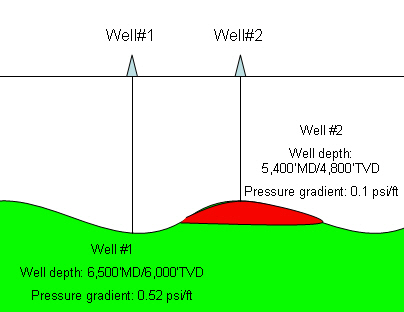
I got a question about how an anticline gas cap can create the abnormal pressure. The anticline with gas cap can be the potential high pressurized zone. Because of reservoir connectivity between fluid underneath gas and gas reservoir, it can generate abnormal pressure. This example below demonstrates you how this situation could happen.

Continue reading

Increase oil/water ratio

The concept of increase oil water ratio is to increase oil volume in the system without any changes in water to meet new oil water ratio.

How can we increase oil water ratio from 80/20 to 85/15?

Let’s make it simple to understand. We start with 100 bbl of mud and we have the following information from the retort analysis.

Retort analysis:

% by volume oil = 56

% by volume water = 14

% by volume solids = 30

According to this retort analysis (learn how to calculate oil water ratio), the oil water ratio is 80/20 and there are 56 bbl of oil, 14 bbl of water and 30 bbl of solid from 100 bbl of mud. In order to increase oil water ratio, oil must be added and water volume remains the same. Therefore, 14 bbl of water will represent only 15% of water ratio for the new system. We give X equals to the new total liquid volume.

Then; 15 = (14×100)÷X

X = 93.33 bbl

Total new liquid volume is 93.33 bbl

Barrel of base oil added per 100 bbl of mud

Oil added = new total liquid volume – original volume

Oil added = 93.33 – 70 = 23.33 bbl

It means that you need to add oil 23.33 bbl per 100 bbl of original mud without adding any volume of water in order to achieve 85/15 oil water ratio.

Please find the Excel sheet for calculating how to increase oil water  ratio.

Ref book: Formulas and Calculations for Drilling, Production and Workover, Second Edition

Calculate Oil-Water Ratio from Retort Data

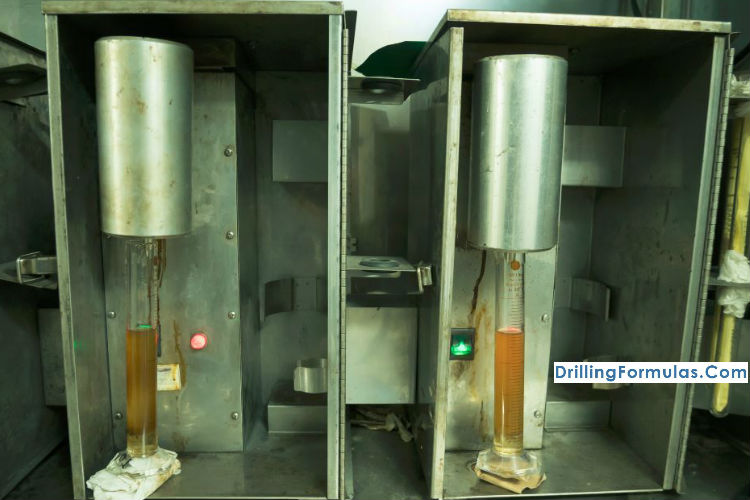
Oil Water Ratio (OWR) is a figure representing the fraction of oil and water in oil based drilling mud.  Generally speaking, it is a ratio between the percent oil in liquid phase and the percent water in liquid phase. In order to determine OWR, volume of oil/water/solid in drilling mud comes from a retort analysis. A sample of oil based mud is controlled burnt in a retort kit at required temperature. When the mud is heated, water and oil will be extracted out and solid is left in the retort kit. The retort analysis report shows percentage of each component by volume so we use data from the retort analysis to determine oil water ratio.

Retort kits, OilfieldPix.com 2017

Retort kits, OilfieldPix.com 2017

The formulas below demonstrate how to calculate oil water ratio from retort data.

a) % oil in liquid phase = (% by volume oil x 100) ÷ (% by volume oil + % by volume water)

b) % water in liquid phase = (% by volume water x 100) ÷ (% by volume oil + % by volume water)

c) Result: The oil/water ratio equals to the percent oil in liquid phase and the percent water in liquid phase.

Example: Determine oil water ratio from following information

Data from a retort analysis:

% by volume oil = 56

% by volume water = 14

% by volume solids = 30

Solution:

a) % oil in liquid phase = (56 x 100) ÷ (56+14)

% oil in liquid phase = 80

b) % water in liquid phase = (14 x 100) ÷ (56+14)

% water in liquid phase = 20

c) According to this retort report, the oil/water ratio equals to 80/20.

Ref books: Lapeyrouse, N.J., 2002. Formulas and calculations for drilling, production and workover, Boston: Gulf Professional publishing.

Bourgoyne, A.J.T., Chenevert , M.E. & Millheim, K.K., 1986. SPE Textbook Series, Volume 2: Applied Drilling Engineering, Society of Petroleum Engineers.

Mitchell, R.F., Miska, S. & Aadny, B.S., 2011. Fundamentals of drilling engineering, Richardson, TX: Society of Petroleum Engineers.
Determine the density of oil and water mixture

You normally get the oil/water ratio from a retort so you can use these numbers to determine density oil and water mixture by the following formula.

(V1)(D1) + (V2)(D2) = (V1 + V2)DF

Where;

V1 = percentage of oil

V2 = percentage of water

D1 = density of oil

D2 = density of water

DF = final density of mixed fluid between oil and water

Example: If the oil/water (o/w) ratio is 80/20 (80% oil and 20% water), please determine the density of mixed fluid between oil and water from the retort. Oil density = 7.0 ppg. Water density = 8.33 ppg.

V1 = 0.8

V2 = 0.2

D1 = 7.0

D2 = 8.33

(V1)(D1) + (V2)(D2) = (V1 + V2)DF

(0.8)(7.0) + (0.2)(8.33) = (0.8 + 0.2) DF

5.60 + 1.67= 1.0 DF

7.27 = DF

The density of the oil/water mixture = 7.27 ppg

Please the Excel sheet used to calculate the density of oil and water mixture.

Ref book: Formulas and Calculations for Drilling, Production and Workover, Second Edition