Why Do We Need To Minimize Influx (Kick)?

As you know, we’ve always been trained or told to minimize influx (kick). Nowadays, there are several tools and procedures guiding us to prevent large influx; however, interestingly there are quite a lot of people who don’t understand why we need to do this. In this topic, we will demonstrate how kick volume will affect wellbore and surface casing pressure.

Why-Do-We-Need-To-Minimize-Influx-(Kick)

Main concept of minimizing kick coming into the wellbore is to minimize surface casing pressure when shut in. If you have excessive surface casing pressure, you will have a chance to fracture the weakest formation in the wellbore such as formation at casing shoe. You need to remember that more influx equals to more surface pressure. We will do basic calculation to see the effect of kick volume and surface pressure.
Continue reading

API Ring Gaskets Used in BOP Connections

There are several API types of ring gaskets used in BOP connections and this is very important to personnel involving in drilling operation to know about it. API 6A: Specification for Wellhead and Christmas Tree Equipment is the standard which every manufacture refers to their equipment.

API Type R Ring Gasket

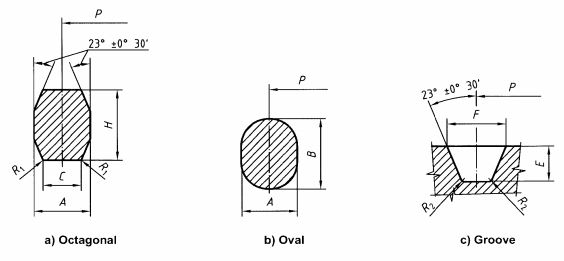
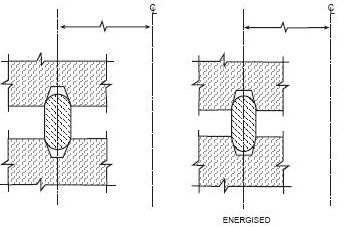
The API type “R” rig gasket is not a pressure energized gasket therefore this type does NOT recommend for BOP equipment or safety critical equipment as x-mas tree, wellhead valves, etc. Sealing area is along small bands of contact between the gasket and the ring gasket on both ID and OD of the gasket. Shape of type “R” may be oval or octagonal in cross section (see Figure 1). Additionally, face to face between flanges will not touch when the flanges are tightened (see Figure 2). The “R” gasket is compatible for 6B flanges.

 Figure 1 - Type R ring gaskets (shape and groove)


Figure 1 – Type R ring gaskets (shape and groove)

Figure 2 - Type R Gasket When Energized

Figure 2 – Type “R” Gasket When Energized

Continue reading

Basic Pressure Control – VDO Training

As you know well control is very important subject in drilling industry and in order to understand it clearly, you need to understand basic principle. This time we would like to share this excellent VDO showing the basic pressure control of drilling process. It is just only five minutes but it will give you details plus illustration for more understanding. Additionally, we also add full VDO transcript for anyone who cannot catch the VDO content.

This is the VDO transcript from our team.

basic pressure control

Fluids in a formation are under pressure. When drilled, this pressure can escape to the surface if it is not controlled. Normally, drilling mud offsets formation pressure, that is the weight or pressure of the drilling mud keeps fluids in the formation from coming to the surface.

Continue reading

Casing Shoe Pressure While Circulating Influx in Well Control Situation

Many people ask us a lot of questions regarding shoe pressure while circulating kick (wellbore influx) out of the wellbore. Pressure acting at casing shoe is different depending on where the kick is in the well therefore we will summarize all the scenarios to help you get clearer picture. There are a total of three cases which we will separately discuss as per the details below.


Note: All the calculations and scenarios are based on water based mud and gas kick. This assumption is used because it is the worst case scenario. The casing shoe will have less pressure if the influx is oil or gas kick.

casing-shoe-presure

 First Scenario – Top of Gas Kick Below Casing Shoe


Figure 1 - Top of Gas Kick Below Casing Shoe

Figure 1 – Top of Gas Kick Below Casing Shoe

Continue reading

What is Closing Ratio in Blow Out Preventer (BOP)?

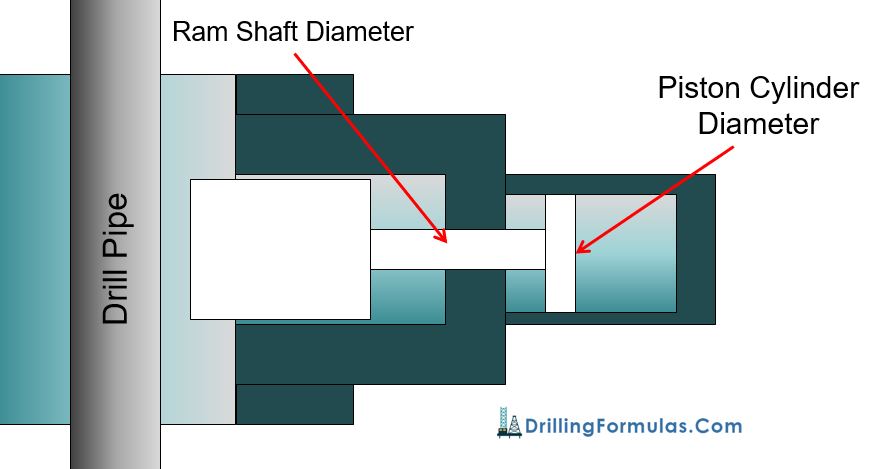
People asked me about what the closing ratio is and what it tells us. Closing ratio is defined as the cross sectional area of the ram piston (cylinder) divided by the cross sectional area of the ram shaft. The closing ratio is used to determine Ram closing pressure which will overcome wellbore pressure acting to Ram body. The closing ratio formula is below;

Closing Ratio = Ram Piston Cylinder Area ÷ Ram Shaft Area

Before going into the detailed calculation, we would like to show you where the cylinder and the ram shaft are in BOP. In Figure 1 (Shaffer SL-Ram BOP), the yellow shaded parts demonstrate these two areas which will be used to calculate the closing ratio.

Figure 1 - Shaffer SL-Ram BOP

Figure 1 – Shaffer SL-Ram BOP


Detailed Formulas are as follows;

Ram Piston Cylinder Area  (square inch) = ( π× Ram Piston Cylinder Diameter) ÷ 4

Ram Shaft Area  (square inch) = ( π× Ram Shaft Diameter) ÷ 4

Closing Ratio = Ram Piston Cylinder Area ÷ Ram Shaft Area  

Figure 2 - Diagram of Closing Ratio Calculation

Figure 2 – Diagram of Closing Ratio Calculation

Continue reading