Gas Behavior and Bottom Hole Pressure with Constant Surface Pressure

This example demonstrates how bottom hole pressure will be when maintaining constant surface pressure and letting gas bubble migrating up.

From the previous post, Gas Behavior and Bottom Hole Pressure in a Shut in well, you know that if you take gas kick and you do nothing only letting gas migrating up, you will have an increase in casing pressure (surface pressure) and you may end up breaking shoe or surface equipment. You know that this practice is a bad idea.

What will be happened if the surface pressure is maintained at constant value?

The well will be maintained constant surface pressure by bleeding some mud in order to compensate pressure increment.

Do you think this is a good idea to do that?

Let’s go though all details about it.

This is the same well. The well is shut-in without pipe in hole. 5 bbl of gas kick is taken and initial shut in casing pressure is equal to 400 psi. Hydrostatic head on top of gas is 4,000 psi. The well is bleed off mud in order to keep 400 psi constant surface pressure.

Assumptions:

  • Volume not change
  • No temperature change
  • Formation not broken
  • No must loss

Figure 1 – Well Shut In Diagram

Determine Gas Kick Pressure

Gas kick pressure at the bottom is equal to hydrostatic pressure above gas kick plus shut in pressure

Gas kick pressure = 4,000 + 400

Gas kick pressure = 4,400 psi

Figure 2 – Gas Pressure at The Bottom

What happens if we maintain surface pressure?

Surface pressure is kept constant at 400 psi by bleeding 5 bbl of mud. It means that gas is allowed to expand another 5 bbl so the gas influx is 10 bbl in total.

According to the Boyle’s Law,  gas influx pressure can be calculated.

Pressure of gas (P1) is 4,400 which equates to the bottom hole pressure.

Volume of gas at beginning (V1) is 5 bbl.

Volume of gas at the second condition (V2) is 10 bbl.

Bolye’s Law

P1 × V1 = P2 × V2

4,400 × 5 = P2 × 10

P2 = 2,200 psi ->Gas pressure decreases because of expansion.


Figure 3 – Gas Pressure with Constant Surface Pressure

What will happen to Bottom Hole Pressure?

We apply the hydrostatic pressure concept.

Bottom Hole Pressure (BHP) = Hydrostatic Pressure (HP) + Surface Pressure (SP)

Surface pressure: Surface pressure remains constant because it is controlled at a planned value, which is 400 psi in this example.

Hydrostatic pressure: The overall hydrostatic pressure will decrease because gas expansion will displace volume of mud.

Bottom hole pressure: Bottom hole pressure will decrease because of reducing hydrostatic pressure in the wellbore.

Figure 4 – Bottom Hole Pressure Reduction due to Hydrostatic Pressure Reduction

Reduction in bottom hole pressure will result in more influx.

Figure 5 – More Influx to the well

Conclusion

If gas influx is in the well and  casing pressure is maintained at constant value by bleeding off mud of surface, the bottom hole pressure will be decreased. Therefore, additional influx will be allowed into the wellbore. This is not good idea.

References

Cormack, D. (2007). An introduction to well control calculations for drilling operations. 1st ed. Texas: Springer.

Crumpton, H. (2010). Well Control for Completions and Interventions. 1st ed. Texas: Gulf Publishing.

Grace, R. (2003). Blowout and well control handbook [recurso electrónico]. 1st ed. Paises Bajos: Gulf Professional Pub.

Grace, R. and Cudd, B. (1994). Advanced blowout & well control. 1st ed. Houston: Gulf Publishing Company.

Watson, D., Brittenham, T. and Moore, P. (2003). Advanced well control. 1st ed. Richardson, Tex.: Society of Petroleum Engineers.

Gas Behavior and Bottom Hole Pressure in a Shut in well

This is a an example demonstrating how bottom hole pressure will be due to gas migration in a shut in well. This is very important concept in well control.

This example will demonstrate the gas behavior in a shut in well.

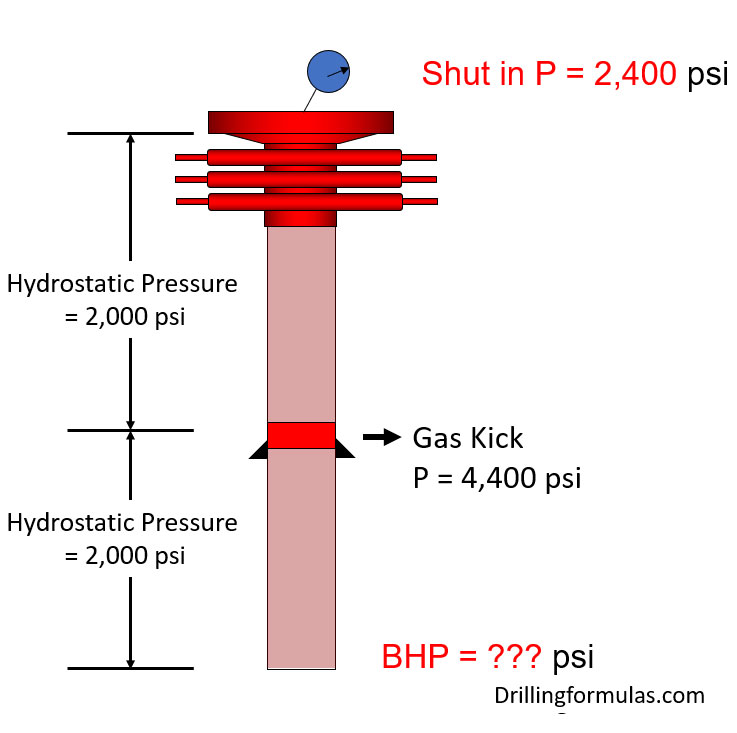
The well is shut-in without pipe in hole. 5 bbl of gas kick is taken and initial shut in casing pressure is equal to 400 psi. Hydrostatic head on top of gas is 4,000 psi (see figure 1). The well is shut in and gas migrates up until where hydrostatic pressure underneath gas is 2000 psi. What will happen to bottom hole pressure and shut in pressure?

Assumptions:

  • Volume not change
  • No temperature change
  • Formation not broken
  • No must loss

Figure 1 – Well Shut In Diagram

Determine Gas Kick Pressure

Gas kick pressure at the bottom is equal to hydrostatic pressure above gas kick plus shut in pressure

Gas kick pressure = 4,000 + 400

Gas kick pressure = 4,400 psi

Figure 2 – Gas Pressure at The Bottom

Determine Bottom Hole Pressure and Shut In Pressure at The Second Condition

Even though the well is shut in, the gas influx is able to move upwards due to gas migration.

In this case, we will not allow any gas expansion and let the gas gradually migrate.

The well is shut in and gas is allowed to migrate up hole until hydrostatic pressure underneath gas is 2000 psi (see the figure 3).

Figure 3 – Gas Migrate up

What will happen to bottom hole pressure and shut in pressure?

Determine gas kick pressure –  With Bolye’s Law concept, we will apply it see how much gas bubble should be.

According to this example,

Pressure of gas (P1) is 4,400 which equates to the bottom hole pressure.

Volume of gas at beginning (V1) is 5 bbl.

Volume of gas at this condition (V2) is 5 bbl (volume not change).

Bolye’s Law

P1 × V1 = P2 × V2

4,400 × 5 = P2 × 5

P2 = 4,400 psi ->Gas pressure remains constant.

Determine hydrostatic pressure above kick

Since there is no change in volume of fluid, total hydrostatic pressure remains constant. With this relationship, we can calculate hydrostatic pressure above migrated kick.

Total hydrostatic pressure = Hydrostatic pressure above kick +  Hydrostatic pressure below kick

4,000 = Hydrostatic pressure above kick + 2,000

Hydrostatic pressure above kick = 2,000 psi

You have total of hydrostatic pressure of 4,000 psi at the beginning. Currently, you have 2,000 psi of hydrostatic at the bottom therefore you have 2,000 psi of hydrostatic on top of gas. See the figure 4 below.

Figure 4 – Hydrostatic Pressure above Gas Kick

Determine Shut in Pressure

Let’s see how much shut in pressure will be.

Apply hydrostatic pressure concept to solve this problem.

Gas Kick Pressure = Hydrostatic Pressure above the gas kick+ Shut in Pressure

4400 = 2000 +Shut in pressure

Shut in pressure = 2,400 psi

Figure 5 – Shut In Pressure

Determine Bottom Hole Pressure

Moreover, you can calculate the bottom hole pressure by applying the same concept.

Bottom Hole Pressure = Hydrostatic Pressure  + Shut in Pressure

Bottom hole pressure = 4,000 + 2,400

Bottom hole pressure = 6,400 psi.

Figure 6 – New Bottom Hole Pressure

Conclusions

  • If gas migrates in a shut-in well without allowing it to expand, pressures everywhere in the well will go up, except in the gas bubble it self.
  • If a well is shut in and the gas influx is allowed to migrate, gas pressure will remain constant; however, bottom hole pressure and casing pressure will be increased.
  • If casing pressure (surface pressure) increases too much, you can break formation or damage surface equipment.
  • Surface pressure will be increased by the amount of hydrostatic pressure that gas migrates past.
  • If there is no change in total hydrostatic pressure in the well, the increase in surface pressure causes a corresponding increase in bottom hole pressure.

References

Cormack, D. (2007). An introduction to well control calculations for drilling operations. 1st ed. Texas: Springer.

Crumpton, H. (2010). Well Control for Completions and Interventions. 1st ed. Texas: Gulf Publishing.

Grace, R. (2003). Blowout and well control handbook [recurso electrónico]. 1st ed. Paises Bajos: Gulf Professional Pub.

Grace, R. and Cudd, B. (1994). Advanced blowout & well control. 1st ed. Houston: Gulf Publishing Company.

Watson, D., Brittenham, T. and Moore, P. (2003). Advanced well control. 1st ed. Richardson, Tex.: Society of Petroleum Engineers.

Bottom hole pressure change while performing well control operation with driller’s method

In the first circulation of driller’s method, driller circulates gas kick with 25 spm and the initial circulating pressure (ICP) is 1600 psi. The initial shut in drill pipe pressure is 450 psi. After shift change, another driller accidentally changes pump rate to 30 spm but he still holds drill pipe pressure constant.

What will happen to bottom hole pressure?

Continue reading

Kick Tolerance Calculation

This post will teach you how to calculate kick tolerance. This concept is very important to well design and will give you an idea how much kick you can take at particular parameters.

Firstly, I would like to be clear about the following terms;

Kick tolerance is the maximum gas influx volumes (bbl) for a designed kick intensity that can be successfully shut the well in and circulated out without breaking formation pressure at the casing shoe.

Kick intensity is the different between the maximum anticipated formation pressure and planned mud weight.

Secondly, learn how to determin kick tolerance by following steps below:

Continue reading