Jun 28

When you get differentially stuck, you may consider spotting light weight fluid to reduce force created by differential pressure between mud in wellbore and formation pressure. However, you really need to understand and be able to calculate how much light fluid you can put in hole that it will not create well control situation by accidentally underbalance formation pressure. This post demonstrates you how to determine maximum height of light weight spot pill that can be in the annulus.

Firstly, we really need to know how much under balance with current mud weigh is. You may get this information by calculating current hydrostatic pressure minus expected pressure based on pressure profile. Secondly, you must know how much your light weight pill is. Then please follow the steps below to determine how height of light weight spot pill in the annulus should be.

a) Determine the difference in pressure gradient in psi/ft between the mud weight and light weight spot fluid:

Difference pressure in pressure gradient in psi/ft = (current mud wt in ppg – light weight spot pill in ppg) x 0.052

b) Determine height in ft of light weight spot fluid that will balance formation pressure in the annulus:

Height ft in vertical = overbalance pressure with current mud weigh in psi ÷ difference in pressure gradient in psi/ft

This height is the maximum allowable height of light weight spot pill in the annulus. If you have higher length of light weight spot pill in the annulus, it may create well control situation.

Example: Use the following data to determine the height in ft of light weight spot pill that will balance formation pressure in the annulus:

Mud weight = 13.0 ppg

Light weight spot pill = 8.3 ppg

Amount of overbalance = 300 psi

a) Difference in pressure gradient in psi/ft:

Difference pressure in pressure gradient in psi/ft = (13 ppg – 8.3 ppg) x 0.052

Difference pressure in pressure gradient in psi/ft = 0.2444

b) Determine the height in ft of light weight spot liquid that will balance formation pressure in the annulus:

Height = 300 psi ÷ 0.244 psi/ft

Height = 1227 ft

You must ensure than height of light weight pill in the annulus must less than 1227 ft in order to prevent wellcontrol situation.

Please find the Excel sheet to calculate maximum height in annulus of light weight spot pill.

Ref: Drilling Formula Book Formulas and Calculations for Drilling, Production and Workover, Second Edition

  • Share/Bookmark
Jun 24

There are several units of temperature used in the drilling industry and you sometimes need to convert one unit into another unit. So you need to know and be able to convert temperature from one unit to another temperature unit. This post demonstrates how to use temperature conversion formulas to convert one temperature unit to another unit.

1 – Convert temperature from °Fahrenheit (F) to °Celsius (C)

°C = ((°F – 32) x 5) ÷ 9

Example: Convert 80 °F to °C:

°C = ((80 – 32) x 5) ÷ 9

°C = 26.7

2 – Convert temperature from ° Celsius (C) to °Fahrenheit

°F = (°C x 9) ÷ 5 + 32

Example: Convert 30 °C to °F:

°F = (30 x 9) ÷ 5 + 32

°F = 86

3 – Convert temperature from ° Celsius (C) to °Kelvin (K)

°K = °C + 273.16

Example: Convert 30 °C to °K:

°K = 30 + 273.16

°K = 303.16

4 – Convert temperature from °Fahrenheit (F) to °Rankine (R)

°R = °F + 459.69

Example: Convert 150 °F to °R:

°R = 150 + 459.69

°R = 609.69

** The 1st and 2nd are the most frequently used in oil field.

Please find the Excel sheet for converting temperature.

Ref: Drilling Formula Book Formulas and Calculations for Drilling, Production and Workover, Second Edition

  • Share/Bookmark
Jun 21

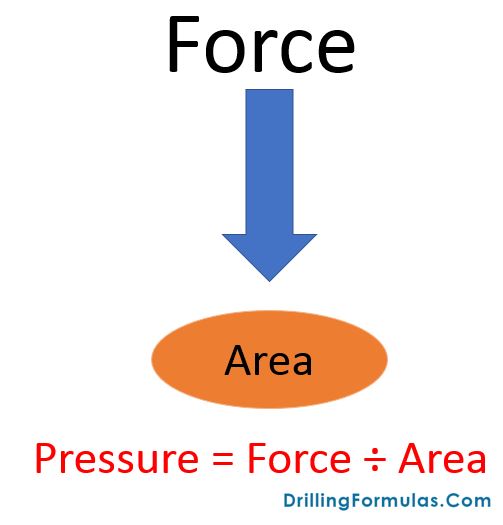
Pressure is force divided by cross section area (see an image below).

pressure and force

We normally use pressure in many units such as psi (pound per square inch), Pascal, kg/m3, etc.

In drilling operation, we mostly use circular area so area can be calculated by this formula;

Area = ¶ x (radius)2 or ¶ x (diameter)2÷ 4

Where  ¶= 22/7 = 3.143, so we can write a formula above in easy way

Area = 3.143 x (radius)2 or 0.7857 x (diameter)2

Pressure = force ÷ (3.143 x (radius)2) or force ÷ (0.7857 x (diameter)2)

Let’s try to apply pressure and force relationship in drilling operation. We plan to bullhead well and we still have drill string in the hole.

Drill string weight in the air = 45,000 lb
Mud weight in hole = 12.0 ppg
Bit size = 8.5”
Drill pipe size = 5″

What is the maximum pressure at surface you can apply before drilling string will be blow out due to bullheading pressure.

Buoyancy factor = (65.5 – 12.0) ÷ 65.5 = 0.817

Buoyed weight of drill string = 45,000 x 0.817 = 36,765 lb

Area = 0.7857 x (diameter)2= 0.7857 x (8.5)2= 56.77 square inch

Pressure = 36,765 lb ÷ 56.77 square inch= 647 psi.

In order to perform safe bullheading operation with drill string in hole, you need to apply bullheading pressure less than 647 psi on surface.

bull head

Please find Excel sheet for calculating force created by pressure.

Ref: Drilling Formula Book Formulas and Calculations for Drilling, Production and Workover, Second Edition

  • Share/Bookmark
Jun 18

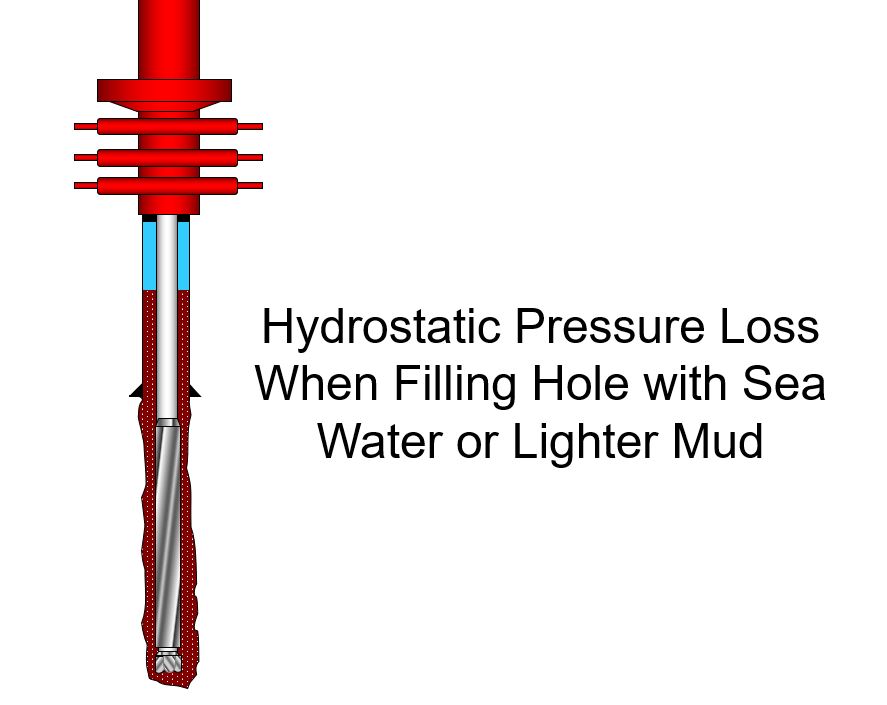
In case of totally lost return, the annulus must be fully filled with fluid, normally water, as fast as we can. Water filled in annulus causes loss of hydrostatic pressure in the wellbore. This post demonstrates how to determine hydrostatic pressure reduction due to fully filling water into annulus. There are 2 main concepts, annular capacity and hydrostatic pressure, applied to determine loss of hydrostatic pressure.

Please following concepts below.

Number of feet of water in annulus

Ft of water added = water added in bbl ÷ annular capacity in bbl/ft

Bottomhole (BHP) pressure reduction

In order to calculate bottom hole pressure reduction, we assume the column of water in annulus is true vertical depth.

BHP decrease in psi = (current mud weight in ppg – weight of water in ppg) x 0.052 x (ft of water added)

Equivalent Mud Weight at TD

EMW in ppg = current mud weight in ppg – (BHP decrease in psi ÷ 0.052 ÷ TVD ft of hole)

Example: Determine bottom hole pressure loss and equivalent mud weight at TD due to filling up water into annulus.

Mud weight = 13.0 ppg
Water added = 140 bbl required to fill annulus
Weight of water = 8.6 ppg **
Annular capacity = 0.1422 bbl/ft
Hole TVD = 6,000 ft

** If you fill lighter mud in hole instead of water, please adjust water weight to your mud weight.

Number of feet of water in annulus

Feet of water in annulus = 140 bbl ÷ 0.1422 bbl/ft
Feet = 984.5 ft

Bottomhole (BHP) pressure reduction

BHP reduction = (13.0 ppg – 8.6 ppg) x 0.052 x 984.5 ft
BHP reduction = 225.3 psi

Equivalent mud weight at TD

EMW in ppg = 13.0 – (225.3 psi ÷ (0.052 x 6,000 ft))
EMW = 12.3 ppg

Please find the Excel sheet for calculating how much pressure loss due to lost return

Ref: Drilling Formula Book Formulas and Calculations for Drilling, Production and Workover, Second Edition

  • Share/Bookmark
Jun 16

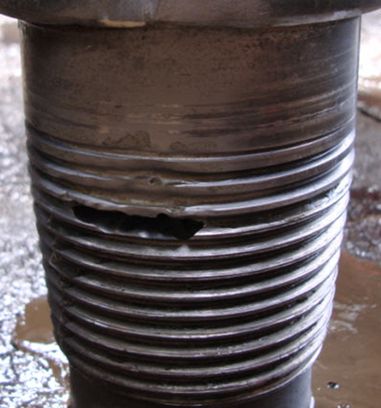
Washout in drill string can cause big problem later such as parted drill string.

When we see stand pipe pressure decrease without changing any parameters as flow rate, mud properties, etc, you may need to consider following items before you decide to pull out of hole for washout.

1. Check surface line: You may need to close stand pipe valves or IBOP and then pressure up to see leaking in the surface. If you see pressure drop, you can fix the surface problem. Anyway you still need to test system again.

2. Check drillstring: You may pump the same flow rate and see how your MWD tool down hole response. If y MWD tool response gets weaker signal so it means that you have washout somewhere above MWD tool. If not, you may have washout below that such as bit, mud motor, etc.

You may consider finding washout depth by using 2 following methods below.

Method 1: The concept of this method is to pump plugging material to plug the wash out. We will count how many strokes pump till pump pressure increases then we can calculate back where the washout is by applying internal capacity concept and pump output concept.

Depth of washout in ft= (strokes pumped till seeing pressure increase x pump output in bbl/stk) ÷ drill pipe capacity in bbl/ft

Determine washout depth from following information:

Internal drill pipe capacity = 0.00742 bbl/ft
Pump output = 0.0855 bbl/stk
Pressure increase was noticed after 400 strokes.
Depth of washout, ft = 400 stk x 0.0855 bbl/stk ÷ 0.00742 bbl/ft
Depth of washout = 4609 ft

Method 2: The concept of this method is to pump material that can be easily observed from drill pipe pass through wash out into annulus and over the surface. We can calculate the depth of washout bases on the combination volume of internal drill pipe volume and annulus volume.

Note: The materials can be easily observed when it comes across the shakers are as follows: carbide, corn starch, glass beads, bright colored paint, etc.

Depth of washout in ft = (strokes pumped till observed material on surface x pump output in bbl/stk) ÷ (drill pipe capacity in bbl/ft + annular capacity in bbl/ft)

Determine depth of washout from following information:

Internal drill pipe capacity capacity = 0.00742 bbl/ft
Pump output = 0.0855 bbl/stk
Annulus capacity = 0.0455 bbl/ft
The material pumped down the drill pipe was noticed coming over the shaker after 2500 strokes.
Depth of washout, ft = (2500 x 0.0855) ÷ (0.00742+0.0455)
Depth of washout = 4039 ft

If you want to subtract volume from bell nipple to shale shaker, you can subtract the volume out of total volume pumped. Therefore the formula will be

Depth of washout, ft = (strokes pumped till observed material on surface x pump output in bbl/stk – volume (bbl) from bell nipple to shale shaker) ÷ (drill pipe capacity in bbl/ft + annular capacity in bbl/ft)

Example: Internal drill pipe capacity capacity = 0.00742 bbl/ft

Pump output = 0.0855 bbl/stk

Annulus capacity = 0.0455 bbl/ft

The material pumped down the drill pipe was noticed coming over the shaker after 2500 strokes.

Volume from bell nipple to shale shaker = 10 bbl

Depth of washout in ft = (2500 x 0.0855 – 10) ÷ (0.00742+0.0455)

Depth of washout = 3850 ft

ANYWAY PLEASE REMEMBER. If you know that your wash out is down hole, practically, we need to pull out of hole ASAP after we determine washout situation. The more you pump, more washout will be occurred.

Please find the excel sheet for calculating depth of washout

Ref: Drilling Formula Book Formulas and Calculations for Drilling, Production and Workover, Second Edition

  • Share/Bookmark
Jun 12

When you operate top drive, you may need to know critical RPM that you can go. If you rotate pipe more than the critical RPM, it will create a lot of vibration that can cause failure in your drilling equipment such as drill pipe, TDS, etc.

In order to find out how much critical RPM, you may need high-tech simulation but sometimes you don’t really have that information supplied from town. So you really need to be able to roughly estimate how much critical RPM is ( at least you get a idea for this limitation). This formula below shows you how to estimate the critical RPM and it has accuracy of 15% roughly.

Critical RPM = 33,055 x (OD2 + ID2) 1/2 ÷ (L)2

Where;
OD = drill pipe outside diameter in inch
ID = drill pipe inside diameter in inch
L = length of one joint of drill pipe in feet

Example: Determine critical RPM from these following information

L = length of one joint of drill pipe = 32 ft
OD = drill pipe outside diameter = 4.0 in.
ID = drill pipe inside diameter = 3.5 in.

Critical RPM = 33,055 x (42+ 3.52)1/2 ÷ (32)2

Critical RPM = 172 RPM

Please remember this is ONLY estimation of the critical RPM. If you have your service companies or you have specific programs to determine it, please use the value from those programs because it should consider many parameters than this simple formula. USE IT IN CASE OF YOU HAVE NOTHING AVAILABLE TO CALCULATE THE CRITICAL RPM.

Please find the Excel for calculating the critical RPM.

Ref: Drilling Formula Book Formulas and Calculations for Drilling, Production and Workover, Second Edition

  • Share/Bookmark
Jun 9

Wet cutting coming over shale shakers can be used to determine cutting bulk density. This post demonstrates you how to find bulk density (specific gravity) in specific gravity of cutting using mud balance so please read and understand procedure to determine resulting weith with cutting plus water (RW) and then use RW to determine specific gravity of cutting bulk density.

Procedure to obtain resulting weight with cuttings plus water (RW):

1. Cuttings must be washed free of mud. In oil base mud, diesel oil can be used instead of water.
2. Set mud balance at 8.33 ppg.
3. Fill the mud balance with cuttings until a balance is obtained with the lid in place.
4. Remove lid, fill cup with water (cuttings included), replace lid and dry outside of mud balance.
5. Move counterweight to obtain new balance. This value is “Rw” = resulting weight with cuttings plus water in ppg.

The specific gravity of cutting is calculated as follows:
SG = 1 ÷ (2 – (0.12 x Rw))

Where;
SG = specific gravity of cuttings – bulk density
Rw = resulting weight with cuttings plus water in ppg

Example:
Determine the bulk density of cuttings:
Rw = 14.0 ppg
SG= 1 ÷ (2 – (0.12 x 14.0))
SG = 3.13

 Moreover, if you can to convert specific gravity to mud weight (ppg and lb/ft3) and pressure gradient (psi/ft). Learn more about how to Convert specific gravity to mud weight (ppg and lb/ft3) and pressure gradient (psi/ft)

Please the Excel sheet used to calculate Bulk Density of Cuttings Using Mud Balance

Ref book: Formulas and Calculations for drill, production and workover by Norton J. Lapeyrouse

Note: If you don’t want to miss any post from drillingformulas.com, please consider subscribing to our mail list. So you will not miss our posts.

Enter your email address:

Delivered by FeedBurner

  • Share/Bookmark
Jun 6

Drilling cost per foot is the total drilling cost per footage drilled. This value is used for evaluating drilling projects, bit performance, drilling performance, etc. The formula for drilling cost per foot as shown below;

CT = (B + CR (t + T)) ÷ F

Where:
CT = drilling cost per foot
B = bit cost
t = drilling time
CR = Rig cost per hour. This number must include all fixed daily cost not just only drilling contractor rate.
T = round trip
F = footage drill

Example: Determine the drilling cost per foot (CT) using the following data:

Bit cost (B) = 27,000 $
Drilling time (t) = 50 hours
Rig cost (CR) = $3500/hour
Round trip time (T) = 12 hours
Footage per bit (F) = 5000 ft

CT = (27,000 + 3,500 (50 + 12)) ÷ 5000
CT = 48.8$ per foot

Please find the excel sheet for calculating drilling cost per foot.

Ref: Drilling Formula Book Formulas and Calculations for Drilling, Production and Workover, Second Edition

  • Share/Bookmark
Jun 3

There is relationship between pump pressure and pump stroke that you really need to understand and be able to determine pump pressure after adjusting new pump stroke. There are 2 formulas used to determine pump pressure as shown in the detail below:

1st formula for estimating new circulating pressure (simple and handy for field use)

New circulating pressure in psi = present circulating pressure in psi x (new pump rate in spm ÷ old pump rate in spm) 2

Example: Determine the new circulating pressure, psi using the following data:
Present circulating pressure = 2500 psi
Old pump rate = 40 spm
New pump rate = 25 spm
New circulating pressure in psi = 2500 psi x (25 spm ÷ 40 spm) 2
New circulating pressure = 976.6 psi

2nd formula for estimating new circulating pressure (more complex)

For the 1st formula, the factor “2” is used but it’s just the round up figure. If you want more accurate figure, you need to figure out an exact figure. So the 2nd formula has one additional formula to calculate the factor based on 2 pressure readings at different pump rate.  Please follow these steps to determine new circulating pressure

1. Determine the factor ”n” and  the formula to determine factor “n” is below:

Factor (n) = log (pressure 1 ÷ pressure 2) ÷ log (pump rate 1÷pump rate 2)
2. Determine new circulating pressure with this following formula.

New circulating pressure in psi = present circulating pressure in psi x (new pump rate in spm ÷ old pump rate in spm) n

Note: factor “n” comes from the first step of calculation.

Example: Determine the factor “n” from 2 pump pressure reading
Pressure 1 = 2700 psi at 320 gpm
Pressure 2 = 500 psi at 130 gpm
Factor (n)   = log (2700 psi ÷ 500 psi) ÷ log (320 gpm ÷ 130 gpm)
Factor (n) = 1.872

Example: Determine new circulating pressure by using these following information and the factor “n” from above example:
Present circulating pressure = 2500 psi
Old pump rate = 40 spm
New pump rate = 25 spm
New circulating pressure, psi = 2500 psi x (25 spm ÷ 40 spm) 1.872
New circulating pressure = 1037 psi

Please find the Excel sheet used to calculate new circulating pressure based on pump pressure and pump stroke relationship.

Ref book: Drilling Formula Book Formulas and Calculations for Drilling, Production and Workover, Second Edition

  • Share/Bookmark