Sep 27

What is slug? Slug: It is heavy mud which is used to push lighter mud weight down before pulling drill pipe out of hole. Slug is used when pipe became wet while pulling out of hole.

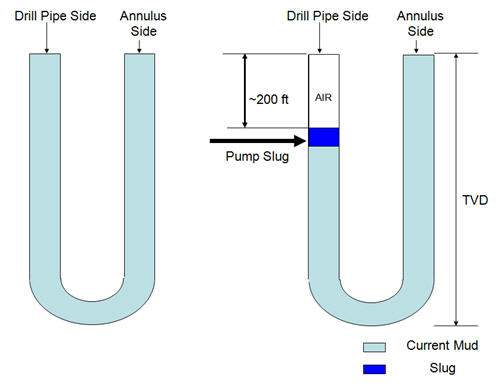
Normally, 1.5 to 2 PPG over current mud weight is a rule of thumb to decide how much weight of slug should be. For example, current mud weight is 10 PPG. Slug weight should be about 11.5 to 12 PPG. Generally, slug is pumped to push mud down approximate 200 ft and slug volume can be calculated by applying a concept of U-tube (See Figure below).

slug

Volume of slug required for required length of dry pipe can be calculated by this following equations:

Step 1: Determine hydrostatic pressure required to give desired drop inside drill pipe:

Hydrostatic Pressure in psi = mud weight in ppg x 0.052 x ft of dry pipe

Step 2: Determine difference in pressure gradient between slug weight and mud weight:

Pressure gradient difference in psi/ft = (slug weight in ppg – mud weight in ppg) x 0.052

Step 3: Determine length of slug in drill pipe:

Slug length in ft = Hydrostatic Pressure in psi (in step 1) ÷ Pressure gradient difference in psi/ft (step 2)

Step 4 Slug volume required in barrels:

Slug volume in barrel = Slug length in ft x drill pipe capacity in bbl/ft

Example: Determine the barrels of slug required for the following:

Desired length of dry pipe = 200 ft

Drill pipe capacity = 0.016 bbl/ft

Mud weight = 10.0 ppg

Slug weight = 11.5 ppg
Step 1 Hydrostatic pressure required:

Hydrostatic Prssure in psi = 10.0 ppg x 0.052 x 200 ft

Hydrostatic Prssure in psi = 104 psi

Step 2 differences in pressure gradient between slug weight and mud weight:

Pressure gradient difference in psi/ft = (11.5 ppg – 10.5 ppg) x 0.052

Pressure gradient difference in psi/ft = 0.078 psi/ft

Step 3 length of slug in drill pipe:

Slug length in ft = 104psi ÷ 0.078

Slug length in ft = 1,333 ft

Step 4 Slug volume required in barrels:

Slug volume required = 1333 ft x 0.016 bbl/ft

Slug volume required = 21.3 bbl

Please find the Excel sheet for calculating barrels of slug required for desired length of dry pipe.

Ref book: Formulas and Calculations for drill, production and workover by Norton J. Lapeyrouse

Note: If you don’t want to miss any post from drillingformulas.com, please consider subscribing to our mail list. So you will not miss our posts.

Enter your email address:

Delivered by FeedBurner

  • Share/Bookmark
Sep 24

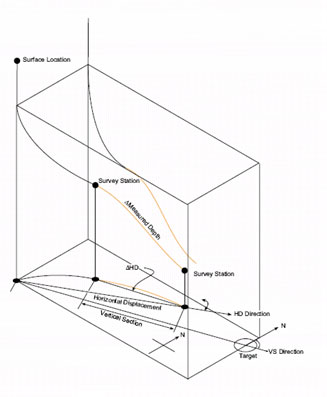
Vertical Section is the horizontal distance of wellbore that moves in the direction of the target per each station or in total.  For instance, in the figure below, vertical section is the distance from survey to survey point and it’s measured in the same direction of the vertical section direction.

vertical-section-direction

The two factors that affect vertical section are as follows:

1. The Incremental horizontal displacement (Δ HD)

2. Vertical section direction (VSD) is the azimuth that is used to reference to the vertical section. Normally, VSD is the azimuth of the last target.

The simple mathematics as Average Angle Method calculation demonstrates the relationship of the VS as below:

VS = cos (VSD – Az avg) X ΔHD

VS: Vertical Section

VSD: Vertical Section Direction

Az avg: Average Azimuth between 2 points (Az1 + Az2) ÷2

ΔHD: Delta Horizontal Displacement

In order to get the Positive Vertical Section or Zero Vertical Section, a well path must have difference of angle between VSD and Az avg, (VSD – Az avg), within a range of +90 to -90 degree. On the other hands, the negative Vertical Section can occur because the difference of angle between VSD and A zavg, (VSD – Az avg), is out of range of +90 to -90 degree AZI.

Ref book: Formulas and Calculations for drill, production and workover by Norton J. Lapeyrouse

Note: If you don’t want to miss any post from drillingformulas.com, please consider subscribing to our mail list. So you will not miss our posts.

Enter your email address:

Delivered by FeedBurner

  • Share/Bookmark
Sep 20

From the previous post, I posted about how to calculate dogleg severity based on Radius of Curvature Method. What’s more, there is another way to calculate dogleg severity based on the concept of Tangential Method.

The following formula provides dogleg severity in degrees/100 ft and is based on the Tangential Method:

Dogleg severity (DLS) = 100 ÷ {MD x [(sin I1 x sin I2) x (sin Az1 x sin Az2 + cos Az1 x cos Az2) + (cos I1 x cos I2)]}

directional survey photo

where

DLS = dogleg severity in degrees/l00 ft

MD = measured depth between survey points, ft

I1 = inclination (angle) at upper survey in degrees

I2 = inclination (angle) at lower in degrees

Az1= Azimuth direction at upper survey

Az2 = Azimuth direction at lower survey


Calculation example for dogleg severity based on Tangential Method

Survey 1

Depth = 7500 ft

Inclination = 45 degree (I1)

Azimuth = 130 degree (Az1)

Survey 2

Depth = 7595 ft

Inclination = 52 degree (I2)

Azimuth = 139 degree (Az2)

Dogleg severity (DLS) = 100 ÷ {95 x [(sin 45 x sin 52) x (sin 130 x sin 139 + cos 130 x cos 139) + (cos 45 x cos 52)]}

Dogleg severity (DLS) = 1.07 degree/100 ft

Please find the Excel sheet for calculating dogleg severity with the concept of Tangential Method

Ref book: Formulas and Calculations for drill, production and workover by Norton J. Lapeyrouse

Note: If you don’t want to miss any post from drillingformulas.com, please consider subscribing to our mail list. So you will not miss our posts.

Enter your email address:

Delivered by FeedBurner

  • Share/Bookmark
Sep 15

Dogleg severity (DLS) is a normalized estimation, normally described in degrees per 100 feet or degree per 30 meters, of the overall well bore curvature between two consecutive directional surveys. Regarding a planned well path, dogleg severity may be synonymous about build and/or turn. The following formula provides dogleg severity in degrees/100 ft  based on the Radius of Curvature Method.

directional survey photo

Dogleg severity (DLS) = {cos-1 [(cos I1 x cos I2) + (sin I1 x sin I2) x cos (Az2 - Az1)]} x (100 ÷ MD)

Where;

DLS = dogleg severity in degrees/l00 ft

MD = Measured Depth between survey points in ft

I1 = Inclination (angle) at upper survey in degrees

I2 = Inclination (angle) at lower in degrees

Az1= Azimuth direction at upper survey

Az2 = Azimuth direction at lower survey

Example for dogleg severity based on Radius of Curvature Method

Survey 1

Depth = 7500 ft

Inclination = 45 degree (I1)

Azimuth = 130degree (Az1)

Survey 2

Depth = 7595 ft

Inclination = 52 degree (I2)

Azimuth = 139 degree (Az2)

Dogleg severity (DLS) = {cos-1 [(cos 45 x cos 52) + (sin 45 x sin 52) x cos (139 - 130)]} x (100 ÷ 95)

Dogleg severity (DLS) =  10.22 degree/100 ft

Please find the Excel sheet used to calculate dogleg severity based on Radius of Curvature Method.


Ref book: Formulas and Calculations for drill, production and workover by Norton J. Lapeyrouse

Note: If you don’t want to miss any post from drillingformulas.com, please consider subscribing to our mail list. So you will not miss our posts.

Enter your email address:

Delivered by FeedBurner

  • Share/Bookmark
Sep 12

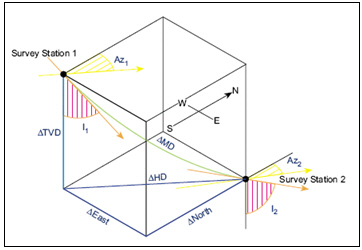
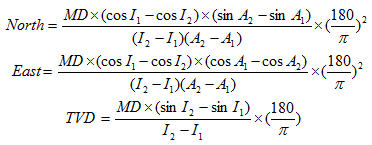
Radius of Curvature Method is the most famous method for directional survey calculation. You can calculate North, East and TVD between directional surveys based on the Radius of Curvature Method as per formula below:

directional survey photo

Where;

MD = measured depth between surveys in ft

I1 = inclination (angle) at upper survey in degrees

I2 = inclination (angle) at lower in degrees

Az1= Azimuth direction at upper survey

Az2 = Azimuth direction at lower survey

Calculation example for Radius of Curvature Method

Survey 1

Depth = 7500 ft

Inclination = 45 degree (I1)

Azimuth = 130degree (A1)

Survey 2

Depth = 7595 ft

Inclination = 52 degree (I2)

Azimuth = 139 degree (A2)

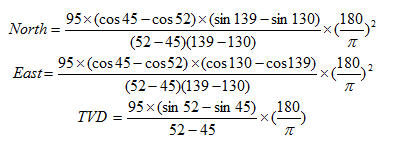
MD = 7595 – 7500 = 95 ft

As per the calculation above,

North = -49.97 ft

East = 50.66 ft

TVD = 62.91 ft

Please find the Excel sheet used for directional survey calculation with Radius of Curvature Method.

Ref book: Formulas and Calculations for drill, production and workover by Norton J. Lapeyrouse

Note: If you don’t want to miss any post from drillingformulas.com, please consider subscribing to our mail list. So you will not miss our posts.

Enter your email address:

Delivered by FeedBurner

  • Share/Bookmark
Sep 8

You can calculate North, East and TVD between directional surveys based on the Angle Averaging Method as per formula below:

directional survey photo

angle averaging method

Where;

MD = measured depth between surveys in ft

I1 = inclination (angle) at upper survey in degrees

I2 = inclination (angle) at lower in degrees

Az1= Azimuth direction at upper survey

Az2 = Azimuth direction at lower survey

Calculation example for Angle Averaging Method

Survey 1

Depth = 7500 ft

Inclination = 45 degree

Azimuth = 130degree

Survey 2

Depth = 7595 ft

Inclination = 52 degree

Azimuth = 139 degree

angle averaging method number

As per formula above,

North = -49.87 ft

East = 50.74 ft

TVD = 62.95 ft

Please find the Excel sheet used for directional survey calculation with Angle Averaging Method

Ref book: Formulas and Calculations for drill, production and workover by Norton J. Lapeyrouse

Note: If you don’t want to miss any post from drillingformulas.com, please consider subscribing to our mail list. So you will not miss our posts.

Enter your email address:

Delivered by FeedBurner

  • Share/Bookmark
Sep 5

You may sometimes find the table for Free Point Constant for your stuck pipe calculation so you use the formula from the previous post to determine Free Point Constant and apply it into free pipe formula to determine where the depth of stuck pipe is.

*** This calculation is based on vertical well assumption.***

The steps of calculation are as follows:

1 ) Determine the free point constant (FPC) by this following formula:

FPC = As x 2500

where: As = pipe wall cross sectional area, sq in.

As = (OD2-ID2) x 0.7854

OD and ID are inch unit

2) Determine depth of stuck pipe by this following formula:

Depth of stuck pipe = (Pipe stretch in inch x free point constant (FPC)) ÷ Pull force in thousands of pounds

Please see the example below to demonstrate you how to apply those 2 formulas above into real drilling operation.

Example#2: Determine the free point constant (FPC) and the depth the pipe is stuck using the following information:

3-1/2” tubing # 9.5 lb/ft

3-1/2” tubing ID = 2.992 inch

20 inch of stretch with 25 Klb of pulling force

a) Determine free point constant (FPC):

FPC = (3.52 – 2.9922) x 0.7854 x 2500

FPC = 6475.5

b) Determine the depth of stuck pipe:

Feet of free pipe (ft) = (20 inch x 6475.5) ÷ 25

** 25 is the kilo-force to pull to 20 inch **

Feet of free pipe (ft) = 5,180 ft

Please find the Excel sheet used for calculating depth of stuck pipe.

Ref book: Formulas and Calculations for drill, production and workover by Norton J. Lapeyrouse

Note: If you don’t want to miss any post from drillingformulas.com, please consider subscribing to our mail list. So you will not miss our posts.

Enter your email address:

Delivered by FeedBurner

  • Share/Bookmark
Sep 2

Referring to the previous post, it is difficult to find drill pipe stretch table or there is no data available for you when you are really need it. This post will show you how to calculate free point constant (FPC) based on cross section of drill pipe, tubing or any cylindrical objects.

The free point constant (FPC) formula for any type of steel drill pipe is listed below:

FPC = As x 2500

where: As = pipe wall cross sectional area, sq in.

As = (OD2-ID2) x 0.7854

This method requires outside diameter and inside diameter data.

Example#1: Determine free point constant (FPC) of 4 in. drill pipe 14.0 lb/ft, inside diameter of drill pipe = 3.34 inch.

FPC = (42 – 3.342) x 0.7854 x 2500

FPC = 9512

Please find the Excel sheet to calculate free point constant.

Ref book: Formulas and Calculations for drill, production and workover by Norton J. Lapeyrouse

Note: If you don’t want to miss any post from drillingformulas.com, please consider subscribing to our mail list. So you will not miss our posts.

Enter your email address:

Delivered by FeedBurner

  • Share/Bookmark