About DrillingFormulas.Com

Working in the oil field and loving to share knowledge.

Total Bit Revolution in When Running A Drilling Mud Motor and Rotating At Surface

I’ve got an email asking me about how to figure out the total bit revolution (RPM) at down hole when the mud motor is used in the drill string  and the rotating at surface is also conducted.

There are two components contributing in the total revolution of downhole drilling bit using mud motor.

1. The rotor RPM of drilling mud motor– each drilling mud motor has its specific performance data which will tell you how many revolutions per flow rate flowing through it.

For example (see the image below), it shows Rev/Gal which means the rotor will turn 0.147 turn/min per one gallon/min of drilling mud passing thought.

2. The rotary speed from top drive or rotary table.

The total drilling bit revolution downhole:

The total drilling bit revolution is equal to summation of the rotor RPM at specific flow rate and the rotary speed on surface.
Continue reading

Coefficient For Annulus Around Drill Pipe and Drill Collar

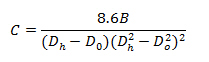
A term “C” represents the general coefficient for annulus around drill pipe and drill collar and the equation is as follow:

Where:

Dh = hole diameter, inch

Do = Outside diameter of drill pipe or drill collar, inch

B = a parameter which takes into account the difference between Q1.86 and Q2

This term does not consider the different between size of tool joint and pipe which affect pressure drop in the annulus. This topic will demonstrate equations to get more accurate coefficient.

Coefficient of Annulus around Drill Pipe and Tool Joint

In order to get an accurate annulus pressure drop around a drill string, the coefficient for the annulus around tool joint must be taken in to account.

Continue reading

Deep Water The Gulf Oil Disaster And The Future Of Offshore Drilling – Report to the President (Macondo Well – Deepwater Horizon)

Today, I would like to share the great resport of the deepwater horizon – Macondo well published by the US Government. You can download the report for FREE. 

Click Here to download the report => http://www.gpo.gov/fdsys/pkg/GPO-OILCOMMISSION/pdf/GPO-OILCOMMISSION.pdf

On April 20, 2010, the Macondo well blew out, costing the lives of 11 men and beginning a catastrophe that sank the Deepwater Horizon drilling rig and spilled nearly 5 million barrels of crude oil into the Gulf of Mexico. The spill disrupted an entire region’s economy, damaged fisheries and critical habitats, and brought vividly to light the risks of deepwater drilling for oil and gas — the latest frontier in the national energy supply. Soon after, President Barack Obama appointed a seven-member Commission to investigate the disaster, analyze its causes and effects, and recommend the actions necessary to minimize such risks in the future. The Commission’s report offers the American public and policymakers alike the fullest account available of what happened in the Gulf and why, and proposes actions — changes in company behavior, reform of Government oversight, and investments in research and technology — required as industry moves forward to meet the nation’s energy needs.

Continue reading

How To Determine Hole Size By Fluid Caliper

This article will demonstrate you how to determine hole size by fluid caliper. First of all, you need to know what is the fluid caliper is. The fluid caliper is one simple way to calculate hole diameter. The concept is based on hole volume, annular capacity, and inner capacity. You pump any substance and when you seen it on surface, you back calculate the hole size based on strokes pumped. It is quite tricky to explain so I would like you to see the example below which it will make you clear about what I say.

116 How To Determine Hole Size Based On Carbide

Assumption for the calculation: No losses


7” casing shoe is set at 5000’MD/4500’TVD

7” casing 23 ppf, ID 6.33 inch

4” drill pipe is used to drill the well and its ID is 3.34 inch.

4-3/4” drill collar is used as BHA and its ID is 2.5 inch. The length of drill collar is 500 ft.

This hole section is used water based mud and the bit size is 6-1/8”

Drill to section TD at 10,000’MD/9,000’TVD then drop carbide once TD is reached.

Pump output is 0.1 bbl/stroke.

Surface line from pumps to rig floor is 20 bbl.

Carbide is detected by a gas sensor on surface after 4,000 strokes pump.

With the given information, determine what is the hole size of the open hole section.

Continue reading