About DrillingFormulas.Com

Working in the oil field and loving to share knowledge.

Drilling Fluids, Mud Pumps, and Conditioning Equipment Book Review

Learning about drilling fluids, mud pumps and conditioning equipment is required basic knowledge which personnel working on the rig must understand. In the old day, you may need to take a lot of time to learn this knowledge. Nowadays, Petroleum Extension Service publishes the book named “Drilling Fluids, Mud Pumps, and Conditioning Equipment” which will provide learners a lot of essential thing regarding drilling fluids, mud pumps and equipment. Today, I would like to review this book so you will know what inside and what you will you get from it.

What will you learn from this book?

These are brief contents which you will learn from the book.

Continue reading

Coefficient For ID of Pipe and Tool Joints

You’ve learned about pressure loss in the drill string from the previous topic (Pressure Losses through Drill String Calculation). The general coefficient for internal diameter of pipe does not account the inside diameter of tool joint.

The general coefficient equation is shown below:

Coefficient of The Bore of Drill Pipe and Tool Joint

To get the accurate pressure loss calculation, the coefficient of a section of pipe must be accounted for both the pipe ID and the tool joint ID.

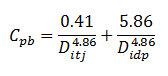
In general, each 100 ft of pipe, there is appoximately 6.7 ft of tool joint length (6.7% of total length) and 93.3 ft of drill pipe (93.3% of total length). Therefore, the general coefficient for internal diameter of pipe can be derived in to this following equation:

Continue reading

Pressure Losses Through Drill String Calculation

This articles demonstrates how to determine pressure losses through drill string.

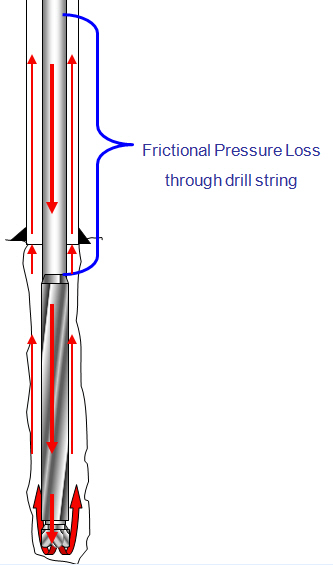
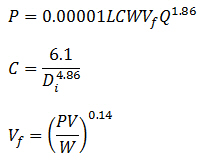
To determine pressure drop while the drilling mud is passing through a circular pipe (drill pipe and drill collar), you can calculate pressure loss with the following equation:

Assumptions:

Turbulent viscosity = 3 cp

Friction factor = 0.378(Q/D)-0.14

The first equation has a coefficient (C) to take into account the friction and the geometry of the bore ID.

Where:

P = pressure loss, psi

L = length of pipe, ft

W = mud density, ppg

Vf = viscosity correction factor

PV = plastic viscosity, centipoises

Q = flow rate, gpm

Di = inside diameter of pipe, inch

C = general coefficient for internal diameter of pipe

Continue reading

Five Useful Websites To Find The Oil and Gas Jobs

Finding the drilling job worldwide is not a tough job anymore because we have the internet that you can use to search the positions in oil and gas industry.

oil-and-gas-job-2


We would like to recommend you five online websites that you should take a look if you want to get the oil and gas jobs. Moreover you can see how much the oil and gas exploration grow over time. Let’s get started.

http://rigzone.com/

Rigzone is “Your Gateway to the Oil and Gas Industry” providing you with industry news and information, careers, company directory, offshore rig data, equipment marketplace, and more.

Rigzone provides its visitors and membership with an unequaled source of information – a true industry gateway full of dynamic, original content and resources that cannot be found anywhere else. Some of the key sections and services of Rigzone include:

Industry News and Analysis – news coverage of the latest news and events in the oil & gas industry

Career Center – a vibrant community of job seekers and employers in the oil and gas industry

Company Directory – the industry’s most complete listing of online oil and gas industry companies and related services

Offshore Rig Data Services – continually updated status and location information on the world’s offshore drilling fleet

Equipment Marketplace – online forum for buying and selling new and used oilfield equipment

Newsletter Subscriptions – daily, weekly, and monthly updates to your inbox full of news and commentary, rig information, and more

Continue reading

Drilling Hydraulics Optimization for the System with Downhole Tools

BHA - Ref. Spe.org

The system with downhole tools means the drill string consisting of drill pipe, drill collar, down hole equipment (MWD, PWD, LWD) and a bit. The process of optimization this system is more complicated than the simple system. Due to the fact that the down hole equipment responses differently when changing in flow rate, even the similar tool, the pressure responses cannot be modeled with simple equation.

There are two methods used to optimize drilling hydraulics with downhole tools.

1. The first method is to subtract the expected pressure loss generated by downhole tools from the surface pressure. After you get the reduced surface pressure, you optimize the system with lower pump pressure.

2. The second method is to optimize whole system as if there is no downhole equipment and then you subtract the expected pressure loss by downhole tools from available bit pressure.

What are the differences between both methods of optimization with downhole tools?

Continue reading