Reserve Fluid System and Pumping System in Koomey Unit

Reserve Fluid System in Koomey

According to API RP53, each closing unit should have a fluid reservoir tank with a capacity equal to or at least twice the usable fluid capacity of the accumulator system and reservoir fluid is stored at atmospheric pressure

Pumping System in Koomey Unit

Pumps in the Koomey Unit provide power to charge bottles to 3,000 psi. According to API RP53, it states about the pumping system as follows:

Two or three independent sources of power (Air, Electric or Nitrogen)

• For surface accumulators: With the accumulator removed from service, each pump system should be capable of closing the annular BOP on drill pipe, opening HCR and obtaining a minimum pressure of 200 psi over pre-charge pressure within 2 minutes.

Continue reading

Mechanism of Accumulator (Koomey Unit)

This topic describes how an accumulator (Koomey Unit) works. First of all, I will start with accumulator bottles. The accumulator bottles are used to store hydraulic pressure for closing/opening all blow out preventers. Each bottle, which has a rubber bladder inside, has a storage volume of 10 gallons. The rubber bladder inside is pre-charged to 1,000 psi with Nitrogen (N2). Each bottle will be pressured up 200 psi over the pressure charge pressure. At this stage, 1.7 gal of hydraulic fluid is used in order to compress N2 to minimum system pressure of 1,200 psi (200 psi over pre charge pressure), called “minimum operating pressure”. Hydraulic oil will be pumped into the bottle until pressure in the bladder reach 3,000 psi, called “Operating Pressure”. Volume of hydraulic fluid used to pressure up from 1200 psi to 3000 ps,which is called “Useable Fluid”, is equal to 5 gallons,


Note: I will show you how to use Bolye’s Law to figure out usable fluid later.

Accumulator Pressure Charging System

Continue reading

Factors Affecting Kick Tolerance

As you know, Kick Tolerance is the maximum gas kick volume for required Kick Intensity at a certain depth that you are able to successfully shut-in and circulate gas kick out of a well without breaking down formation at shoe.

There are several factors affecting kick tolerance as listed below:

Continue reading

Maximum pit gain from gas kick in water based mud

In water based mud, you can not only estimate the maximum surface casing pressure, but you are also be able to determine the maximum pit gain due to gas influx.

The following formula demonstrates how to figure out the maximum pit gain from gas influx in water based mud system.
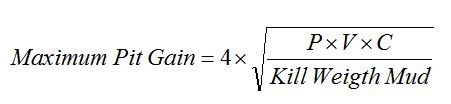
maximum pit gain


Where

Maximum Pit Gain in bbl

P is formation pressure in psi.

V is original pit gain in bbl.

C is annular capacity in bbl/ft.

Kill Weight Mud in ppg

Let’s take a look at this following example in order to get more understanding regarding this topic.

Drill well with water based mud.

Pit gain = 20 bbl

Initial shut in casing pressure = 600 psi

Initial shut in drill pipe pressure = 500 psi

Current mud weight = 12.5 ppg

Hole depth = 6,000’MD/4,800’TVD

Hole diameter = 12-1/4 inch

Drill pipe = 5 inch

According to the data, you need to figure out the Kill Mud Weight , formation pressure, and annular capacity.

Kill Weight Mud = current mud weight + (shut in drill pipe pressure ÷ (0.052 x TVD))

Kill Weight Mud = 12.5 + (500 ÷ (0.052 x 4800)) = 14.5 ppg

Note: Please read the following link about kill weight mud -> well control formulas

Formation pressure = surface pressure + hydrostatic pressure

Formation pressure = 500 + (0.052 x 12.5 x 4800) = 3620 psi

Note: Please read the following link about formation pressure -> Formation Pressure from Kick Analysis

Determine annular capacity: Annular capacity = (12.252 – 52) ÷ 1029.4 = 0.1215 bbl/ft

Note: if you would like to understand annular capacity, please check out the following links -> Annular Capacity

Once you get all parameters required, you can add all of them into the equation like this.
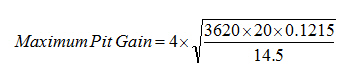
Maximum Pit Gain = 98.5 bbl

References

Cormack, D. (2007). An introduction to well control calculations for drilling operations. 1st ed. Texas: Springer.

Crumpton, H. (2010). Well Control for Completions and Interventions. 1st ed. Texas: Gulf Publishing.

Grace, R. (2003). Blowout and well control handbook [recurso electrónico]. 1st ed. Paises Bajos: Gulf Professional Pub.

Maximum Surface Pressure from Gas Influx in Water Based Mud

When a well is shut in due to well control operation, the casing pressure will increase due to gas migration and gas expansion. In water based mud, you are able to estimate the maximum surface pressure with this following formula.

Where;

Max surface pressure in psi.

P is expected formation pressure in psi.

V is pit volume gain in bbl.

KWM is kill weight mud in ppg.

An is an annular capacity in bbl/ft.

Continue reading