Cement Transition Period in The Oil Well Can Cause Well Control Situation

When cement is in transition period (forming the bond), you will lose some hydrostatic pressure because cement becomes solid phase, therefore only water in the cement will provide hydrostatic pressure. In many cases happened, there is no issue while performing the cement job, however; once the cement is set after period of time, there is a casing pressure indicating that there is hydrocarbon in the annulus.

This example will demonstrate you why the well is in underbalance condition while waiting on cement.

Well information: Previous 9-5/8” casing shoe at 4000’ ft.

The vertical well (8.5” hole) is drilled to TD at 10,000ft with 12.1 ppg mud and the pay zone is at 9,800’ TVD with reservoir pressure of 11.6 ppg. The cement is planned to cover 3,500 ft in the annulus above the casing shoe. Water used to mix cement is 8.3 ppg weight.
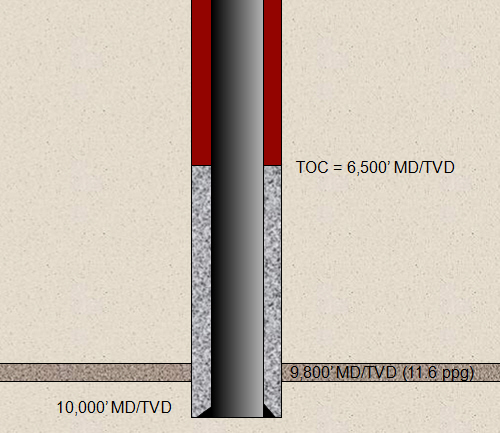
 cement Transition Period

Continue reading

Free Promotion Download Well Control Quiz Book: Basic Pressure In Well Control

We would like to have a free download promotion for our Kindle well control book “Basic Pressure In Well Control” which is the interactive quiz book running on kindle.

2-Basic-Pressure-In-Well-Control

This promotion will be only 5 days from 11-Feb-13 to 15-Feb-13.  This promotion will be end at 11:59 PM Pacific Standard Time on 15-Feb-13.

Please click this link to see the download page


http://amzn.to/QHXLKv

Continue reading

Iranian Oil Platform Sunk To Bottom of Persian Gulf During Installation

Iranian Oil Platform Sink


Iranian oil workers had to jump for their lives when part of a multi-million dollar oil platform began to sink into the Persian Gulf.


New video of last week’s sinking shows the workers running along the structure and diving into the water as the ‘jacket’ of the $40 million rig plunges under the waves. Continue reading

Drilling Formula Spread Sheet V1.5

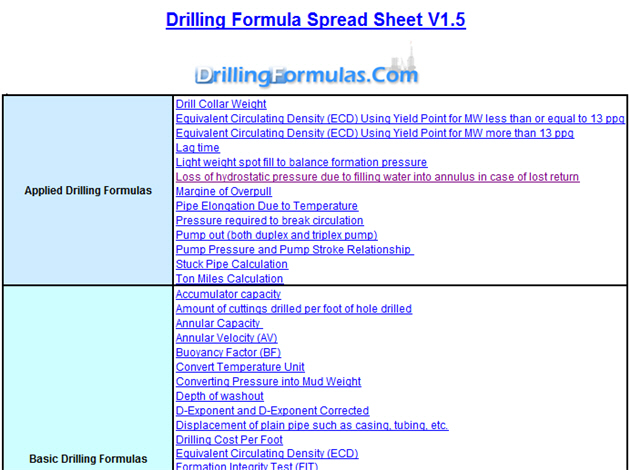
This is the updated version of drilling formulas (Figure 1 – Drilling Formula Spread Sheet V1.5). In this version, we’ve added several equations and fixed some errors.

The download period is end. If you like to get the spreadsheet, please subscribe to our mailing list here => http://eepurl.com/eXduw

 drilling formulas v1_5

Figure 1 – Drillingformulas Spread Sheet Version 1.5

Continue reading

How To Perform Volumetric Well Control Method

This article will demonstrate how to perform volume metric well control. There are a total of 5 steps as listed below;

146 How To Perform Volumetric Method 0

Step 1 – Calculation

Three calculations must be determined before conducting volumetric well control.

1. Safety Factor (SF) – The Safety Factor (SF) in an increase in bottom hole pressure which we allow to happen naturally when gas influx migrates up with the shut in well. SF is important because it will allow the bottom hole pressure to be over formation pressure so the well is not in underbalance condition while conducting later steps. Typically, SF is around 50 – 200 psi. If the initial shut in casing pressure is very close to maximum allowable surface pressure. Personnel must select small safety factor to prevent fracturing formation.

2. Pressure Increment (PI) – It is pressure used as a working pressure while conducting Volume Metric well control. This pressure will be equal amount of hydrostatic pressure of mud bled during each step.

3. Mud Increment (MI) – It is volume of mud bled off from the annulus to reduce hydrostatic pressure by amount of Pressure Increment. It is very important that the rig must have an accurate measurement to measure small amount of mud bled from annulus. Mud Increment is determined by the following equation:

 146 How To Perform Volumetric Method - MI

Where;

Mud Increment is in bbl.

PI is pressure increment in psi.

ACF is annular capacity factor in bbl/ft

MW is mud weight in ppg.

Continue reading