Bullheading Well Control Method

Bullheading is one of the well control methods which may be utilized in some occasions in order to control the well. Concept of bullheading is to pump kicks back into formations by using kill weight fluid. People usually use this method when normal circulation is impossible and volumetric method is not feasible to perform.

bullheading-Well-Control-Method-cover

When May You Consider Using the Bullheading Well Control Method?

  • When the kick size is very big so you may not be able to control the excessive volume coming to the surface.
  • When you need to reduce surface pressure in order to start further well control operations.
  • When there is a possibility to exceed surface pressure and volume gas on the surface if the conventional methods (drillers’ method, wait and weight and volumetric) are performed.
  • When there is no pipe in the hole while taking influx.
  • The influx contains high level of H2S which can cause safety of personnel on the rig.
  • When there is no feasible way to strip back to the bottom in order to kill in the flux below.

Continue reading

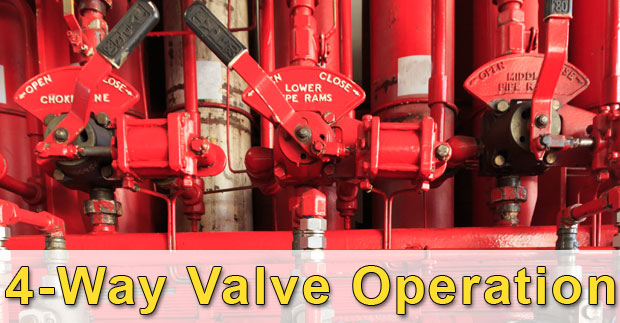
4-Way Valve Operation in Blow Out Preventer Accumulator (Koomey) Unit

4-way valves in the accumulator (Koomey) unit are used to control the position of Blow Out Preventer (BOP). Today we will go into the detail of 3 positions of 4-way vales in order to see how each position affects to the BOP.

4-way valve operation fb

Read more details about Koomey Unit here =>mechanism of Koomey unit.

Four-Way Vale in Open Position

When the valve is turned into the open position, it directs hydraulic pressure from the manifold into the BOP openning port therefore the BOP is in the open position. The hydraulic fluid in the ram closing chamber will return back to the reservoir tank. Figure 1 illustrates how the hydraulic pressure is lined up to open the BOP.

 4-way-vale-open-rams

Figure 1 – Open position of the 4-way valve

  Continue reading

Basic Understanding of Sub Sea BOP VDO Training

Sub Sea BOP is one of the most critical well control equipment in deep water drilling and it is a good topic for everybody working on the rig to learn.

Sub-sea-BOP-equipment-fb-size

Today, we would like to share a valuable VDO training regarding the basic of sub sea BOP. Additionally, we provides learner full VDO transcript to accelerate your learning curve.

Basic Understanding of Sub Sea BOP VDO Transcript

Subsea BOP equipment is similar to a surface stack. There are however some very important differences. This section discusses these differences.

Subsea stacks attached to the well head on the seafloor meanwhile the rig floats on the water hundreds of thousands of feet or meters above. Major parts include;

Continue reading

Basic Blow Out Preventer – VDO Training

Blow Out Preventer is one of the most critical equipment on the rig therefore it is very important that you need to understand it. This VDO demonstrates the basic of BOP with a lot of colorful pictures which will help you learn about it. We also add full VDO transcript in order to help people fully understand this topic. We wish you would love this.

Full VDO Transcript Deails

BOP-basic-fb

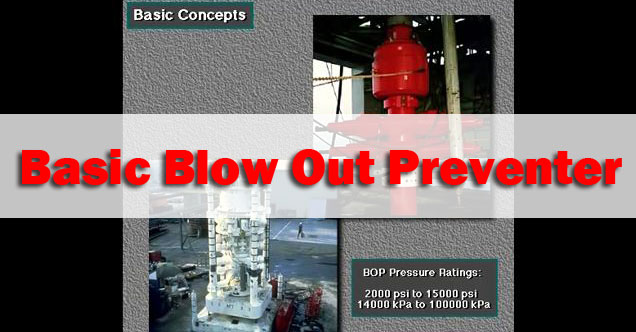
The blowout preventer, BOP stack, consists of several large valves stacked on top of each other. These large valves are called blowout preventers. Manufacturers rate BOP stacks to work against pressures as low as 2m000 pounds per square inch or psi and as high as 15,000 psi. That is about 14,000 kPa to over 100,000 kPa.

Rigs usually have two kinds of preventers, on top is an annular preventer it is called an annular preventer because it surrounds the top of the well bore in the shape of a ring or an annulus. Below the annular preventer are ram preventers. The shutoff valves in RAM preventers close my forcing or ramming themselves together.

The choke line is a line through which well fluids flow through the choke manifold when the preventers are closed. Even though the preventers shut in the well the core members must have a way to remove or circulate the kick in the mud out of the well. When the BOP shut in the well, mud and formation fluids exit through the choke line to the choke manifold. The manifold is made up of special piping and valves. The most important valve is the choke.

Continue reading