What is “Drilled Gas”?

While drilling, there will be a certain amount of the gas in cuttings entering into drilling fluid when we drill through porous formations that contain gas. The gas showing on the surface due to drilling through formations is called “Drilled Gas”.

When gas from the cutting comes into drilling fluid, it will expand as it is circulated out of hole, hence, you will see the gas from the monitors at the flow line. Even though we have overbalance hydrostatic pressure exerted by mud column, gas showing on the surface by this mechanism always happens. You cannot rise mud weight up to make it disappear.

Continue reading

Shut in Procedures and Their Importance

Shut in Well Procedures

The shut in procedure must be developed and practiced for every rig activity such as:

• Shut in while drilling
• Shut in while tripping
• Shut in while running casing, tubing, completion, etc.
• Shut in while performing workover operation
• Shut in while logging
• Shut in while performing drill stem test

What is the main reason why we need to have the shut in procedure and frequently practice it?

Continue reading

Possible Kick (wellbore influx) Indications Part2

This is the second part of the possible kick indications that I would like to share with you.

Decrease in d-Exponent Value

Normally, trends of d-Exponent will increase as we drill deeper, but this value will decrease to lower values than what we expect in transition zones. By closely monitored d-Exponent, d-Exponent chart will be useful for people on the rig to notify the high pressure transition zones.

Read and understand about d-Exponent and learn how to calculate d-Exponent and normalized d-Exponent (corrected d-Exponent)

Continue reading

Possible Kick (wellbore influx) Indications Part1

Possible Kick Indications mean that there is possibility to get influx into wellbore. The indications can be either kick or just formation react while drilling. You need to remember that just only a single possible indicator cannot may not good enough to identify underbalanced condition in wellbore and the possible kick indicators must be used collectively. Therefore, drilling team on the rig needs to closely monitor the well and prepare appropriate action plans.

The possible kick indications are as follows;

Continue reading

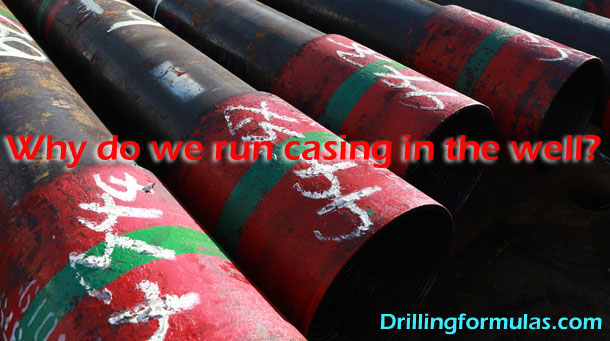
Why do we run casing in the well?

Simple question: “What are the reasons casing is run in the well?”

IMG_1119

There are several importance of casing as follow;

• To prevent collapse of the borehole

• To confine production to the wellbore

• To provide a flow path for drilling fluid

• To contain formation pressure and prevent fracturing of upper and weaker zones

• To provide an anchor for surface and sub surface equipment

• To provide a high strength flow conduit for drilling fluid to surface and ,with BOP , permit the safe control of formation pressure

• To prevent contamination of fluid in formations

• To exclude water zones from the producing formations


Any additional ideas are welcome.

Ref books: Cementing Technology Books