Hydraulicing Casing Calculation Example

For the previous topic, Hydraulicing Casing (pressure to lift the casing while cementing), you already know the concept. This topic will demonstrate you how to figure out if the casing will be hydraulically lifted while pumping cement.


Example:

Casing 9-5/8”, 40 ppf (pound per foot), ID of casing = 8.835”

Casing is set at 3,200’MD/3,000’TVD

Top of cement at 600’MD/550’TVD

Previous casing shoe (13-3/8”) = 1000’MD/900TVD

Cement weight = 14.0 ppg

Mud weight = 9.5 ppg

Displacement fluid weight (Brine) = 8.4 ppg


What is the condition at the static condition after cement in place?

What is the maximum pressure that we can apply before the casing is hydraulically pumped out of the well?

Continue reading

Balanced Cement Plug Calculation

You already learn about balance cement plug and I would like to show how to calculate balance cement plug.

 Let’s start with the concept so you can imagine how the calculation should be.

1. Determine volume of cement that you need.

2. Determine height of cement and spacer when pipe in hole.

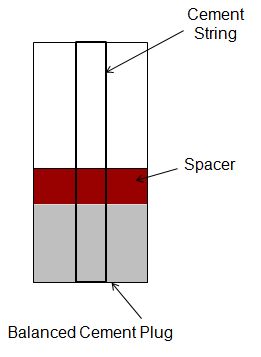
3. Determine displace volume to balance the hydrostatic both sides. When the displacement is completed, you should have equal height of cement/spacer/mud. You can see the figure below for more understanding.

4. When you pull cement stinger, you will have the balance set properly like this.

Continue reading

Balanced Cement Plug

Balanced cement plug is the method to set cement plug by applying concept of balanced hydrostatic. Generally speaking, when we say “balance”, it means that hydrostatic pressure at the end of the drilling string is the same as hydrostatic pressure in the annulus (see the figure below).


(Balance hydrostatic pressure both side)

Continue reading

Salt Cement Systems

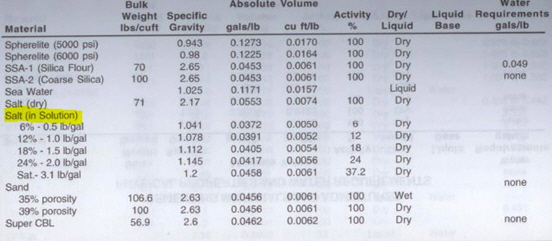
Some cement formulas have salt as NaCl, and KCl into the cement system and we call them “salt cement systems”. The salt cement systems cause confusion in cement calculations because salt can be dissolved in based fluid and the volume of salt in solid state is not the same as salt in solution phase. Therefore, density of solid salt is not the same as the dissolved salt in liquid.

To get correct density and absolute volume of salt solution, you can find information about from cementing hand books. The books should tell you how much % salt is in solution and how much absolute volume/density is. Please see an image below that I just got from my Halliburton redbook.

Continue reading

Calculate Cement Density and Yield Based on Cement Formula

This topic demonstrates how to determine cement density and yield as per the cement slurry formula.

The cement formula given from town is listed below:

Cement formula:

Class G cement

35% Silica sand

0.2 gps of chemical A

0.6 gps of chemical B

4.5 gps of drill water

The absolute volume of each material is listed below:

Class G cement = 0.0382 gal/lb

Silica sand = 0.0456 gal/lb

Chemical A = 0.0974 gal/lb

Chemical B = 0.103 gal/lb

Continue reading