Kill Weight Mud or Kill Drilling Fluid Density is the mud weight required to balance formation pressure. The kill weight mud may be pumped into the well at different time depending on kill methods (Driller’s method, Wait and Weight, Bull head, etc).

How to determine kill weight mud?
Oilfield Unit
With the following equation, you can determine this figure.
Kill Weight Mud (KWM) = Current Mud Weight + (SIDPP ÷ 0.052 ÷ Well TVD)
Where,
Kill Weight Mud (KWM) in ppg
Current Mud Weight in ppg
SIDP stands for “Shut In Drill Pipe Pressure” in psi.
Well TVD is true vertical depth of the well in ft.
Example:
Drilling with 9.5 ppg mud and current depth at 9,500’MD/9,000’ TVD. The well takes influx. Operation is stopped and the well is shut in.
Shut in drill pipe pressure = 500 psi.
Shut in casing pressure = 700 psi.
What is the kill weight mud?
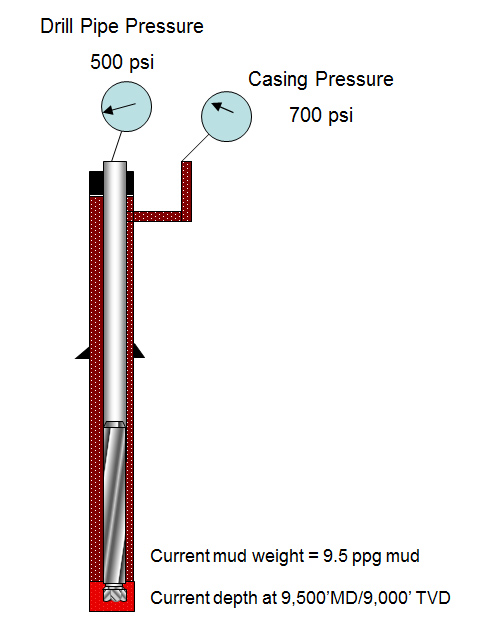
The kill weight mud required to balance formation pressure:
Kill Weight Mud (KWM) = 9.5 + (500 ÷ 0.052 ÷ 9,000)
Kill Weight Mud (KWM) = 10.6 ppg (round up number)
Metric Unit
With the following equation, you can determine this figure.
Kill Weight Mud (KWM) = Current Mud Weight + (SIDPP ÷ 0.00981 ÷ Well TVD)
Where,
Kill Weight Mud (KWM) in Kg/m³
Current Mud Weight in Kg/m³
SIDP stands for “Shut In Drill Pipe Pressure” in KPa.
Well TVD is true vertical depth of the well in m.
Example:
Drilling with 1,140 Kg/m³ mud and current depth at 3,000 m MD/2,700 m TVD. The well takes influx. Operation is stopped and the well is shut in.
Shut in drill pipe pressure = 3,450 KPa
Shut in casing pressure = 4,500 KPa
What is the kill weight mud?
The kill weight mud required to balance formation pressure:
Kill Weight Mud (KWM) = 1,140 + (3,450 ÷ 0.00981 ÷ 2,700) Kg/m³
Kill Weight Mud (KWM) = 1271 Kg/m³ (round up number)
Why do we need to use SIDPP?
When you take a kick (wellbore influx), the density of fluid in the annulus is very hard to predict because it is a mixture between drilling mud and influx. Therefore, you don’t know exactly what the density in the annulus is. Moreover if you take gas kick, shut in casing pressure will increase over time, and you will NOT be able to identify the right shut in pressure to determine formation pressure.
Looking at the drill pipe side, there is only one pure fluid column so you know exactly its density. With the precise mud density, you can apply hydrostatic pressure concept in order to get the formation pressure and kill weight mud (the equation is showed at the beginning of the topic).
Note: If your drilling string has a solid float, you will not be able to read SIDPP right away. So you need to bump the float to get SIDPP. You can read more detail about it via this > float bumping procedure.
Kill Weight Mud Spreadsheet (Oilfield and Metric Unit)
You can download the spreadsheet for free from the link below.
References
Cormack, D. (2007). An introduction to well control calculations for drilling operations. 1st ed. Texas: Springer.
Crumpton, H. (2010). Well Control for Completions and Interventions. 1st ed. Texas: Gulf Publishing.
Grace, R. (2003). Blowout and well control handbook [recurso electrónico]. 1st ed. Paises Bajos: Gulf Professional Pub.
Grace, R. and Cudd, B. (1994). Advanced blowout & well control. 1st ed. Houston: Gulf Publishing Company.
Watson, D., Brittenham, T. and Moore, P. (2003). Advanced well control. 1st ed. Richardson, Tex.: Society of Petroleum Engineers.


