You know about kick tolerance factor from previous section and you can use it to determine the maximum formation pressure which can be controlled when the well is shut in.

This equation below demonstrates you how to calculate it.
You know about kick tolerance factor from previous section and you can use it to determine the maximum formation pressure which can be controlled when the well is shut in.
This equation below demonstrates you how to calculate it.
Driller’s method is one of several methods to kill the well. The main idea of driller method is to kill the well with constant bottom hole pressure. The Driller’s Method of well control requires two complete and separate circulations of drilling fluid in the well. Learn about it via VDO multimedia.
Link from youtube >> http://www.youtube.com/watch?v=vPmKvm01-Hw
You have learned about the kick tolerance factor from the previous blog posting and this article will demonstrate you how to use the kick tolerance factor to determine the maximum surface pressure from it.
The formula is listed below;
Maximum surface pressure = kick tolerance factor x 0.052 x TVD of well
Where;
Maximum surface pressure in psi
kick tolerance factor in ppg
TVD of well in ft
Determine the maximum surface pressure with this following data:
Kick tolerance factor = 1.8 ppg
Hole depth = 10,000’MD/9500’TVD
Based on these data, you can calculate the maximum surface pressure like this;
Maximum surface pressure = 1.8 x 0.052 x 9500 = 889 psi
Please find the Excel sheet for this calculation  Maximum surface pressure from kick tolerance factor
Ref book: Formulas and Calculations for Drilling, Production and Workover, Second Edition
Hydrostatic pressure is created by fluid column and two factors affecting hydrostatic pressure are mud weight and True Vertical Depth. Learn about it via VDO multimedia.
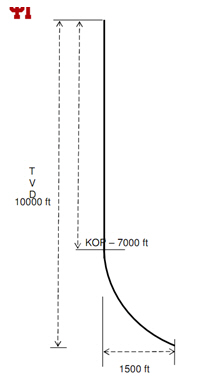
I got the question from my friend, Nien, asking me about directional drilling calculation and the question is shown below:
Wellplanner is planning to design a deep kick-off well with a build section to by pass a salt dome section. He intends to achieve a horizontal departure of 1500 ft at the with the TVD at the target point to be 10,000 ft. Calculate the measure depth and build up rate.