About DrillingFormulas.Com

Working in the oil field and loving to share knowledge.

Buoyancy Effect on Weight of Tubular Submersed in Fluid

When a tubular submerses into drilling fluid or completion fluid, it will affect how the force distribution works on the tubular. This article will describe how buoyancy will affect tubular weight and a location of neutral axial load (zero axial load).

Weight of Tubing in Air

When tubing is hung in the air, the string weight is equal to linear weight per foot multiplied by the total length of the string. The maximum tensile load is on surface and the zero axial load point is at the bottom.

Tubing Detail

  • 5” Tubing
  • Weight per length = 17.7 lb/ft
  • Total Length = 10,000 ft

Total weight = 17.7 x 10,000 = 177,000 lb

Weight at the bottom of tubing is 0 and weight on top is 177,000 lb in tensile.

Figure 1 demonstrates force distribution of tubing hanging in air.
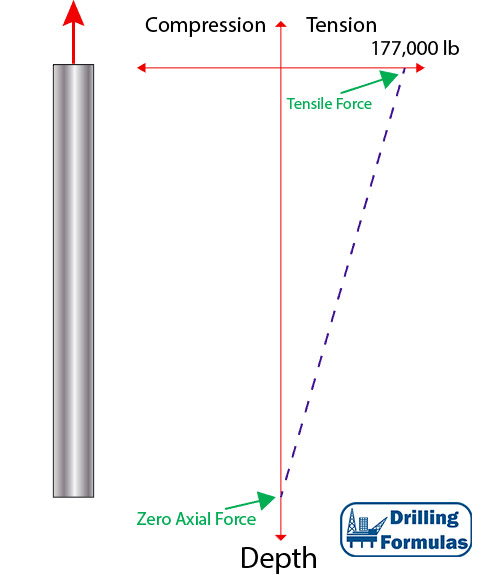
Figure 1 - Weight of Tubing in Air

Figure 1 – Weight of Tubing in Air

Weight of Tubing When Submersed in Fluid Continue reading

Design Factor for Tubular Design

Tubular must be properly deigned to cover all anticipated load cases during the life of the well.  Engineers must select the appropriate tubular grade and weight, which will withstand the loads and be economic for the project. High grade to tubular can lead to excessive cost, which may not be economic viable. However, if the selected tubular is very close to the anticipated load, it might not be safe to operate the well. Therefore, engineers must fully understand the concept about design factors in tubular design.

Continue reading

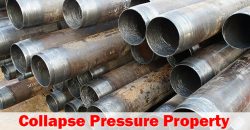
Collapse Pressure Property for Oilfield Tubular

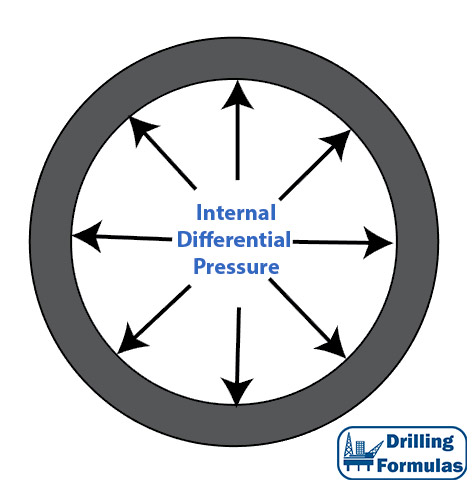
Collapse happens when differential between external and internal pressure exceeds a collapse rating pressure of material. This situation can happen due to several cases, such as pressure testing in annulus, trapped pressure in the annulus or well fully evacuated with gas, etc.

Figure 1 - Collapse Pressure Diagram

Figure 1 – Collapse Pressure Diagram


Collapse pressure equations come from experiments from test specimens and the full details can be found in API Bulleting 5C3, Formulas and Calculations for Casing, Tubing, Drillpipe, and Line Pipe Properties. From the experimental results, there are 4 collapse regimes based on Diameter of pipe/Wall thickness (D/t) and yield strength of material which are yield strength collapse, plastic collapse, transitional collapse and elastic collapse. Continue reading

Burst (Internal Yield Pressure) Property of Tubular

Burst is a condition where internal pressure exceeds pressure loading. Burst can happen in several situations, such as well control, pressure test casing/tubing, pumping operation, etc.

Figure 1 - Burst Pressure Diagram

Figure 1 – Burst Pressure Diagram

Minimum burst rating pressure (internal yield pressure) can be calculated by the following equation.

Where;

Continue reading