About DrillingFormulas.Com

Working in the oil field and loving to share knowledge.

Advice for New Graduates During Downturn of Oil and Gas Industry

Obviously this isn’t the best time to graduate in Geophysics, Geology or Engineering if you have a plan to make a career in oil & gas at this time 2016. However, it isn’t the first time that such precipitous fall in the oil prices has taken place, and many people in the industry today graduated when the prices of oil previously hit low levels, quite similar to the present situation. So what are the things that new graduates should do in order to position themselves for the time when oil prices finally begins rising again and “recovery” starts in the oil industry.

Advice-For-New-Graduates-In-Times-Of-Low-Oil-Prices Continue reading

Basic Sand Control Methods in Oil and Gas Industry

Sand control is a method to control sand production into a wellbore. This is common requirement for several oil and gas producing wells around the world. There are two situations which cause sand production. The first cause is rock mechanical failure near wellbore and the second one is dragging force from producing or injection fluid. Sand production can lead to several issues such as production impairment due to sand plugging, erosion to completion string and down hole tool, damage surface facilities as separator, piping, etc.

In order to avoid sand production, there are two main methods as listed below;

Passive sand control

This method uses non-intrusive measures to control, mitigate or avoid sand production from the reservoir. The following techniques are passive sand control methods.

  • Oriented perforation
  • Selective perforation
  • Sand management

Active sand control

This method relies on the use of filters to control sand production and it is known as intrusive measure. The following techniques are active sand control methods.

  • Stand alone screens (slotted liner, wire-wrapped screen, prepacked screen and premium screen)
  • Expandable sand screen
  • Gravel pack & Frack Pack
  • Chemical consolidation

Continue reading

Multiple Zone Completion

Multiple zone completion is one type of completion which allows operators to selectively produce or comingle reservoir fluid from different zones into one well.  It is also possible to workover the upper part of completion string without removing the next interval completion.  Additionally, through tubing perforation is can  performed at the bottom zone.  A multiple zone completion can be divided into two parts, which are single string completion and multiple string completion.

multiple-zone-completion-cover Continue reading

Single Zone Completion

Single zone completion is one of the types of upper completion which allows producing only one zone. Production tubing is a flow path for fluid from a reservoir to flow to the surface so it protects the casing from corrosion and maximizes the efficiency of the flow.

In a single tubing string completion, typically a packer is set on top of a reservoir so the reservoir fluid can flow up into the production tubing. Types of packers are based on several factors as temperature, pressure, reservoir fluid, etc. Additionally, complexity of tubing and packer installation is driven by objectives.

Single-Zone-Completion-cover Continue reading

Cased and Perforated Completion

Cased and perforated completion is the most common type of completion which is selected my many companies. For this completion, a production casing or a liner is cemented through reservoir zone(s) and subsequently, a well is perforated in order to provide communication between the formation and wellbore.

Perforation should ideally penetrate deeper rather than nearer a wellbore damage zone around a wellbore so fluid from a reservoir can effectively flow into a wellbore. Additionally, several depth control methods help to accurately select which section of reservoir to be perforated. Hence, undesired zones, such as gas, water or weak formation can be avoided and this will improve well production efficiency.

Cementing around the wellbore is one of the critical parts for this completion because good cement will effectively isolate all zones and allows a wellbore to produce from several zones without communication between reservoirs. Moreover, packers are run into a wellbore to isolate reservoir fluid when it flows into a wellbore.

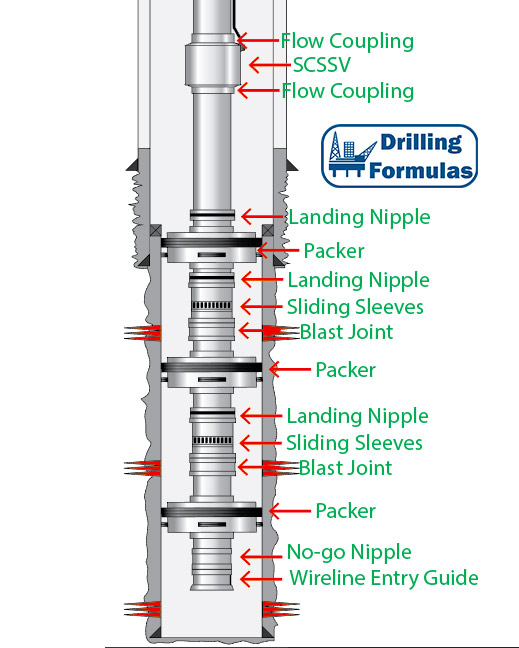
Another important feature of this completion is the ability to selectively produce or inject into any reservoir. A sliding sleeve on each zone can be opened and closed to allow selective production or injection operation. Figure 1 illustrates the diagram of cased and perforated completion.

Example of Cased and Perforated Schematic

Figure 1- Example of Cased and Perforated Schematic

Continue reading