About DrillingFormulas.Com

Working in the oil field and loving to share knowledge.

Pm, Pf and Mf of Drilling Mud (Water based mud)

Pm, Pf and Mf are values indicating the alkalinity of drilling mud and the following is meaning of each value.

Pm

Pm stands for “phenolphthalein end point of the mud” and it indicates quantities of Potassium Hydroxide (KOH), caustic soda, cement, etc., in the water base mud.  The Pm refers to the amount of acid required to reduce the pH of mud to 8.3. The Pm test includes the effect of both dissolved and non-dissolved bases and salts in drilling fluid.  Especially in lime mud, Pm is used to determine the ratio of insoluble lime to soluble lime in the filtrate.

Pf

Pf stands for the phenolphthalein alkalinity of the mud filtrate. Pf is different from the Pm because it tests the affect of only dissolved bases and salts.  However, Pm includes the effect of both dissolved and non-dissolved bases and salts in drilling mud. Continue reading

pH in Drilling Mud (Water Based Mud)

pH is a value representing the hydrogen ion concentration in liquid and it is used to indicate acidity or alkalinity of drilling mud. The pH is presented in a numerical value (0-14), which means an inverse measurement of hydrogen concentration in the fluid.

The pH formula is listed below;

pH = -log10[H]

Where: H is the hydrogen ion concentration in mol.

According to the pH formula, the more hydrogen atoms present, the more acidity of substance is but the pH valve decreases. Generally speaking, a pH of 7 means neutral. Fluids with a pH above 7 are considered as being alkaline. On the other hand, the fluids with pH below 7 are defined as being acidic.

In the drilling mud, there are three main chemical components involved in Alkalinity of drilling fluid, which are bicarbonate ions (HCO3), hydroxyl ions (OH), and carbonate ions (CO3-2). The Alkalinity means ions that will reduce the acidity. Continue reading

Pemex oil facility explosion in Coatzacoalcos

Safety is very crucial in oil and gas industry. We wish most of people would be safe and the situation would be back to normal soon.

MEXICO CITY, April 20 (Reuters) – A massive explosion rocked a major petrochemical facility of Mexican national oil company Pemex in the Gulf state of Veracruz on Wednesday (20-Apr-16), killing at least three people, injuring dozens more, and pumping a cloud of noxious chemicals into the sky. Luis Felipe Puente, head of federal emergency services, told Reuters that three people had died in the blast. Pemex confirmed that three of its workers had died, and said another 136 were injured, of which 88 were still in the hospital.

Continue reading

Solid Content in Drill Mud

Solid content is a fraction of the total solid in drilling mud, and it always increases while drilling ahead because of drilling solid (cuttings), mud chemical additives and weighting material. Solid content refers to soluble and insoluble solid content in the drilling fluid system.

solid-content-in-mud

There are three types of solid contents as listed below;

Soluble material such as salt
Insoluble high gravity solid (HGS) such as weighting agents (barite, calcium carbonate, hematite, etc.)
Insoluble low gravity solid (LGS) or drilled solid such as solids particles from cuttings

Continue reading

Example of Real Gas Calculation

This example will demonstrate how to calculate the compressibility of real gas in order to determine gas density and specific gravity at a specific condition.

Calculate the following based on the given condition:

1) Density of this gas under the reservoir conditions of 7,500psia and 220ºF,

2) Specific gravity of the gas.

Gas component is shown in Table 1
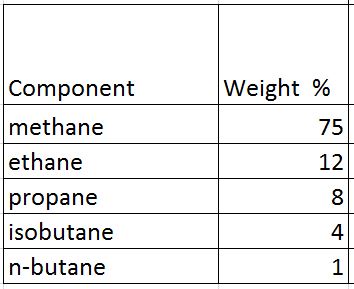
Table 1 - Gas Component

Table 1 – Gas Component

Average density of air = 28.96 lb/cu-ft

Solution

  • Determine critical pressure and temperature of gas mixtures using Kay’s rule
Table 2 - Critical Pressure and Temperature

Table 2 – Critical Pressure and Temperature

Note: critical pressure and temperature can be found from this link – https://www.drillingformulas.com/determine-compressibility-of-gases/

Pc’ = Σyipci = 660.5 psia

Tc’ = ΣyiTci = -46.2 F = -46.2 +460 F = 413.8 R
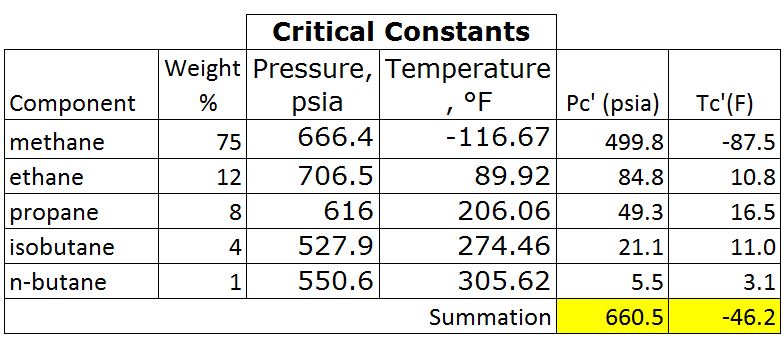
Table 3 - Pc' and Tr' by Kay's Rule

Table 3 – Pc’ and Tr’ by Kay’s Rule

  • Calculate Tr and Pr

Tr = T ÷Tc

Tr = (220+460) ÷ (-46.2+460)

Tr = 1.64

Note: temperature must be in Rankin.

Rankin = Fahrenheit + 460

For the critical temperature calculation, it can be converted the critical temperature from F to R before calculating Tc’. This will still give the same result. 

Pr = P ÷ Pc

Pr = 7500 ÷ 660.5 = 11.4

  • Read the compressibility factor (z) from the chart.

z = 1.22

Figure 1-z-factor from the Standing and Katz Chart

Figure 1-z-factor from the Standing and Katz Chart

  • Calculate average molar mass

Average Molar Mass = Σyi×Mi = 22.1 lb

Table 4 - Average Molar Mass of Gas

Table 4 – Average Molar Mass of Gas

  • Calculate density of gas from the equation below;
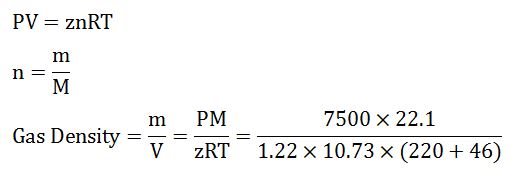
gas density

Gas Density = 18.6 lb/cu-ft

  • Calculate gas specific gravity from the equation below;

SG = Gas Density ÷ Air Density

SG = 18.6 ÷ 28.96

SG = 0.64

Summary:

The answers for this answer are listed below;

Gas Density = 18.6 lb/cu-ft

SG = 0.64

We wish that this example will help you understand to determine z-factor and use it to calculate any related information.

References

Abhijit Y. Dandekar, 2013. Petroleum Reservoir Rock and Fluid Properties, Second Edition. 2 Edition. CRC Press.

L.P. Dake, 1983. Fundamentals of Reservoir Engineering, Volume 8 (Developments in Petroleum Science). New impression Edition. Elsevier Science.

Tarek Ahmed PhD PE, 2011. Advanced Reservoir Management and Engineering, Second Edition. 2 Edition. Gulf Professional Publishing.