About DrillingFormulas.Com

Working in the oil field and loving to share knowledge.

Determine Compressibility of Gases

This article will demonstrate how to determine gas compressibility by using simplified equation of state.

At a low pressure condition, gas similarly behaves like ideal gas and the equation for the ideal gas law is listed below;

PV = nRT

Where;

P = pressure

V = gas volume

T = absolute temperature

n = number of moles of gas

R = gas constant

Gas constant (R) is different because it depends on the unit system used in the calculation. The R in the different unit system is demonstrated in the below table.

1 table for R

Table 1 – Gas Constant (R) at Different Unit

Continue reading

Mud Filter Cake

Mud filter cake is a layer formed by solid particles in drilling mud against porous zones due to differential pressure between hydrostatic pressure and formation pressure.  For the drilling operation, it is preferred to have a filter cake that is impermeable and thin. Practically, the filter cake from API or HTHP fluid loss test should be less than or equal to 1/16 inch. If drilling fluid is not in a good shape, which results in a thick filter cake in the wellbore, it will lead to a stuck pipe situation and high torque/drag.

Mud filter cake

Mud Filter Cake from HTHP Fluid Loss Test (http://oilfieldpix.com/photo/679/Mud-filter-cake.html)

Continue reading

API and HTHP Fluid Loss

Fluid loss is one of important drilling fluid properties and two type of fluid loss are API and HTHP fluid loss. This article will explain about both of them and effect on the drilling operation.

API Fluid Loss Test

API Fluid Loss Test (low-pressure, low-temperature filtration test) is a test used to measure a filtration of mud with ambient temperature and 100 psi differential pressure. The API fluid loss testing equipment is shown below (Figure 1).

Figure 1 - API Fluid Loss Test Kit

Figure 1 – API Fluid Loss Test Kit

How will the drilling mud be tested?

  • Place a filter
  • Add the sample into the testing chamber
  • Place the chamber in the testing kit
  • Apply 100 psi pressure
  • Record volume for 30 minutes; at the end of the test the volume of filtrate will be recorded.
  • Record thickness of filter cake

Continue reading

Volumetric Method To Estimate Volume In Place and Reserves

Volumetric is a method to estimate fluid in reservoir based on volume of pore space in a rock and water saturation.

Volume of Oil Initially In Place (OIIP)

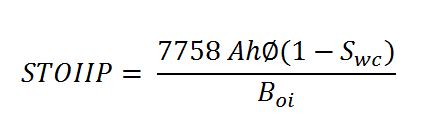
To estimate oil initially volume in place, the following formula is a volumetric calculation for oil.

STOIIP

Where;

STOIIP = stock tank oil in place, stb

A= area, acre

h = reservoir thickness, ft

ɸ = rock porosity, %

Swc =connate water saturation, %

Boi = oil formation volume factor, rb/stb

Note: the stock tank condition is a standard surface condition of oil and gas at 60F and 14.7 psia. Continue reading

Determine Quantity of Material Used in Mixing a Simple Drilling Mud

This is a simple example to demonstrate how to determine quantity of material required in a simple mixing system. Let’s learn from the example below.

The objective is to build mud which has a weight of 11.0 ppg with 1,000 bbl.

The mud recipe is shown below;

  • 30 ppb bentonite
  • 5 ppb CMC polymer
  • 5 ppb caustic soda (NaOH)
  • 25 ppb Na2CO3
  • Weighting Material is barite.

The following are important data of water and chemical used for this calculation.

Base fluid = fresh water

Specific gravity of water = 1

Specific gravity of barite = 4.2

Specific gravity of bentonite = 2.4

Specific gravity of CMC polymer = 2.4

Fresh water weight = 8.34 ppg

NaOH and Na3CO3 have negligible volume because it is dissolvable.

What is quantity of material required to meet the mud specification?

What is the final volume? Continue reading