About DrillingFormulas.Com

Working in the oil field and loving to share knowledge.

Rock Compressibility

Compressibility is a relative volume change of a fluid or solid in a response to a pressure change. We can relate this into a reservoir engineering aspect. Overburden pressure is rock weight and it typically has a gradient of 1 psi/ft. Rock metric and formation fluid in pore spaces supports the weight of rock above. When petroleum is produced from reservoir rocks, pressure of fluid in pore space decreases, but overburden is still the same. This will result in the reduction of bulk volume of rock and pore spaces. The reduction on volume in relation to pressure is called “pore volume compressibility (cf)” or “formation compressibility” and it can be mathematically expressed like this.
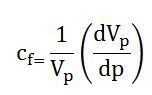
rock compressibility equation Continue reading

Well Control

This page contains well control contents in this site.

well-control-in-one-page

Basic Calculation Related to Well Control

Adjusted maximum allowable shut-in casing pressure
Brine weight with temperature correction
Calculate Annular Capacity
Calculate Annular Pressure Loss
Calculate Equivalent Circulation Density (ECD) with complex engineering equations
Calculate Influx Height
Calculate inner capacity of open hole/inside cylindrical objects
Calculate Pressure Gradient and Convert Pressure Gradient
Calculate Specific Gravity (SG) in oilfield unit
Convert Pressure into Equivalent Mud Weight
Convert specific gravity to mud weight (ppg and lb/ft3) and pressure gradient (psi/ft)
Corrected D Exponent Calculation
D Exponent Calculation
Determine height of light weight spot pill to balance formation pressure
Determine the actual gas migration rate
Drill pipe pulled to lose hydrostatic pressure
Equivalent Circulating Density (ECD) in ppg
Equivalent Circulating Density (ECD) Using Yield Point for MW less than 13 ppg
Equivalent Circulating Density (ECD) Using Yield Point for MW More than 13 ppg
Estimate gas migration rate in a shut in well
Estimate Type of Influx (kick)
Formation Integrity Test (FIT) Procedure and Calculation
Formation Pressure from Kick Analysis
How does the 0.052 constant come from?
Hydraulic Horse Power (HPP) Calculation
Hydrostatic Pressure (HP) Decrease When POOH
Hydrostatic Pressure Calculation
Hydrostatic Pressure Loss Due to Gas Cut Mud
Kick Tolerance Calculation
Kill Weight Mud
Leak Off Test (Procedures and Calcuation)
Loss of Hydrostatic Pressure due to Lost Return
Maximum pit gain from gas kick in water based mud
Maximum Surface Pressure from Gas Influx in Water Based Mud
Pipe Displacement Calculation
Pump Output Calculation for Duplex Pump and Triplex Pump
Pump pressure and pump stroke relationship
Temperature Conversion Formulas
Continue reading

What is Porosity?

Porosity is one of rock important rock properties and it is a measure of pore space in a rock.

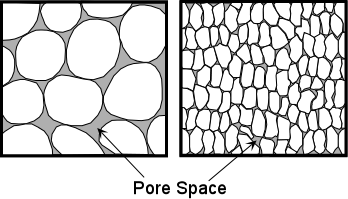
Figure 1 – Porosity

(Ref: http://www.tulane.edu/~sanelson/images/pores.gif)

Figure 1 shows the illustration of porosity and it can be seen that grain size and distribution can affect porosity of rock.

Porosity (ɸ) is mathematically expressed as a ratio of total void space with a rock to a total volume of rock.

Porosity (ɸ) = (Vp ÷ Vb) × 100

Where;

Vp = pore volume

Vb = bulk volume of rock

Porosity (ɸ) is shown in percentage form. Continue reading

Rotary Friction Welding for Oilfield Drill Pipe

This is very interesting to see how the body of drill pipe and tool joint together using the rotary friction welding.

The friction welding or FRW is solid-state welding process which generates the heat using the friction between the work pieces in relative motion to each other, with addition of lateral force known as “upset” in order to displace and fuse materials plastically. Technically, no melt takes place and in the traditional sense friction welding isn’t a process of welding, rather it is a forging technique. Because of similarities between traditional welding and these techniques, it has become a commonly used term. The friction welding is used with thermoplastics and metals in a variety of automotive and aviation applications.

Benefits of Friction Welding Continue reading

5 Steps To Heaven in Petroleum Geology

The 5 Steps to Heaven, which are source, migration, reservoir, seal and trap, is one of the most important concepts of petroleum geology. This tells us how petroleum was formed, migrated and trapped in a reservoir. Please note that the 5 Steps to Heaven is valid for conventional petroleum resources.

5-Step-to-Heaven

Source

Typically, organic matter from animals and plants is oxidized and turned an organic matter into carbon dioxide and water. However, if organic matter is buried rapidly, it may be preserved and can be turned into petroleum. These following conditions enhance organic matter preservation.

  • High sedimentation rate
  • Fine grain size so oxygen will not be able to penetrate and oxidize the organic matter
  • Anoxic bottom water

These conditions are mostly found in shale and fine limestone, which are common source rocks. Continue reading