About DrillingFormulas.Com

Working in the oil field and loving to share knowledge.

Mud Weight and Its Importance in Drilling

Mud weight or mud density is a weight of mud per unit volume. It is one of the most important drilling fluid properties because it controls formation pressure and it also helps wellbore stability. Mud weight is measured and reported in pounds per gallon (PPG), pounds per cubic feet (lb/ft3), or grams per milliliter (b/ml).
Mud weight is normally measured by a conventional mud balance; however, if you have some air inside a fluid phase, reading from the conventional mud balance will give you an inaccurate number. Therefore, the most accurate method to measure the mud weight is with a pressurized mud balance.
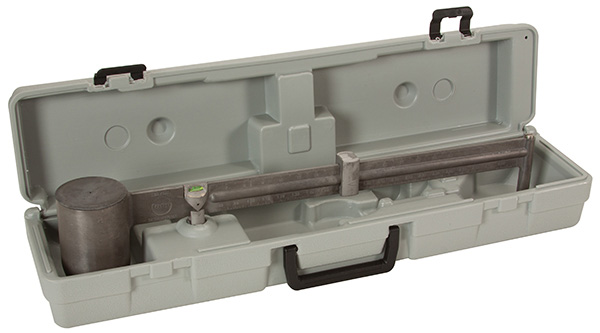
conventional mud balance

Conventional Mud Balance

Pressurized Mud Balance

Pressurized Mud Balance

The pressurized mud balance looks like the convention one, but it has a pressurized sample cup. When you press a mud sample into the cup, any gas in a fluid phase is compressed to a very small volume so the mud weight measurement is more accurate. Continue reading

Basic Understanding about 3D Seismic for Petroleum Exploration

3D seismic is one of the most important techniques to help geologists and engineers to find out where possible hydrocarbon is below thousands of feet below the earth surface. Without 3D seismic technology, many oilfields cannot be discovered.

We’ve found this excellent which will give you some ideas of how 3D seismic works in order to help us find oil and gas. Additionally, we also provide the full video transcript to help someone to learn about this topic. We wish you would enjoy watching and learning from this VDO.


  Continue reading

What was happened? Kelly was bent.

We just got photo from our friend sharing these images of Kelly which was bent from parted drillstring.
This is the details.

While working the stuck drillstem using the kelly rig system, maximum tensile load applied on surface was about 375 Klb (170 tonne)  and the over pull was about 155 klb (70 tonne) and then the drill pipe was suddenly parted. This resulted in the Kelly to pop out of rotary table and the swivel bail came out of the hook. Therefore, the Kelly fail down freely because there was nothing to hold it. The equipment went down with the Kelly which was bent due to falling action from the rotary table to outside of the rig floor. Fortunately, nobody got injured from this incident.

Kelly-Bent-Over-From-The-Rotary-Table-1 Kelly-Bent-Over-From-The-Rotary-Table-2

Continue reading

What is Kelly Rig?

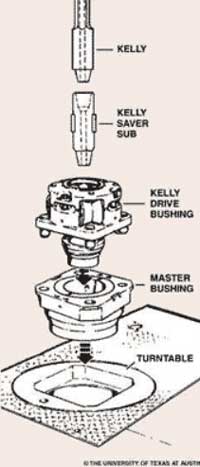
This is the brief explanation of a Kelly rotating system on the rig. Kelly rig is on an old style rigs and  nowadays it is mostly used on land operations. For offshore operation, a top drive system is used instead.

First of all, it is important for new people to look at these images before reading the information below because they show the equipment’s name and where they are on the rig.

Continue reading

What are differences between Mast and Derrick?

Mast and derrick are used to support load from hoisting system and drilling load. However, they are different.

Mast

Referring to the API definition, a mast is a structural tower comprised of one or more sections assembled in a horizontal position near the ground and then raised to the operating position. If the unit contains two or more sections, it may be telescoped or unfolded during the erection procedure. Generally, masts are assembled on the ground in a horizontal position and then are raised using the draw works. Some masts use telescopic sections and are assembled in a vertical (boot strap) fashion. Masts are normally used on land rigs; they are rarely used on offshore rigs.

drilling-mast Continue reading