What is Drilling Ton-Mile (TM)?

Drilling Ton-Mile is the work of drilling line that is commonly measured as the cumulative of the load lifted in tons and the distance lifted or lowered in miles. When the predetermined ton-mile limit is reached, drilling contractors will perform slip and cut drilling line to prevent drilling line fatigue.

When drilling line is spooled on and off a drawworks drum during operation as drilling a well, running casing, coring, etc.The drilling line get worn out; therefore, drilling contractors must cut old section and replace with new section of drilling line at specific period based on ton mile calculation.

The most worn area is the end of drilling line where is constantly spooled over the draw works drum. A section of drilling line, typically around 100 ft, is cut then the drilling line is re-attached to the draw works drum and the amount cut off is spooled back on the drum. This operation is called “slip and cut drilling line”.

Note: Ton-mile is the important figure that must be recorded correctly. However, the most important is to visually inspect drilling line all time to see if there is any worn out wire. If you see the worn out line, you need to cut the drilling line even though the drilling line does  not reach ton-mile limit yet.

All types of ton-mile service should be calculated and recorded in order to obtain a true picture of the total service received from the rotary drilling line. There are several types of ton miles as follows;

1. Round trip ton-miles
2. Drilling or “connection” ton-miles
3. Coring ton-miles
4. Ton-miles setting casing
5. Short-trip ton-miles

Ref book: Formulas and Calculations for Drilling, Production and Workover, Second Edition
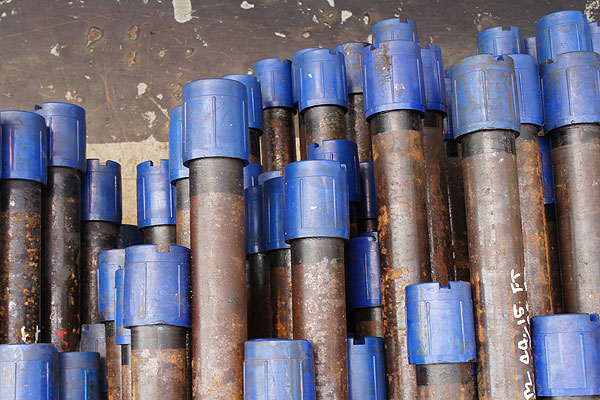
What factors must be considered when designing a casing/tubing string?

Casing and tubing selection are one of the critical tasks that engineers must carefully decide which type of casing/tubing will be used in the wellbore in order to meet the objective of each well.  I would like to share my knowledge about the selection criteria for casing/tubing string design.

Oilfield Tubing

Oilfield Tubing

The factors must be contemplated when designing a casing and/or tubing string as listed below;

• Reservoir fluid type (oil, gas, or combine)
• Depth of casing and tubing string
• Formation Pressure gradient and fracture gradient
• Reservoir temperature
• How much reserves of reservoir
• How long of production life of wells
• Economic consideration
• Strategy of completion technique as conventional completion, monobore completion, monobore horizontal completion, etc.
• Production plan as production rate, how plateau rate be maintained, secondary recovery plan, etc.
• Bottom hole reservoir pressure and expected surface pressure during future production plan
• Level of sour gas as H2S and CO2
• Hydrocarbon zones are required to be covered by cement
• Tubing size needed to achieve production and stimulation plan
• Artificial lift equipment requirements
• Future workover plan
• Physical property of material
• Clearances needed for fishing
• Type of connection

If you have any more considerations, please feel free to share : )


What is slug mud? How much volume and weight of slug mud should be?

Slug Mud: It is heavy mud which is used to push lighter mud weight down before pulling drill pipe out of hole. Slug is used when pipe became wet while pulling out of hole.

Normally, 1.5 to 2 PPG over current mud weight is a rule of thumb to decide how much weight of slug should be. For example, current mud weight is 10 PPG. Slug weight should be about 11.5 to 12 PPG.

Normally, slug is pumped to push mud down approximate 200 ft (+/2 stands) and slug volume can be calculated by applying a concept of U-tube (see a figure below)

Volume of slug can be calculated by this following equation:

This equation expresses that the higher slug volume, the deeper of dry in drill pipe is met. As per the above equation, length of dry pipe can be substituted by 200 ft.

In normal practice, slug volume pumped to clean drill pipe is around 15-25 bbl depending on drillpipe size. Moreover, it also depends on situations because sometime mud in annulus side may be heavier than measured MW due to cutting, drilling solid contaminated in mud, hence more slug volume is needed.

Ref books: 

Lapeyrouse, N.J., 2002. Formulas and calculations for drilling, production and workover, Boston: Gulf Professional publishing.

Bourgoyne, A.J.T., Chenevert , M.E. & Millheim, K.K., 1986. SPE Textbook Series, Volume 2: Applied Drilling Engineering, Society of Petroleum Engineers.

Mitchell, R.F., Miska, S. & Aadny, B.S., 2011. Fundamentals of drilling engineering, Richardson, TX: Society of Petroleum Engineers.

Drilling Mud Motor Concerns and Practices

I got some questions from Mike R Hogolan regarding mud motor concerns. The questions are very interesting and I would like to share some answers to you all as well.

Why is it more difficult to steer a motor the deeper section of wellbore?

It is harder to steer the motor when well is deeper because the friction exerted from formation to drillstring in open hole section increases. Motor cannot be effectively used to drilled deeper along all well path because high friction force exerted on BHA, higher temperature as well deeper can cause rotor, made of synthetic rubber, failure.

Why is the most effective steering by using the pump pressure gauge rather than the weight indicator?

Driller will use the pump pressure gauge as opposed to the weight indicator because WOB is not accurate while steering. High friction force between drillstring and formation is created when steering. If there are consistent circulating mud properties, flow rate and formation characteristics should be within the normal motor operating range, an increase or decrease in weight on bit will result in a directly proportional increase or decrease in pump pressure.

What is meant by stalling a motor?
Stalling motor means that steerable motor stalls at bottom hole (can not rotate) because of higher WOB, harder formation, not enough torque to turn the bit, etc. When motor stalling, stand pipe pressure increases significantly and ROP significantly drops.

What are indicators a motor is wearing out?
Indicators demonstrate a motor worn out as follows:
• Lower ROP without any changes of parameter on surface
• Difficult to control well direction as per designed well trajectory
• Increase in pump pressure
• Easily motor stall

Reference books: Directional Drilling Books

What are the differences between steering (orienting or sliding) and rotating?

Steering (orienting or sliding) is drilling with mud downhole steerable mud motor. Drilling with the steerable motor does not rotate drill pipe because it uses hydraulic power to drive down hole motor and bit. Steering is used in order to control well direction.

Rotating is drilling with Topdrive or rotary table and drillstring is rotated in order to gouge the hole. Rotary drilling will be used when straight hole direction is needed.

Comparing between steering and rotating, steering can create dog leg more than rotating because mud motor incorporating with bend housing is designed to directionally drill to the specified direction; however, when Rotating, BHA is stiffer and has tendency to hold the direction.

Rotating ROP is always faster than steering ROP by these following reasons:
• Friction force exerts on stable drill string when steering is always more than rotating.
• When steering, WOB is limited. Motor can be stalled or worn out if WOB excesses.
• Direction of well must be controlled carefully that means well can not be drilled faster.

Reference books: Directional Drilling Books